

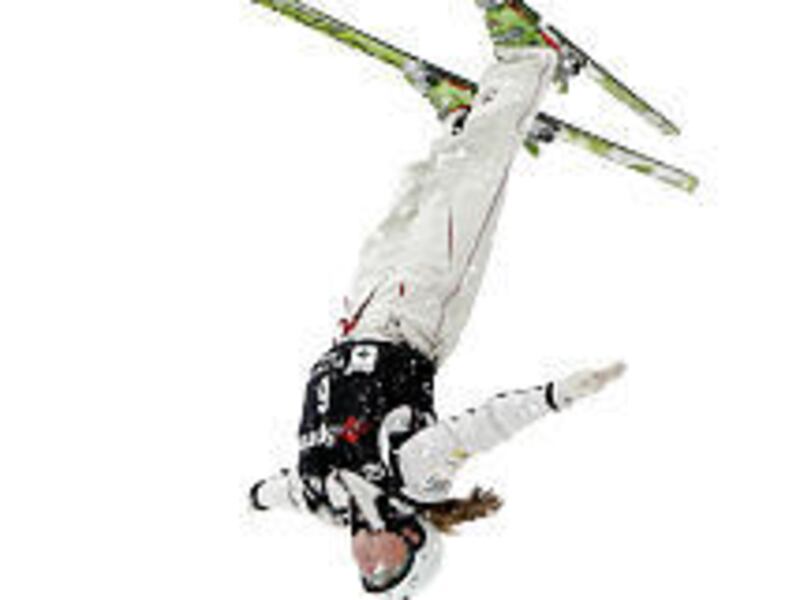

PARK CITY — The last time Lacy Schnoor landed two jumps in competition it was December.
"It feels great to finally land two jumps," said the 19-year-old after winning the U.S. National Aerial Championship at the Utah Olympic Park in weather that looked more like December than March. "This is definitely not nationals weather. It feels like a blizzard. It's a little tough up on the hill. We don't really know where to start from; it's a guess."
Schnoor was happy about her performance, but she felt a little bad about winning the title because announcers initially proclaimed her U.S. Ski Team teammate Emily Cook the winner. Then judges handed down official results that said she was the winner and Cook finished third.
The reason for the change was Cook's decision to balk on her second run.
"As I was coming into the jump, I felt like I was too slow," said Cook, who turned out of the jump and then got another try later. Skiers are penalized in FIS competition for balking, but she doesn't regret the decision, even though the deductions cost her the national title.
"You don't try to make a habit of that," she said, "but I felt like it was a safety issue. I'm still perfectly happy with the choice I made. I do feel good about landing my jumps."
Unfortunately, the mix-up put a damper on the successful jumps of both women.
"It's kind of hard to see your teammate happy that she won, and then they say you won," Schnoor said.
Schnoor and Cook are both in a comeback year after working their way back from injuries.
"This is my first year back, and it's my first year doing doubles (flips and twists)," she said. "I had a little bit of a rough season, but I finished it off great."
Schnoor performed a full-full and a lay-full to earn a score of 154.57, while teammate Kate Reed earned a score of 151.57 and Cook finished with a score of 151.04. The U.S. Ski Team's rookie of the year, 33-year-old Jill Priest, was fourth with a score of 141.97.
Schnoor said Cook was scheduled to take her second jump right before her, and after she balked, Schnoor and her coaches decided she needed to move higher up the hill to increase her speed.
"I had to step up the hill about three ski lengths, which is crazy because I didn't want to go too huge, but it all worked out," she said with a smile. "I don't remember seeing the pine bows (on the landing hill); I remember seeing the snow and thinking, 'land!' "
The snow got even heavier during the finals of the men's competition. Ryan St. Onge easily won the national championship with a score of 195.87, as he was one of the few competitors able to perform his jumps and land on his feet. Second was Park City resident Joe Pack with a score of 162.65 and third was Dylan Ferguson, who scored 158.57.
St. Onge was talking with other competitors about how the goal on a day like Friday is to stay healthy, as well as win a competition.
"I have mixed feelings (about winning on a day like Friday)," he said. "On the one hand, it's almost unfair because it comes down to whoever gets better weather will take home the medal. But then we all have to jump in the same conditions."
The athletes all said the falling snow changed the way they jumped from training to qualifying to finals.
"This is not the light champagne powder we're used to in Utah," Pack said. "This is heavy and wet, and it's making the jumps very sticky."
The win changed directions throughout the day, and the jumps began to crumble as the snow fell. On a day like Friday, coach Matt Christensen said the goal becomes more modest than winning.
"You put safety first," he said. "It's the end of the year, and you just try to keep everyone safe."
Even with the difficulty some athletes had with the jumps and the falls, he was very pleased with how the skiers performed, especially the women.
"The women jumped amazing," he said. "This is the best national competition I've seen since I've been in the States (since 1999)."
E-mail: adonaldson@desnews.com