

McCALL, Idaho (AP) — If you reject the idea of mushroom patches rivaling fishing holes as recreational sites, spend a day in the woods with Orson and Hope Miller.
"Son of a gun!" Orson Miller said in dismay over a clump of scalped stems. "Someone must have seen where I parked."
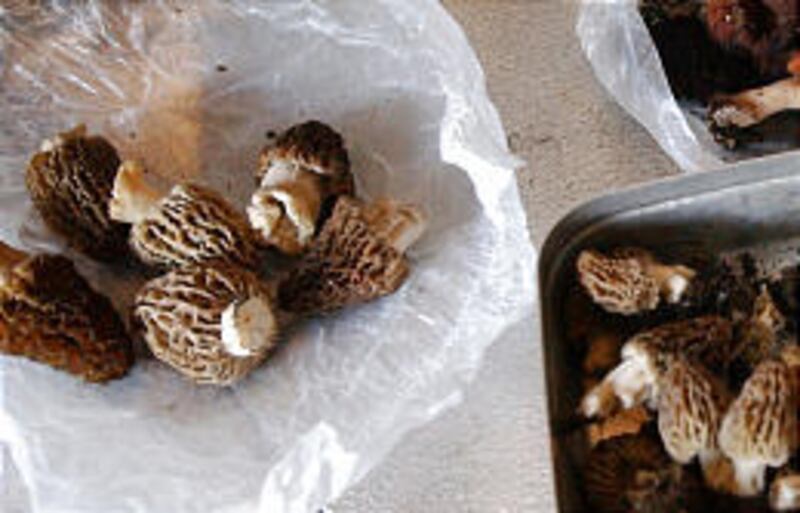
He'd scouted the area a day earlier. Then the clump was a cluster of prized morels.
"We've seen people on four-wheelers, dirt bikes, you name it," Hope Miller said. "You never tell where your favorite spots are. If someone asks, you give them the vaguest directions you can think of. It's just like a fishing hole."
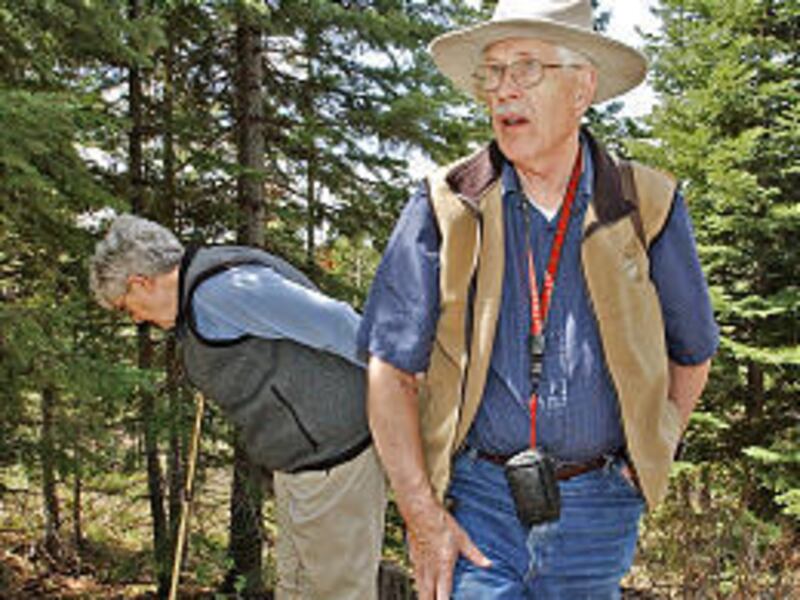
She follows her husband up the hill with the help of a walking stick that doubles as a snake deterrent. He could be a character in a movie, with his floppy hat, mushroom knife dangling from his belt and mushroom basket on his back — the Indiana Jones of the mushroom world.
When it comes to mycology, the study of fungi, the Millers are Idaho's First Couple.
Cathy Cripps of Montana State University, author of a biography of Orson Miller, calls him "one of the best known and best loved mycologists in the world. . . . And Hope has participated with him at every turn, attending more professional meetings than most mycologists. She has been a co-author of three of his books and is an author in her own right."
Orson Miller is a recipient of the Mycological Society of America's Distinguished Mycologist Award, a past president of the society and the author of "Mushrooms of North America," which Cripps calls "a milestone for mushroom identification." It sold 240,000 copies.
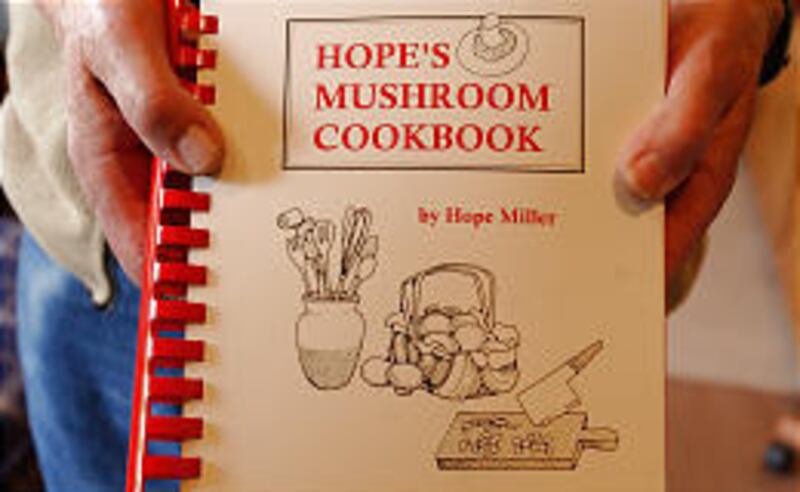
Hope Miller has contributed and edited mycological papers, written a cooking column and is the author of "Hope's Mushroom Cookbook."
Fungi are their life. They've collected and studied them in the United States, Canada, Belize, the West Indies, Europe, Nepal, South Korea, Thailand and Africa. Orson Miller has discovered 140 species of fungi. His eighth fungi book, co-authored with his wife, will be published soon.
The Millers moved to McCall in 2002, supposedly to retire.
"It's not retirement," Hope said, laughing. "It's relocation."
His interest in science began when he was a high school student in Massachusetts and did a project on blister rust in pine trees. He went on to receive multiple degrees and work at the forestry sciences laboratory at the University of Idaho.
By then he had a doctoral degree from the University of Michigan, where mycology became his life work.
"I majored in botany, and the faculty included one of the world's leading mycologists," he said. "It was an opportunity I didn't want to miss. I couldn't lose."
He worked five years at a U.S. Forest Service mycology lab in Maryland and 31 as a professor at Virginia Tech, where he is now a professor emeritus.
Hope Miller's degree is in speech and drama, but her specialty is mushrooms. Absorbing the lectures of her husband and his graduate students and working on mycology books and papers helped make her an expert.
"I learned in self defense," she said. "I figured that if I couldn't beat him, I might as well join him."
Along the way, they raised three daughters. Two are teachers.
She's only half joking about retirement being merely relocation. A book is almost always in the making, their calendars are booked with mycological events, and they still travel to exotic places to gather and study mushrooms.
They've been to the rain forests of the West Indies 10 times on National Science Foundation expeditions and may go again this fall.
They also lead mushroom "forays" for Idaho fungi enthusiasts.
"It's like going on a treasure hunt," Hope said. "You never know what you're going to find."
Or not find. Her husband mitigated his disappointment at having one of his favorite spots raided by hunting for mushrooms other collectors had overlooked.
"They're not obvious," he said. "Let's check one other place to see how well they checked the area. Look, here's some they missed."
Removing his knife from the sheath on his belt, he pushed the blade into the soft soil and sliced off a handful of morels at ground level.
"These are selling fresh for $30 a pound now in Seattle," he said. "Saute them with butter, salt and pepper, and they're delicious."
About 40 varieties of edible mushrooms grow in Idaho — as do some highly poisonous varieties.
"It's important to know the difference," he said. "Some can be fatal. There aren't a lot of those in Idaho, but there are some small brown ones that grow on wood that kill liver cells. There also are varieties that cause people to be very ill."
Just cooking some varieties can be risky, Hope added. Cooking fumes are absorbed by the cook.
"People have gotten sick without ever eating them," she said.
Books can help prospective gatherers distinguish between safe and poisonous mushrooms. Forays with groups, such as the Southern Idaho Mycological Association, do the same thing. The Millers often lead the forays.
"We love having them," association President Genny Steiner said. "We have lots of outdoors people who aren't mycologists, and he can explain very technical things in a way that they can understand. There aren't a lot of people who can do that."
For most outdoors people, mushrooms are an excuse to enjoy a day in the wilds and a good meal. For the Millers, they're a way of life.
"I love it," Orson said. "I love everything from forays to poisoning cases to working on a mold problem to all the scientific projects. It's my world."