

The harp is an ancient instrument with a history that can be traced back millennia to the civilizations of Egypt and Mesopotamia. Hieroglyphs and drawings on vases show that the harp was an important part of life in both cultures.
Later, in ancient Greece, the harp was considered the domain of Apollo, the god of music and harmony. And the Bible notes that King David was a skilled harp player.
In its basic form, the harp has remained unchanged throughout the ages. Although the modern harp, with its foot pedals and expanded range, bears little resemblance to the instrument played by King David, the shape and the manner in which it is played have not been altered to any considerable degree.
Unlike other instruments, however, the harp has, from earliest times, been ascribed powers that go beyond music. It's been regarded as both a sacred instrument and one that can heal, comfort and soothe. Orpheus charmed Pluto, the god of the underworld, with his harp playing, allowing him to bring his wife Eurydice back from the dead. Poets and writers, from ancient times to today, have extolled the palliative nature of the harp.
Until now, the harp's therapeutic capabilities have been thought to be in the realm of mythology and the fanciful imagination of poets. However, recent research has been proving otherwise. According to the Harp Therapy Journal, because of "the unique timbre of the instrument, (it) provides a very soothing and relaxing effect. The harp has a rich archetypal heritage in western culture as an instrument of healing." And this aspect of the harp is gradually beginning to be understood as more harpists embrace it.
Salt Lake City is leading the way in exploring the harp's healing power and will be in the spotlight next week when the nation's first Harp Therapy Gathering takes place in the Jewett Center on the Westminster College campus.
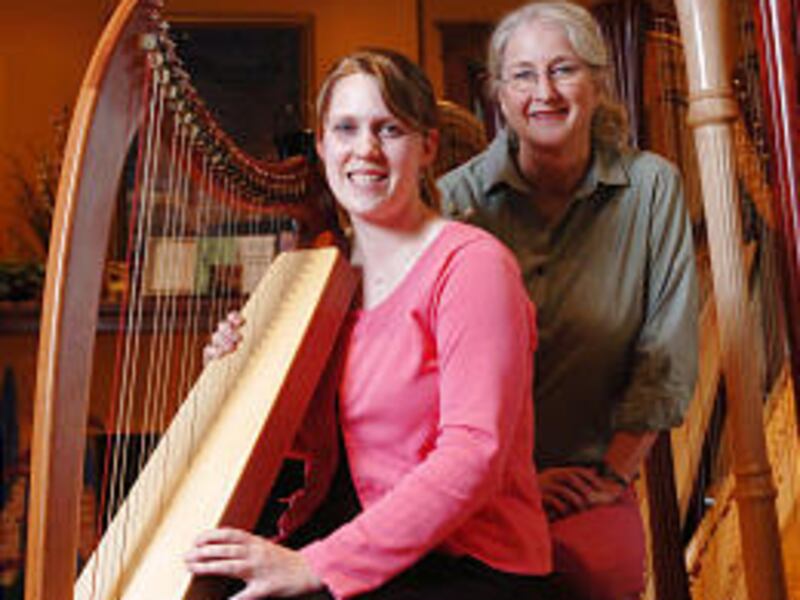
Organized by ShruDeLi Ownbey and Anamae Anderson of Lyon & Healy West, the conference runs Wednesday through Saturday of next week and will feature a dozen harpists from around the country who have been working in the health field. "These are people who have been involved in this for 20 years or more," Ownbey said.
She said there are several different organizations in the United States devoted to music therapy. "They all have separate conferences. This is the first of its kind that's pulling everyone together."
The idea for the conference came from Antonio Forero, president of Lyon & Healy Harps. "He asked us to do this," Ownbey said. The company has been a pioneer in focusing on the harp's therapeutic abilities. Recently, the company and its board of directors donated a harp to Primary Children's Hospital. The instrument is displayed in the lobby during the holidays, and on weekdays from 8 a.m. to 5 p.m., students come in and play it.
Music therapy is a fairly new field. In Utah, only Utah State University offers a program, said Anderson. She is a recent graduate from Brigham Young University in harp performance, who became interested in the therapeutic side of her instrument.
Anderson said that music therapy often attracts older people. "That's very positive, because they have so many life experiences — that's a huge contribution."
She said that people interested in music therapy don't need to play the harp on a professional level. "Virtuosity is not the point. It's a totally different approach to the instrument. You need to understand the psychology of music and how it helps people, and you need to be able to relate to the person you're playing for."
Therapeutic harps aren't the enormous instruments one sees in the concert hall. They are small harps with a narrow range that are held in the player's lap. Often, the player gets on the patient's bed to reinforce the comfort level of the patient.
The music that's played isn't concert fare. "Sometimes you play music people like," Anderson said, "but there is a lot of freedom."
Frequently, the harpist plays music that reflects the mood the patient is in. "It allows them to focus their energy and relax," Ownbey said. "Music can transcend problems and can help people get control of their lives without using drugs."
The harp is a popular instrument in Utah. Ownbey said that there are well over 300 harpists in the state. "Just in this area you have more harpists than there are positions available with orchestras."
The answer for many of these young harpists, she believes, is in music therapy. "You have so many young people trying to figure out what to do with their talents. In music therapy, there is more work than they can handle, and it pays a good living wage."
The workshops and seminars during the conference won't be open to the public. However, there will be a concert on Wednesday performed by members of the conference faculty, which is free to the public.
For more information on music therapy log on to www.harptherapy.com
If you go . . .
What: Edie Elkan, Ray Pool, Laurie Riley, Christina Tourin, harp recital
Where: Jewett Center, Westminster College, 1840 S. 1300 East
When: Wednesday, 7:30 p.m.
How much: Free
E-mail: ereichel@desnews.com