

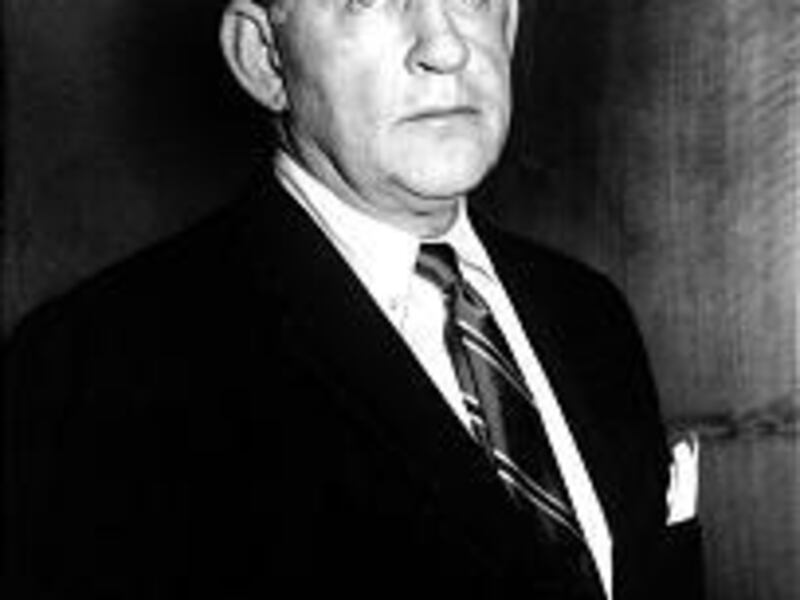
POTTSVILLE, Pa. — John O'Hara, who needled the upper middle class in such novels as "Butterfield 8" and "Pal Joey," began his writing career as a journalist in Pottsville, the coal town where he grew up in the early 1900s and which provided the setting for much of his later fiction.
But the articles he wrote as a general assignment reporter for the Pottsville Journal are missing — and have been since the paper folded in the early 1950s and its archives were transferred to the local historical society.
Now, a leading O'Hara scholar, Matthew J. Bruccoli, is offering a $1,000 reward in hopes that somebody will come forward with the missing newspaper volumes — which span the years 1924 to 1926 — and let him put them on microfilm.
Bruccoli, who edited "Gibbsville, Pa.," an anthology of O'Hara's classic short stories, and wrote a 1975 biography about the author, tried the same thing a decade ago.
However, no one came forward and Bruccoli, now 73, figures he is running out of time.
"I am trying to rescue a piece of American literary history, a piece of American culture," said Bruccoli, who began looking for the volumes in 1970, the year O'Hara died.
O'Hara's early newspaper work could provide insight into the gestation of Gibbsville, the thinly veiled stand-in for Pottsville that some scholars, including Bruccoli, call one of literature's great fictional towns — as richly drawn as William Faulkner's Yoknapatawpha County, Miss.
Born a doctor's son exactly 100 years ago, O'Hara spent his childhood around the anthracite coal patches of eastern Pennsylvania. Gibbsville made its debut in 1934 in "Appointment in Samarra," a piercing look at small-town high society that garnered praise from Ernest Hemingway and later drew comparisons to the work of F. Scott Fitzgerald.
O'Hara went on to write about Gibbsville in other novels and in dozens of short stories that appeared in The New Yorker, among other publications. He won a National Book Award in 1956 for "Ten North Frederick." His "Pal Joey" was turned into a musical and later a movie, and the film version of "Butterfield 8" earned Elizabeth Taylor an Academy Award for best actress. Other best sellers included "A Rage to Live" and "From the Terrace," made into a movie starring Paul Newman and Joanne Woodward.
Gibbsville — like O'Hara's hometown Pottsville — grew prosperous because of the coal industry, leading to a kind of caste system that O'Hara chronicled with a reporter's eye. "Anyone in Gibbsville who had any important money made it in coal; anthracite," O'Hara wrote.
Lantenengo Street, where Gibbsville's snooty upper crust lived, was an obvious reference to the real-life Mahantongo Street, where O'Hara spent about a dozen years in a row house near mansions.
O'Hara left Pottsville in 1927 and rarely returned. But there is little doubt about his feelings toward the place. In a 1935 letter to longtime Pottsville newspaperman Walter Farquhar, O'Hara referred to it as "that God awful town."
Bruccoli, a University of South Carolina English professor who has written extensively about Hemingway, Fitzgerald and James Dickey, speculates that whoever took the newspaper volumes didn't care about O'Hara but was instead a fan of the Pottsville Maroons, the legendary football team disqualified from winning the 1925 NFL championship because it had played an unauthorized exhibition game. He believes the volumes probably wound up in someone's attic, and have been forgotten.
Peter Yasenchak, director of the Schuylkill County Historical Society, agreed the newspapers are probably gathering dust somewhere.
"Somebody has it, but we don't know who that somebody is," he said.