

PROVO — Will Cross wanted to scale the world's highest mountains and walk to the North and South poles — but could not find anyone to sponsor the expeditions.
Companies and organizations kept a distance from Cross' dreams.
From a marketing perspective, it was too risky. After all, it wouldn't look good to be the sponsor of a man whose medical conditions heightened the risk he would die or be severely injured during the grueling trips.
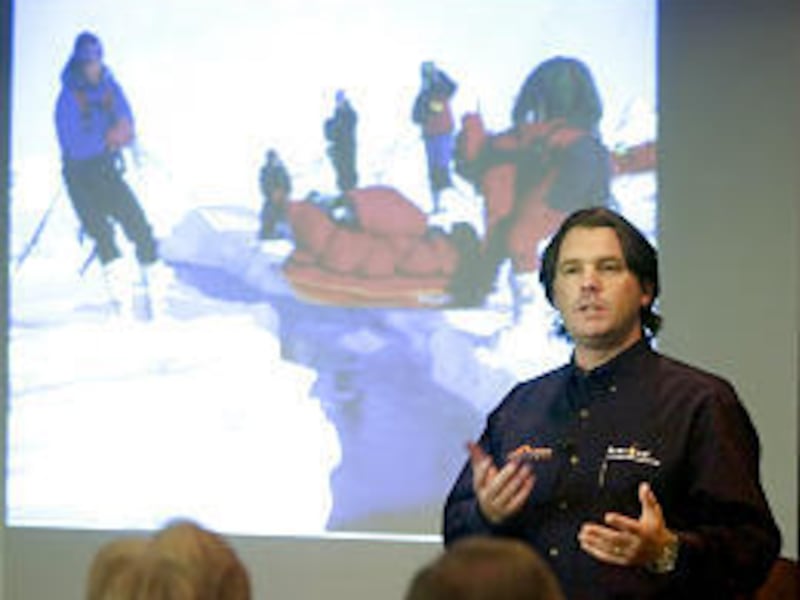
But Cross, who has Type 1 diabetes, eventually secured a sponsor — and reached the summit of his dreams. He recalled his adventures — he's scaled peaks ranging from Mount Denali, Alaska, to Vinson Massif, Antarctica — this week at Utah Valley Regional Medical Center.
"We all have challenges in our lives, and those mountains symbolize these challenges," said Cross, a father of six and former principal who's now a motivational speaker and full-time athlete.
One of Cross' first challenges was to reach the South Pole.
When the Pittsburg, Pa., man found businesses hesitant to sponsor him, he realized he must prove himself by safely traveling to the North Pole first.
He carried insulin in a NASA-developed package that prevents it from freezing and planned a diet with University of Pittsburgh specialists. He again sought a sponsor after he successfully completed the journey in April 2001.
He teamed up with insulin company NovoLog for the "Peaks and Poles Challenge" and has strived to be the first diabetic to climb the tallest peaks on all seven continents and walk to the North and South poles.
Yet Mount Everest remains an obstacle for Cross. He has tried it twice, most recently last spring. Fierce winds forced him to turn down.
He vividly remembered his first attempt to climb the 29,000-foot peak in May 2004.
Blocks of ice shifted on the snow-covered mountain; sometimes Cross was standing on them. Cross and his climbing partner used bridges to climb ice and cross crevasses, carefully placing "one foot in front of the other," a practice that works well in life, too, he said.
"With diabetes, it's very easy to think about the disasters — and, boy, are there a lot of them," he said, suggesting people need to think "day by day, week by week. The shift allows you to do things, instead (thinking) of what you can't do."
Cross adjusted blood glucose levels with altitude and was surprised to find he needed more insulin. Breathing became labored. By the third camp, he and his partner wore oxygen masks. At 20,000 feet, Cross suffered a minor case of flu.
Cross had counted carbohydrates. He was confident the insulin would not freeze in the NASA pack, and he had plenty of oxygen. But the climb is slow, about 100 meters (110 yards) an hour at that elevation, he said.
Cross and his partner stopped about 300 meters (330 yards) from the summit to rest and evaluate. A valve on one of Cross' oxygen tanks had locked shut. His partner removed eye protection, and Cross noticed his left retina had exploded. His partner admitted he hadn't been able to see from that eye for the past 24 hours.
They decided to turn around and avoid risking their lives.
"We failed to make the summit of Mount Everest. But what we succeeded in is just as important," he said.
He plans to attempt the mountain next year.
"I believe I can climb this mountain," he said.
E-mail: lhancock@desnews.com