

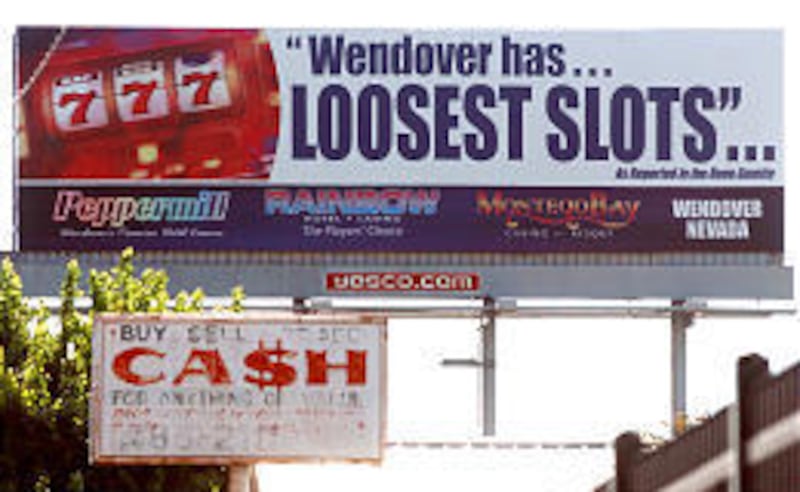
The "loosest slots in town" may become subject to the tightest advertising laws in the land.
Hoping to prevent "normalizing" gambling in the eyes of Utahns, Rep. Scott Wyatt, R-Logan, plans to introduce legislation in next year's general session that would prohibit the advertising of activities that are illegal in Utah, which could range from fireworks to prostitution. Currently, however, the bill would primarily target gambling, an activity that is banned in Utah but is legal, in at least some form, in every neighboring state.
"I would like to see us make the statement that we are not only opposed to gambling in our state, we are opposed to advertising of gambling, and we are opposed to business being set up on our borders that attempt to lure people to those activities that we have made illegal," Wyatt said. "We are losing the revenue and gaining the social costs."
The problem with such a ban is that it would probably have very little impact on reducing the social costs of gambling, said Frank Pignanelli, lobbyist and legal counsel for West Wendover, Nev., because problem gamblers generally rely on more convenient outlets, especially the Internet. Pignanelli is also a Deseret Morning News political columnist.
"Rep. Wyatt has not demonstrated the harm that the cities of Wendover and Mesquite are causing," he said. Both towns are across Utah borders in Nevada, where gambling is legal. "He's talked about bigger problems caused by gambling, but those aren't really caused by casinos. Those are really caused by the Internet, which is much more accessible."
Representatives for Wendover, Mesquite and Las Vegas casinos did not return phone calls asking for comment on this story.
The bill, which is being considered by the Judiciary Interim Committee, was originally proposed during this year's session, but never made it out of committee. As proposed, it did not have a constitutional note about potential legal problems.
A former county prosecutor, Wyatt was confident that it would stand up to court tests and could be enforced because of its limited scope: It would only prohibit ads within Utah, such as on billboards or local radio and television stations, and would only restrict the advertising of the illegal activity.
It would not stop casinos from promoting their buffets, spas or golf courses, but it would prohibit them from touting their slot machines or table games. It would also not stop newspapers from running game lines or lottery numbers. The Deseret Morning News does not run such items, but The Salt Lake Tribune does. They are considered news rather than paid advertisements.
The problem with outlawing gambling but not the advertising is that it simply means that the industry sprouts up on the borders and depends on "luring" Utahns, Wyatt said. If Utah is serious about its gambling ban, which he fully supports and would like to strengthen, the state must take all of the necessary steps.
"If the Supreme Court allows us to restrict an entire industry, we certainly have the authority to do something much less, which is restrict the advertising," he said. "The result of Utah's decision to prohibit gambling has been to have gambling industries wrapped around the state. . . . Gambling is prevalent in Utah."
What the bill would not prevent is advertising that crosses state lines, such as on Nevada or Idaho radio stations, or national advertisements in magazines or on network television, said Joshua Eaton, president of Media Grabbers, Inc., a Salt Lake-based advertising agency.
"The law will not stop gaming imagery from coming into the state," Eaton said. "It will only punish those who cannot advertise nationally."
Some legislators also were skeptical about the actual impact the advertising prohibition would have, especially if casinos could still advertise non-gambling amenities. Rep. Susan Lawrence, R-Salt Lake, said an advertisement for anything at a casino is an advertisement for gambling.
"It seems like if they advertise the place, they advertise the activity," she said.
Such a ban, while new, would not be unique for Utah. Although it is no longer in effect, state law used to restrict alcohol and beer advertising, but instead of stopping the advertising, it simply spawned a slew of signs offering "Bir" and "Ice Cold Bee." On the other hand, tobacco advertising is successfully banned from most media.
E-mail: jloftin@desnews.com