

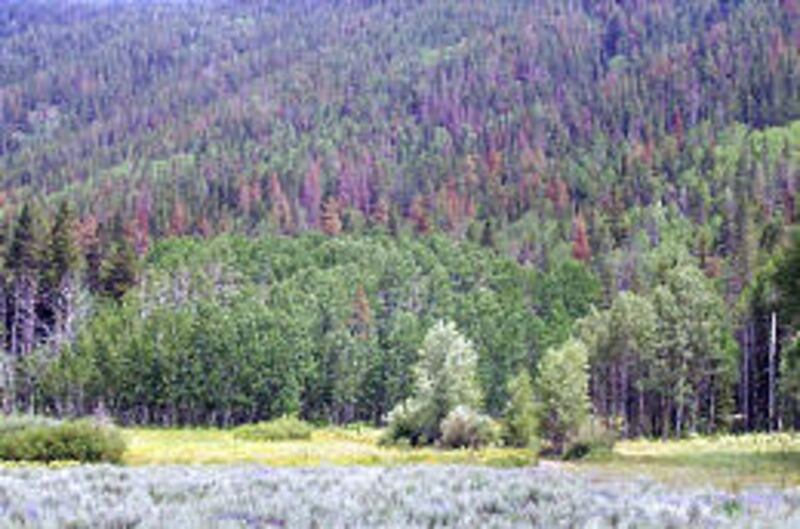

Mother Nature can be a beast, as those who love the Utah's forests are discovering.
About 2.2 million acres of the 3.5 million acres of pine, fir and spruce forests in the state are moderately to highly susceptible to bark beetle attack, according to "Utah Forest Health Report," assembled by the Utah Department of Natural Resources with data through 2001.
"Because of generally high stand densities, greater than 90 percent of Utah's forested landscapes currently have a moderate to high risk of catastrophic wildfires," adds a 2003 update, "Forest Health in Utah."
About 10,000 acres to 30,000 acres of aspen, mostly in the south, are undergoing a mysterious die-off, among 1.6 million acres of aspen forests in Utah, says an aspen expert.
"The beetles are expanding" on Wasatch-Cache National Forest, said Wayne Padgett, ecologist for that forest. It's not just the pine beetles; it's also fir beetles and spruce beetles.
Much of the eruption is because humans have been successful at controlling forest fires for many decades. "We've got what tend to be older trees on the forest," he said. These older, weaker trees are more susceptible to attack by beetles and other stressors.
"We've created this huge fuel load now. These large old pine forests are susceptible to beetles. ... We're looking at probably larger fires than we've seen historically."
The pine-beetle infestation is moving along the north slope of the Uintas, from Evanston, Wyo., along the Mirror Lake highway. They have reached Utah, and some are destroying trees east of Kamas, he said.
Besides the trees' age, a six- or seven-year drought "added stress," he said. "The fuels are dry. The trees have a low, low percent of moisture in them."
Some trees along the highway are to be taken out, because less tree density can reduce the vulnerability of the trees.
Although humans have intensified the impacts by fire suppression, this is a natural process, Padgett said.
Projects to manage bark beetles have been proposed on almost every national forest in Utah, from pesticides to spraying insect pheromones to thinning stands and removing dead trees, said Liz Hebertson, a forest-health expert with the agency's regional office in Ogden.
Lorraine Januzelli, public affairs officer for Wasatch-Cache National Forest, based in Salt Lake City, said the Ponderosa Pine Restoration Project attempts to protect trees that date to before pioneer days by cutting down vegetation around the old ones. The project is on the Kamas Ranger District, covering about 600 acres.
"It creates a healthier stand if it's not so woody, decreasing the understory," she said.
Hebertson said bark-beetle outbreaks are probably related to overstocked and over-mature stands of trees, plus drought.
"In other situations it's related or can be attributed to drought conditions or local climate conditions."
It's not the first time large outbreaks have hit Utah. "For the spruce beetle, we had a widespread and quite severe outbreak in the 1920s on the Aquarius Plateau," she said. These native bark beetles are "prone to outbreak from time to time, particularly under dry climate conditions."
Lodgepole pines may required 50 years to 80 years to grow back. Spruce could take 150 years to 350 years.
"It's alarming ... if the damage and the mortality are going to conflict with very important resource values," like top recreation sites, important timber production or critical wildlife habitat. In such places, "there is some urgency in trying to deal with these outbreaks."
Elsewhere, "this is a natural disturbance agent of natural forest ecosystems, and we tend to look at it that way."
Dale Bartos, aspen ecologist with the Forest Service's Rocky Mountain Research Station in Logan, said an aspen die-off is occurring in southern Utah and western Colorado, as well as other states.
Aspen stands are clones, trees growing up from roots and not sprouting from seeds.
"This is where the clones are completely dying out," he said. "The root systems are dying, and there isn't any regeneration at all."
Drought may be a stressor that allows disease or insects to "take over and wipe them out," he added.
Possibly 30 percent or 40 percent of southern Utah aspen may be affected, but less than 5 percent in the north.
He does not know whether this is a one-time event triggered by the drought or an aggressive disease that will keep spreading. His guess is the damage won't be much worse.
"We're going to have not as much aspen," Bartos said. "That's for sure."
E-mail: bau@desnews.com