



First in a five-part series
Long poverty stricken, Utah's Indian tribes are striving for economic independence. Beginning today, a five-day Deseret Morning News series — "From poverty to promise" — examines how they are tapping their human and natural resources.
FORT DUCHESNE, Uintah County — John Jurrius understands why people in Indian Country don't trust him. He is a smooth-talking Texan who travels by jet, drives a $50,000 "ride" and has been married more than once. He is also white.
"I'm not here to save you," he told tribal leaders before going to work for the 3,100-member Ute Tribe. "I'm not here to further your cause as Native Americans."
What he would do, he told them, was get the most money possible for oil and gas riches pulled from Utah's largest Indian reservation. And the 45-year-old maverick has done just that. On the verge of financial collapse in 2001, the tribe's stated worth now tops $100 million.
For his part, Jurrius receives a salary of $62,500 a month.
"We had to wake up. The federal government is not going to be here to run our programs. We had to learn to take care of ourselves." — Maxine Natchees, chairwoman, Ute Tribe's business committee
For 50 years, lackluster economic growth and debilitating poverty on Utah's Indian reservations have not changed.
But a new day is dawning thanks to an energy boom, "out-of-the-box" money-making strategies and more aggressive protection of oil, gas, water and land resources in Indian Country.
A five-day series beginning today by the Deseret Morning News examines these and other efforts by Utah's five Indian nations to kick-start their economies. As part of the series "From Poverty to Promise," reporters traveled to reservation lands throughout the state and met with tribal elders, community leaders, state officials and dozens of Utah's Native Americans to assess their financial future.
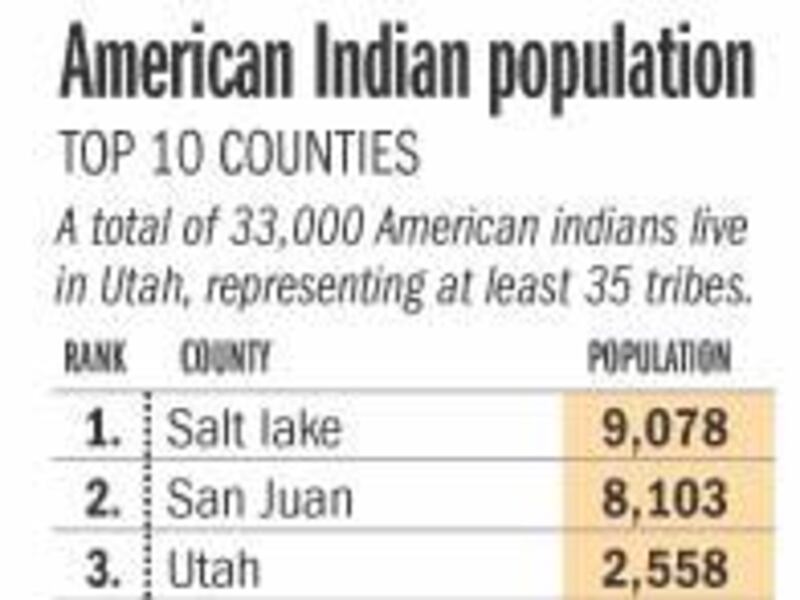
Tribal lands occupy 4 percent of the state, and tribal members make up 2 percent of Utah's population. Many have moved to urban areas, mostly along the Wasatch Front, but nearly 50 percent of Utah Indians still live on their native homelands.
What is clear, say experts on and off the reservations, is that the future of Utah's Indian nations rests upon their ability to reclaim and capitalize on their sovereignty. And tribal leaders say their efforts today will determine the cultural, educational and economic livelihoods of the young people among the state's 33,000 Native Americans.
It is, admittedly, an uphill battle.
Complicated cultural and geographic hurdles continue to stymie growth, says Forrest Cuch, Utah's top official over Native American issues.
And the transition to what Indian experts call "self-determination" also requires a philosophic change in tribes' reliance on the federal Bureau of Indian Affairs.
It's a good move, says Jonathan Taylor, an economic consultant who worked for the Harvard Project on American Indian Economic Development.
"There's good empirical evidence that shows when a tribe takes over from the federal government, the performance of the tribe's government and economy increases."
Across the country, tribes have famously turned to casino operations.
Under federal law, tribes are allowed to host legalized gambling if their home state allows any semblance of the practice.
But in Utah, where the public, the Legislature and the powerful Church of Jesus Christ of Latter-day Saints are against gambling, that door is firmly closed.
So, without the money-making promise of gambling, Utah tribes have become creative.
They have started businesses that translate top-secret federal documents and that provide technology support for the U.S. Air Force. They have ventured into the real estate business, flipping commercial property and building housing and tourist and shopping sites.
They own grocery stores and gas stations. Children on the Navajo Reservation have even formed a chocolate company.
Still, their primary economic efforts lie in the tribes' abilities to capitalize on their natural resources.
"I'm an investment banker. I go in and make money and I leave."
— John Jurrius, financial adviser to the Ute Tribe
In the case of the Utes, the oil and gas was always there, buried beneath the scrappy landscape of eastern Utah. Like many tribes throughout the country, the Utes' wealth is in its land and resources, but for years the value had been squandered by inattention and bad business deals.
Jurrius — bolstered by the tribe's new economic development philosophy — has changed all that.
Projects in the works today will make the tribe the third- or fourth-largest oil producer in the Uintah Basin. And that means more college scholarships for tribal members and more pensions for elders.
With his Cadillac Escalade and confident personality, Jurrius makes no apologies about his salary.
"Do I make a lot of money?" Jurrius asks. "Sure. If they win, I make millions."
This is the boldest — and most lucrative — example of a local tribe taking charge of its future.
"We absolutely did just that," said Maxine Natchees, chairwoman of the Ute Tribe. "We had to do something, and I really saw the promise in this and the potential in this plan for our survival."
In fact, all five of the state's Indian tribes — backed by the gusto and respect of Utah Gov. Jon Huntsman Jr. — are making more money, taking risks and pushing the envelope in an effort to save their rich cultures and the future of their young people. Consider the following:
The Shoshones had no land and no cash a few years ago — today tribal leaders are garnering property for at least $340 million in building projects. They also run a company that translates classified documents for the U.S. Department of Justice and the FBI.
Fortifying their finances will save the culture, said Mike Devine, chief operating officer of the Northwestern Band of the Shoshone Economic Development Corp. The 464-member tribe set goals to preserve their language, songs, dances and crafts before launching its business enterprises.
"If we do economic development," Devine said, "it's got to enhance the culture."
On the Navajo Reservation, high oil prices have helped maintain an income of more than $2.7 million in oil revenues annually for roughly 8,000 Navajos in San Juan County. The money goes to fund college scholarships, housing, roads and utility and water lines. Today those reserves are funding construction of a medical clinic in Monument Valley.
Lacking land and natural resources, the perpetually impoverished Paiute Tribe started a computer services company two years ago. Suh'dutsing, which means cedar tree, employs 28 people to do data processing, network installation and software development for the federal government. The Cedar City company has a standing policy to pay no less than $10 per hour, though many salaries are higher.
"It's not a jobs program," said Carey Wold, senior vice president for business development. "We're in this to make money."
The Goshute Band in Ibapah is one of the poorest tribes in the state. The annual powwow has been canceled in some years because of cost. The reservation on the state's barren westernmost border has few resources, but new tribal chairman Rupert Steele is a college-educated administrator with a fresh enthusiasm for problem solving.
In some cases, these aggressive efforts have met formidable resistance inside and outside of the tribe.
The Skull Valley Band of Goshutes has tangled with the state and federal government for nearly a decade over a proposal to store nuclear waste on its reservation in western Utah.
A confidentiality clause prevents financial specifics from being revealed, but most presume the facility would generate millions of dollars every year for the the band over the 25-year lease. But the unpopular plan has drawn sharp criticism from politicians, the public and other tribes. In the late 1990s, singers and drummers from the Shoshone Nation performed at the Utah Capitol in a protest over the proposal.
Just this month, the U.S. Department of Interior and the Bureau of Indian Affairs drove what some say is the final nail in the coffin when they denied a land lease to Private Fuel Storage.
Tribal Chairman Leon Bear sees that as wresting from the tribe its right to self-determination.
"If what they say is true in the decision, I think it's an attack on our sovereignty," he said. The tribe will keep fighting.
"If they have the final say, they should just go ahead and take over the reservation and manage it for us," Bear said. "We are a people out here, and we should be able to decide our own fate."
"It's about the emerging generation and doing what's necessary for them." — Utah Gov. Jon Huntsman Jr.
Aside from the controversial nuclear storage issue, most tribal officials say there has never been a more favorable climate for tribes in Utah, and Huntsman gets much of the praise for this phenomenon.
The governor has been a stronger advocate for Indian rights and issues than any administration in the state's history, says Brigham Young University law professor Larry EchoHawk, himself a member of the Pawnee Tribe and Idaho's former attorney general.
In fact, Huntsman pledged early in his tenure to visit each of Utah's five Indian reservations to meet with tribal leaders about issues, and he has done so.
In May, Huntsman traveled to Cedar City to meet with the Paiute Tribe. His staff and tribal elders brainstormed better methods for teaching Paiute children, how to improve the business culture within the tribe and how to get a suicide prevention program off the ground.
It was the first time a Utah governor had met with the tribe.
"He sat there for two hours and talked to those people," said Cuch, director of Utah's Division of Indian Affairs. "We were so impressed with that."
In August, Huntsman attended the quarterly Navajo tribal council meetings, where concerns of Utah's 8,000 Navajos are addressed.
"I doubt there's been a governor that has ever addressed the Navajo Nation," EchoHawk said. "The tribe believes that is very important."
The state and tribe believe they share common interests.
"We are all on the same side. We are all human beings. Why we go up against each other sometimes, it's baffling," said Joe Shirley, president of the massive Navajo Nation, which spans parts of Utah, Arizona and New Mexico.
Huntsman says he will continue to advocate for better education, economic development, environmental protections and water conservation on Utah's Indian reservations.
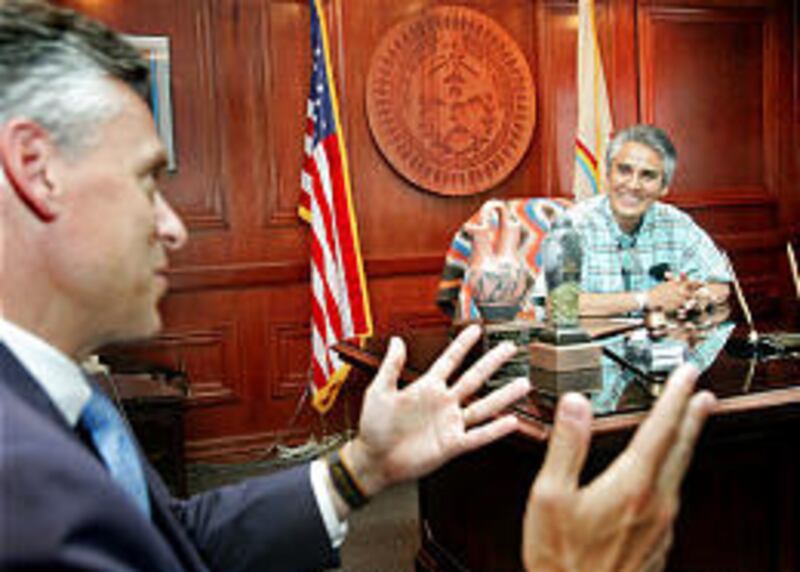
"It is the future of the tribes," Huntsman said in a Deseret Morning News interview. "If we are not successful, the tribes cease to be relevant, and that's not an acceptable outcome for anyone."
The effects of poverty — especially profound on Goshute land in Ibapah and on Utah Navajo territory — are sobering.
A 2005 student survey in Monument Valley on the Navajo Reservation in southern Utah and northern Arizona showed 40 percent of students there had no running water or electricity at home; fewer still have Internet access.
Iowa Test scores for Utah eighth- and 11th-grade students in 2006 show Native American students performing at the 36th percentile, lower than Hispanics and English language learners and only one percentile higher than children with disabilities.
Cuch says suicide rates among Native American young people are five times the the national average. The birth rate among Native Americans has increased, but the mortality rate has also increased.
"That's why these economic plans are so important," says Natchees. "It takes money to provide what we need to fix these problems."
E-mail: lucy@desnews.com; romboy@desnews.com