

The evidence seems innocent enough — a shirt, a sock, a pair of shoes.
But a closer look reveals a darker secret — saliva, semen, a blood stain.
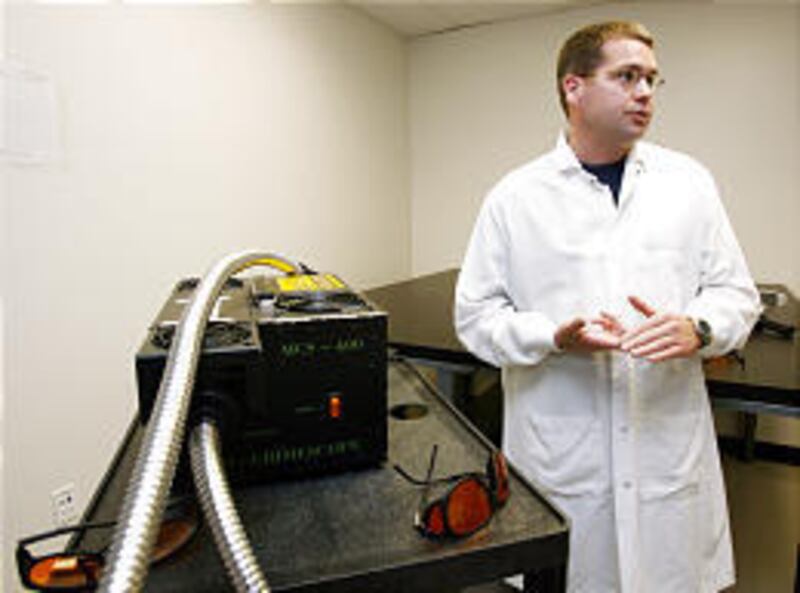
At Sorenson Forensics, a team of nine people is now dedicating its efforts to solving society's worst crimes. The division was created in June after Salt Lake-based Myriad Genetics decided to discontinue its forensic services division.
Bill Hockett, a spokesman for Myriad, said the forensic team at Myriad included about 50 people and was initially started because of extra capacity at the company. However, as Myriad's genetic testing business boomed, few resources were left for forensics.
"We really don't have the capacity we once did," Hockett said. "We've decided that our energy is better spent on our core technology, developing and marketing cancer genetic tests."
Fortunately for Tim Kupferschmid, the former forensic technical director at Myriad, Utah billionaire James LeVoy Sorenson was interested in forensics.
In fact, Sorenson already was heavily involved in DNA analysis through his genomics company, which assists in identifying familial relationships through genetic testing. In 2005, Sorenson Genomics helped the Thai government identify the remains of people who died in the massive tsunami that struck on Dec. 26, 2004. More than 1,200 positive identifications were made at Sorenson Genomics, according to Doug Fogg, chief operating officer.
Now, with the addition of Sorenson Forensics, the team is busy solving murders, rapes and burglaries.
The team operates at the Sorenson Cos. Salt Lake headquarters, 2511 S. West Temple, taking on cases from across the state, the nation and even from overseas.
"Every case is high priority to us, because in every case there is a victim behind it," said Kupferschmid, who now acts as forensic laboratory director at Sorenson Forensics. "We work every case the same, whether the national news is there or if it's just a house burglary."
The lab recently received accreditation from Forensic Quality Services International, allowing it to begin processing cases.
Jennifer Kibler, who graduated from Stanford University in 2004, was one of the eight people Kupferschmid decided to keep when the switch to Sorenson was made.
"I think it is a really exciting opportunity right now since we're basically ground zero of this forensic laboratory," Kibler said. "We get to make all the decisions. We get to set it up the way we think is the best way to set it up."
In the near future, Kupferschmid said the lab's workload could grow to roughly 100 cases per month because of the high demand for forensic work.
The laboratory is one of fewer than a dozen private labs nationwide that process crime evidence, according to Kupferschmid, who sits on the board of directors of the American Society of Crime Laboratory Directors. Most evidence is sent to state, county or city crime labs, which are publicly funded.
"In the early days of DNA we used to need a blood stain the size of a quarter. Now we need a blood stain just the size of a head of a pin. Anything you touch, our testing is sensitive enough that we'll develop a DNA profile."
And what about the perfect crime? Kupferschmid said such a notion is becoming a thing of the past with today's technology.
"If I drove a car and touched the steering wheel, I'm going to leave my DNA behind," Kupferschmid said. "If I chew gum and spit the gum out in a parking lot, there's going to be my DNA on that gum. If I smoke a cigarette, it's the same thing. It's extremely difficult to cover all your bases. There's always evidence."
E-mail: danderton@desnews.com