

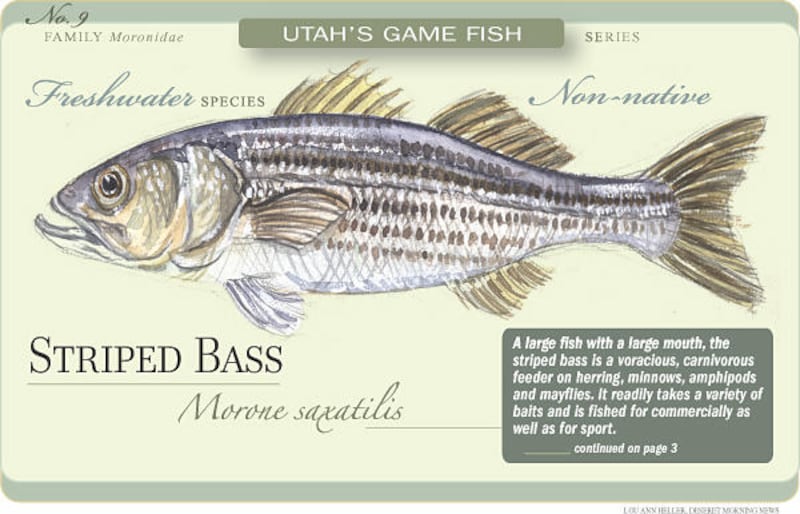
Description
This is an ocean-going fish that has adapted to fresh water. Also known as striper, rockfish, rockbass and, to a few, greenhead. This is a heavy-body fish with a long head, wide girth and underslung jaw. Here in Utah, the striper has a silver body marked by a series of vertical black lines running from the gills to the tail.
Characteristics
The striper is a member of the seranidae family of fish, which are typically found along the Atlantic and Pacific coasts. The fish came into fresh-water rivers to spawn and eventually stayed. It has spines on the dorsal fins, and therefore should be handled with care. This is a fast-growing fish that on occasion can exceed 50 pounds. The world record for fresh water is 67 pounds, 8 ounces. The ocean record is slightly larger - 78 pounds, 8 ounces. The Utah record is 48 pounds, 11 ounces. Fishermen like stripers because of their table qualities and because they put up a good fight when hooked, albeit somewhat short. The striper was introduced into Lake Powell in the 1970s. The assumption at the time was that being a river spawner, numbers could be controlled through a stocking program. The fish did, in fact, spawn in the lake and immediately took control. Stripers feed mainly on minnows but they will eat just about anything they can get down. At one time the Utah State record striper belonged to a black labrador dog that pulled in a 48-pound, 2-ounce fish that had choked on a large carp. Thread fin shad comprise the bulk of the stripers diet at Lake Powell. Thread fin shad are plankton eaters and the availability of plankton depends on the amount of nutrients washed into Lake Powell by spring runoff. Stripers do well in high-water years and poorly in low-water years. The fishery has become a virtual yo-yo over the years. Numbers will increase to the point where the food sources is being overrun, at which time striper numbers decline. When the food source rebounds the striper numbers rebound.
Bait/lures
Catching stripers is mostly about finding them and sometimes that is not easy. Stripers move about in schools and can cover large areas searching for shad. Once they find food they attack and drive the shad to the surface causing a "boil". Birds take advantage of a boil and often the easiest way to find fish is to look for the birds. Surface lures like the Spook, Pop-R or Lucky Crafts Sammy or Splash draw vicious strikes. Best colors are white, silver or shad. Spoon-type lures like Kastmaster, Krocodile or Z-Ray often work when the stripers are spooky and require longer casts. Use them in 3/8- to 1/2-ounce sizes in chrome or chrome/blue colors. If boils are not evident, trolling usually works. Troll deep with diving plugs like Shad Rap, Hot Lips or Flat CB in shad, chrome or chrome/blue. In the fall, stripers drive schools of shad into box canyons and corral them for future consumption. To find them slowly move up narrow canyons until either sentry stripers or shad are found. Back off from the fish and start casting surface lures or white rooster-tail spinners. The best known way to catch stripers is to bait fish with anchovies. Stripers like to rest along sheer rock walls at depth from 35 to 80 feet and in open bays when not cruising for food. Drift over the school and sink pieces of anchovies rigged on strong 2/0 hooks with 1/2-ounce sinkers. If the fish are reluctant to eat at first, chum the area with cut chunks of anchovy until they start to feed. One easy and fairly reliable way to find suspended schools is to go to the fish cleaning station and ask successful anglers where they caught their fish. Striper anglers are quick to aid fellow anglers because they know that the more fish that are harvested, the bigger the fishing will be. Take an extra cooler and fill it up.
Note: Trout anglers would be wise to replace their monofilament line with 10-pound to 12-pound line. These fish are big and strong.
— Byron Gunderson, Fish Tech Outfitters, contributed to this story