

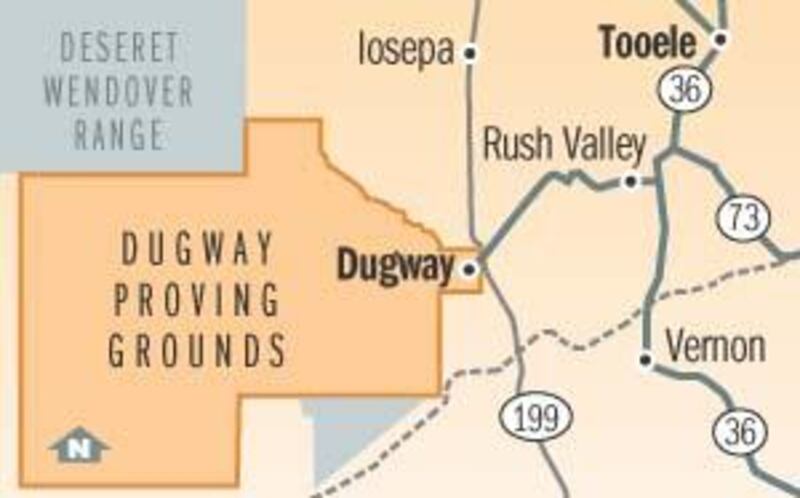
The conclusion to a quiet, long-term, $128 million cleanup effort at the Army's Dugway Proving Ground is getting closer, and while the effort includes covering or hauling away large amounts of hazardous waste, it hasn't captured much public attention.
"Dugway has accomplished a lot of environmental cleanup, especially over the past five years," said David Larsen, a geologist with the Utah Division of Solid and Hazardous Waste.
Public meetings are held several times a year, and one is scheduled for Monday. But people who attend the meetings say few residents of the communities nearest to this remote Army base ever show up. It's apathy that Larsen and others say is
rooted in where Dugway is located and the minimal health risk to anyone beyond the base gates.
Over the past 15 years, Larsen said, Dugway has identified about 200 sites that justified an investigation into determining what kinds of waste were there and what to do with those sites.
In recent months, environmental contractors at Dugway have covered about a dozen landfills where removal of waste, which includes old chemical and conventional munitions, was deemed unsafe to workers. The covering of the sites satisfies the requirements of the Resource Conservation Recovery Act, enacted by Congress in 1976, Larsen said.
Some of those sites also are fenced in, with signs that warn people to stay out.
"It's a long-term solution," Larsen said about burying the waste, which includes using a special liner.
Dugway's Restoration Advisory Board (RAB) will hold a public meeting Monday, from 3 p.m. to 5 p.m., at Dugway to hear from contractors whose companies the Army uses to clean or cover up scores of the contaminated sites, some of which have been landfills for decades.
In addition to six state and local government members, and a Dugway official, the board also includes one community member each from Dugway, Stansbury Park, Draper, Salt Lake City, Tooele, Skull Valley and Grantsville. The board was formed in 1999 to provide public oversight of remediation work on the base.
The contractors "are doing just a good job," said Marianne Rutishauser Andrus, the board's community co-chairwoman. "We more often say, 'Why are we here?' We do ask questions, occasionally."
But Dugway critics such as Stephen Erickson, head of the Utah-based Citizens Education Project, are concerned about Dugway's efforts to expand its mission in the areas of chemical- and biological-defense testing. Erickson also points to what he believes are continuing contamination problems, caused long ago by the military, that are just outside of Dugway's boundaries.
Years of contamination
The Army began its own investigations into Dugway's waste sites in the 1980s, according to Dugway's restoration-program manager, Scott Reed. Even the worst of sites that Dugway termed "high risk" were found to have no threat to human health outside of Dugway boundaries, he said.
"We haven't had any contamination (from waste sites) escape our borders," said Reed, who calls the Army's efforts "proactive."
These days, Dugway is required to remediate its old waste sites in order to maintain its permit to store even more hazardous waste, which comes from Dugway's ongoing chemical- and biological-defense testing.
That means going back over records that date back to the 1940s and 1950s to see what kinds of waste the military disposed of at Dugway and how it was dumped. By today's more stringent environmental standards, those methods no longer pass muster with state officials who took over official oversight at Dugway from the federal government in the late 1980s.
Reed said one of the highest-risk sites, and the first to be cleaned up, contained traces of demilitarized, or decontaminated, chemical nerve agent. That site was 20 miles inside Dugway's border and was believed to pose no human risk off the base, Reed said.
Even so, about 800 people actually live at the remote Rhode Island-size Army base. Risk assessments of sites that are closer to Dugway residents showed a minimal health threat.
"It's very, very minimal, and it always has been," Larsen said.
Sixty years ago, people at Dugway were simply told to stay away from dump sites, some fenced in, that contained demilitarized chemicals and munitions. The same precaution is taken today, Larsen said. Even if someone did come in contact with dirt that contains trace amounts of contaminants, he added, "most likely nothing would ever happen."
Of the 216 sites that he has looked into at Dugway since 1996, only 11 remain that are still being investigated before a decision is made on how to handle them. The rest of the sites have either been cleaned up or are under contract to be remediated.
On the base, Dugway also keeps tabs on about 20 plumes of active, slow-moving waste, or contaminated groundwater, beneath the soil in five regions. Drinking water supplies at Dugway, however, have not been impacted by the plumes, Larsen said.
Dugway officials aren't shy about patting themselves on the back for their efforts. Dugway spokeswoman Paula Nicholson said Dugway is held up as a model for other military installations for its environmental remediation efforts.
The goal is to have all the sites completed by 2010, which means waste will either have been buried on site with a special liner or removed and stored somewhere, usually at a waste-storage facility in Utah near the Nevada border. Some of the waste is either treated or incinerated before it is taken to a waste facility.
"We can see an end in sight, which is something no one ever thought would happen," Reed said.
Little public interest
Over half of the $128 million in federal money budgeted for Dugway's cleanup has been spent. The rest of the funds will continue to come from the Department of Defense's "Defense Environmental Restoration Account."
As restoration efforts near completion, Reed credits the Restoration Advisory Board with smoothing out the process by acting as kind of a mediator between contractors and officials from Dugway and the state.
Still, it took three years for Dugway to drum up public interest to create a board in 1999, after remediation began in 1996. Larsen chalked up the lag in interest to research that showed there was no danger levels to people outside of Dugway's gates.
"There was minimal risk," he said. "You can't even measure it."
Larsen said an official board wasn't formed until after President Bill Clinton signed an executive order in the late 1990s that required all military bases to have a restoration advisory board. Tooele County health officials and emergency management workers were the first to sign on to Dugway's board, followed by residents of outlying communities.
Andrus said that outside of Dugway's boundaries, there are few residences close by, which may be one reason why more people don't attend the board meetings. One glitch in keeping the public informed, she added, has been inadequate updating of the board's Web site.
"You would think people living there would be interested," she said. "We can't get anyone interested in it."
E-mail: sspeckman@desnews.com