

PROVO — To those who find "Candida Hofer: Architecture of Absence," frankly, ordinary, try giving the exhibit another look — a much closer, more studied look. You'll ultimately be rewarded for your effort.
The exhibition at the Brigham Young University Museum of Art through early January is the first North American survey devoted to Hofer's oeuvre, consisting of 50 chromogenic prints embracing the full spectrum of her career, with an emphasis on her most recent pieces.
Moving through the museum's Conway A. Ashton & Carl E. Jackman Gallery, you encounter Hofer's deft interpretations of libraries, academic facilities, lecture and performance halls, painting and sculpture galleries, waiting rooms and cafes.
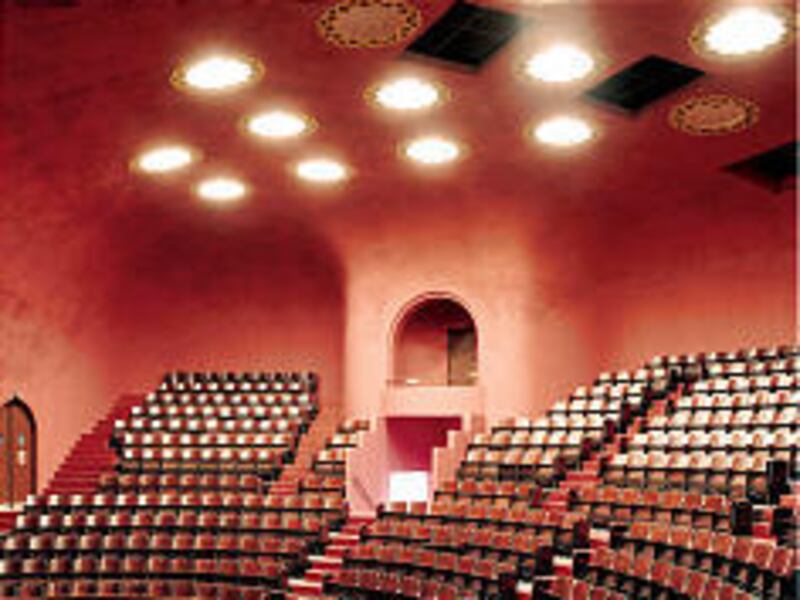
Hofer's large- and medium-size photographs are flawless entities of spatial order and depth; they merge aesthetic and functional concerns with great competence.
Through her trademark employment of ambient light, she masterfully orchestrates each shot, creating a precise composition awash with saturated color, linear perspective and rhythmic patterns.
The "absence" referred to in the show's title is the near total dearth of any human presence in the public spaces she has captured. (If there is a person in the photograph, they are rendered inconsequential by distance and position.)
Her purpose in not including an actual human presence is for us to experience her chosen interiors at a moment just before or right after people have been, or will be, there. It is most intriguing.
Hofer is the senior member of a group of students from the Dusseldorf Academy who studied under the renowned professor Bernd Becher in the 1970s and '80s.
Enrolled in what was considered the most influential German art school of the time, Hofer and her fellow students — which included Axel Hutte, Thomas Struth, Andreas Gursky and Thomas Ruff — took the art-photography world by storm.
"Hofer's photographs of architectural interiors," writes photography curator Virginia Heckert in the exhibit's accompanying book, "create a balancing act between a variety of extremes, oppositions, or tensions; elevation and perspective, absence and presence, public and private, structure and detail, minimalism and effusiveness, functionalism and aestheticism, objective and subjective vision."
If this all sounds a bit cerebral, position yourself in front of "DHFK Leipzig IV 1991" with its captivating impression of deep space.
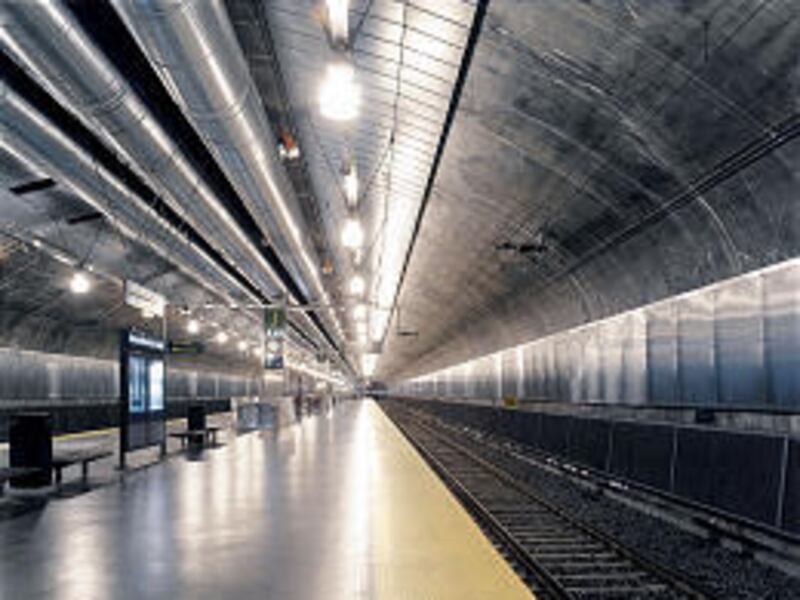
Or, for a dazzling exercise in one-point perspective, study "U-Bahnstation Theaterplatz Oslo II 2000." Here Hofer offers an image that is so balanced you could turn it on its sides or even upside down; the image maintains its picture plane in perfect balance.
In her exhibition essay, Mary-Kay Lombino, curator of exhibitions at the University Art Museum, Cal-State Long Beach, offers perhaps the best description of Hofer's approach: "Like dioramas in a natural history museum, Candida Hofer's photographs offer views into closed systems — immaculately contained and exquisitely composed — disclosing a great deal about the culture of those who inhabit them."
Digging into the meat and meaning of Hofer's work can be arduous, but it is worth the labor. Standing before each of these incomparably composed photographs brings order to the chaos running rampant outside our windows; this German's vision, by emphasizing "absence," somehow offers abundance and adjustment to our way of seeing.
A companion exhibition to "Architecture of Absence" will be on display in the Warren & Alice Jones and Paul & Betty Boshard galleries. "Types & Typologies: German Photographers From the Norton Museum of Art" provides a brief overview of the stylistic heritage of the Dusseldorf Art Academy.
If you go
What: "Candida Hofer: Architecture of Absence"
Where: Brigham Young University Museum of Art, 404 N. Campus Drive, BYU, Provo
When: Through Jan. 6, 2007
Gallery hours: Monday and Thursday, 10 a.m.-9 p.m.; Tuesday, Wednesday, Friday, 10 a.m.-6 p.m.; Saturday, noon-5 p.m.; Sunday, closed
How much: Free
Phone: 422-8251
Web: www.byu.edu
Also: Tours conducted during regular museum hours must be scheduled a week in advance (422-1140)
E-mail: gag@desnews.com