

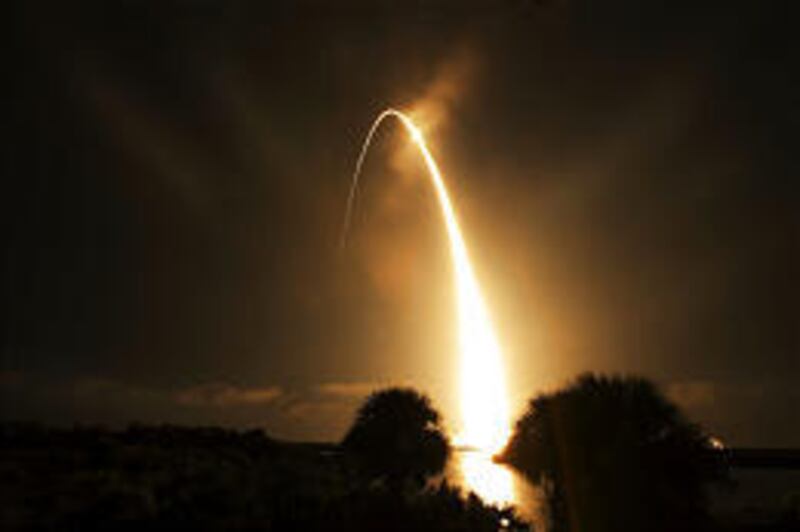
CAPE CANAVERAL, Fla. — Illuminated by 40 pure-white Xenon spotlights and the golden glare of five powerful rocket engines, shuttle Discovery and its seven astronauts thundered from the launch pad and into space Saturday night.
Eight and a half minutes after its ascent from the Kennedy Space Center, the shuttle achieved orbit, and the first night shuttle launch in four years was declared a success.
"You've got a lot of smiling faces up here," shuttle commander Mark Polansky told Mission Control.
After arriving in space, Polansky and his crew swiftly began preparations for their challenging 12-day mission.
They are assigned to dock with the International Space Station, deliver a new component to it and rewire the station's electrical system.
The jobs require three exquisitely choreographed spacewalks 220 miles above Earth and are considered extremely difficult.
In addition, five of the seven astronauts are space rookies.
"This is a truly, truly, truly complex mission," said Bill Gerstenmaier, associate administrator for space operations at the National Aeronautics and Space Administration, before liftoff. "I don't expect everything to go perfectly well."
But, after a weather-related postponement Thursday night and marginal weather throughout Saturday, the mission got off to a good — even visually glorious — start.
Trailed by a tail of smoke and fiery exhaust, brilliantly alight, the shuttle streaked through a night sky sprinkled with stars.
"It's pure poetry almost," said Cobb Milner, 52, of Blowing Rock, N.C., one of thousands of spectators who lined local beaches and riverbanks. "It's incredible. It's just beautiful. It's almost like dawn."
Night launches were suspended in the wake of the Columbia accident in February 2003 to ensure adequate lighting for cameras positioned to photograph any launch debris that might endanger the shuttle.
A slab of foam that peeled off Columbia's external fuel tank sliced a hole in that shuttle's left wing, ultimately dooming it and its seven astronauts.
But engineers and NASA managers said they now felt confident that Discovery's rockets would provide sufficient illumination.
Night liftoffs provide NASA with more opportunities to hit the brief windows of time during which a shuttle can be launched to rendezvous with the space station.
"We think the right thing to do now is go to the night launch," Gerstenmaier said.
In addition to Polansky, also aboard Discovery are pilot William Oefelein, Swedish astronaut Christer Fuglesang and mission specialists Robert Curbeam, Joan Higginbotham, Nicholas Patrick and Sunita Williams.
Williams is being ferried to a six-month stay aboard the space station, and German astronaut Thomas Reiter will be brought back home.
If all goes according to schedule, Discovery and its crew will land Dec. 21 at the Kennedy Space Center at about 3:35 p.m.