

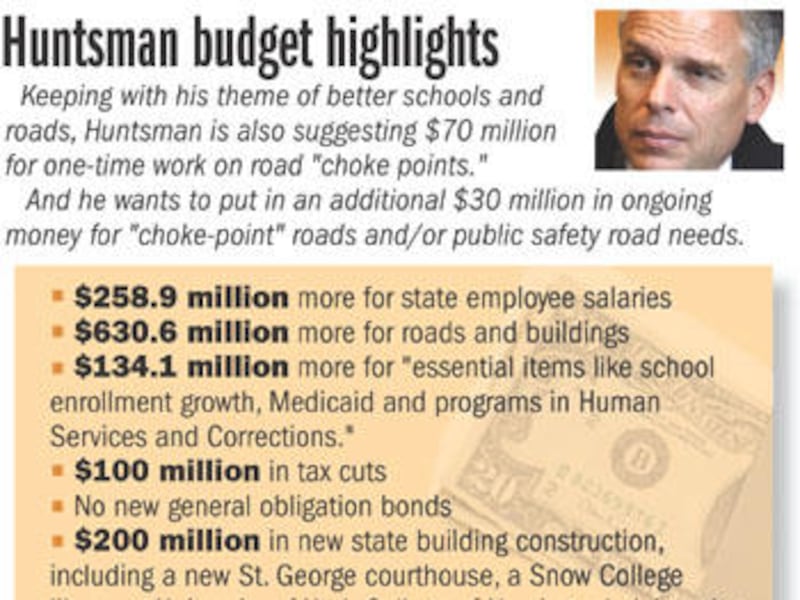
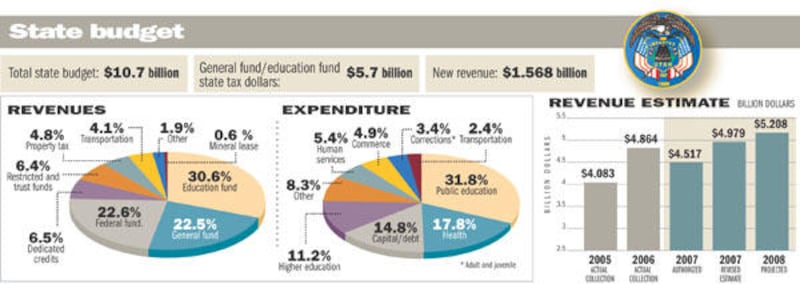
Cashing in on the hottest economy in a quarter century, Gov. Jon Huntsman Jr. on Tuesday unveiled a $10.7 billion budget for next year that includes $100 million in tax cuts, plus record spending for education and other state needs.
"Utah's school kids are on Santa's good list," Huntsman said.
So are Utah taxpayers.
But before the ink was dry on Huntsman's $100 million tax cut proposal, House Republicans in a daylong closed caucus upped the ante.
"We believe there should be a $300 million tax cut," said House Speaker Greg Curtis, R-Sandy. Curtis said he has 38 votes — a House majority — for giving three times the tax relief that Huntsman suggests.
The governor said his $100 million tax package would reduce the new flat tax rate set to take effect Jan. 1 to just 5 percent and lure 60 percent of taxpayers into the new flat-rate income tax system, giving a family of four earning $50,000 a year an extra $50 tax break.
Lawmakers will have more money to spend than ever before when the 2007 Legislature convenes in mid-January. The governor announced Tuesday there's almost $1.6 billion just in one-time surplus and ongoing revenue growth.
"It's the largest single year of revenue increases that I've ever seen in the 19 sessions I've been involved with the Legislature," Senate President John Valentine, R-Orem, said. Past years were "not even close."
While Valentine said Senate Republicans are likely to support the governor's overall recommendations — including the $100 million tax cut — the stage is set for a battle royal over who gets to pass out more cash to Utah taxpayers.
"Actually," said Curtis, "many in our caucus believe our next budget (fiscal 2008) should grow only at historical patterns — 7 percent to 8 percent." If growth were limited to that, considering the huge tax surpluses coming into state government, "we would give a tax cut of $470 million," said Curtis. "The $300 million level is a lot. But we have an extra $1.6 billion in one-time and ongoing revenue to appropriate. And that's a lot of money, too."
Minority Democrats had plenty to be happy about in the governor's proposed budget. One of the most senior members of the Legislature, Senate Minority Leader Mike Dmitrich, D-Price, said he was surprised at the focus on funding programs usually backed by Democrats.
"In all my years in the Legislature, it's one of the most exciting budgets," Dmitrich said. "He not only covered education, he covered human services, transportation and even some of the building needs."
Huntsman said that the big boost for education was "a signal of hope and of commitment" showing the state cares about teachers — a sentiment echoed by executives of the Utah Education Association, the state's largest teachers union.
"He really stepped up to the plate," said Kim Campbell, president of the UEA. "Overall we are really encouraged. It is exciting that (Huntsman) focused on what we value — smaller class size, quality teaching."
The Weighted Pupil Unit — the state's basic per-student budget number for K-12 — goes up by 7 percent, and Huntsman's budget provides money for class-size reduction to an average of 20 children for K-3rd grade and full-time kindergarten for those who want it.
Curtis said his caucus also wants to give an additional $300 million to public education next year. "We match our tax cut to more spending on schools — dollar for dollar." Huntsman would get about the same amount in additional education funding, but the Legislature may not spend the money in the same individual programs or pay raises, said Curtis.
Overall, Huntsman's $10.7 billion spending plan for fiscal 2007-2008 takes care of most state needs with some money left over, the governor said.
Huntsman's economists estimate that the state has a record-setting $498.2 million for the year that ends June 30.
Combine that with estimated revenue growth of $308.4 million for the last fiscal year, and together legislators will have a mind-bending $800 million in new cash to allocate when they come into session Jan. 15.
Add in natural tax revenue growth estimates for next year, and the state will have $1.6 billion in additional revenue.
"The economy is growing, job growth is exceedingly high, and we have a large budget surplus," Huntsman said.
With those record levels of tax collections, Huntsman said he wants to continue with tax reform. That takes away some cash that otherwise would have grown state government more than some conservative legislators wish. Overall, the 2007-08 budget will grow by 6.7 percent, if Huntsman's recommendations in all areas are adopted.
If only state funds are counted, however, the new budget represents a hefty 15 percent increase. That's less than the 17 percent increase that lawmakers adopted in the current year's budget. But at 15 percent, that means state spending on local tax dollars will have gone up nearly a third in two years — a level that some GOP lawmakers may balk at.
Huntsman wants to lower the current 5.35 percent level of the new flat-rate income tax created by the 2006 Legislature to 5 percent and also create a taxpayer credit for Utahns who choose to switch to the new flat-rate system.
Getting the flat tax rate down to 5 percent is a goal the governor had said might take several years to accomplish. Huntsman has said a 5 percent flat-tax would encourage economic development by making Utah more competitive with neighboring states.
His proposed taxpayer credit, which would be available to single taxpayers earning no more than $45,000 and married taxpayers making up to $90,000, is intended to help push up to 60 percent of taxpayers into the new flat-tax system. Those who wouldn't pay lower taxes under the new system would still be able to stay in the current income tax system with a top rate of 6.98 percent and take the traditional deductions, like home mortgage interest and charitable contributions.
The governor's effort to encourage more Utahns to give up taking deductions in favor of a flat tax appears to conflict with The Church of Jesus Christ of Latter-day Saints' position on tax policy.
In a statement issued Tuesday, the church said that while the governor's plan was still under review, "on the question of tax deductions for charitable donations, the church continues to believe that the Utah personal income tax system should contain an incentive for charitable giving."
Curtis said House Republicans aren't yet ready to specify where their $300 million tax cut should come, although there is support for reductions both in the personal and corporate income taxes and state sales taxes. If Huntsman and senators agreed, said Curtis, the state could achieve both — give Huntsman's 5 percent flat-rate tax and remove the final 2.25 percentage points of the state's share of the sales tax from unprepared food.
Senators have already said there's no way the food tax will be cut in the 2007 Legislature. Huntsman told the Deseret Morning News' editorial board Tuesday that while he supports removing the rest of the state's share of the food tax, there is no money in his proposed budget to do that.
Even with all that new spending and tax cuts, Huntsman leaves $27.8 million on the table. No doubt legislators will jump at that money, finding ways to fund their own special programs or projects or just give a larger tax cut to Utahns.
Although the state budget would grow significantly if lawmakers adopt his recommended budget, Huntsman said that such growth must be compared to the state's rapid population growth. The number of state employees will actually drop when compared to the number of citizens they are serving, Huntsman said.
But Curtis said: "Many of us just don't think we can sustain such spending — we can't continue building government like this."
While an insider's concern, Huntsman and legislators will likely have to find a way around several "budget caps" that are aimed at curtailing state spending. Huntsman wants to put an extra $20 million into the state's two "Rainy Day" funds — but the funds are already full. And the governor and lawmakers may want to spend more money on targeted transportation projects, which under current law can only grow by $12 million this year.
The Legislature's Executive Appropriation Committee will meet today to adopt a "base budget" for 2007-08 so lawmakers can immediately start their budget process at the first of the annual 45-day general session.
Contributing: Josh Loftin
E-mail: bbjr@desnews.com