

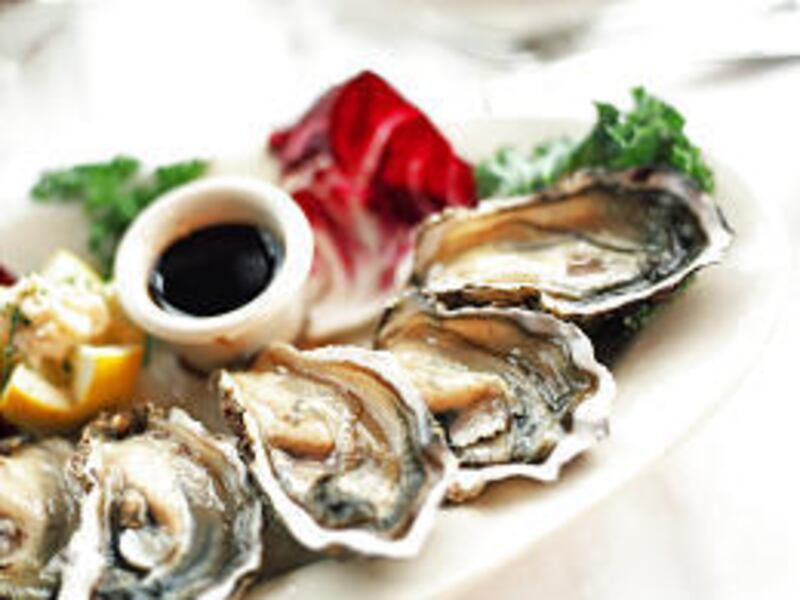

An oyster is a soft-bodied mollusk, a bivalve like the clam, mussel and scallop, with two shells held together by a muscle that acts as a hinge. Mollusks are one of two main types of shellfish, the other being crustaceans. Other types of mollusks include gastropods (or univalves), such as the snail, which have one shell; and cephalopods, such as the squid, which have no shells but tentacles and ink sacs.
The oyster's two-shell protection is hard and rough and requires a tool to open. The meat, which can range from creamy beige to gray, can be bland or salty, tender or firm, depending on the variety and maturity.
Oysters typically live at depths of 8 to 25 feet in marine or brackish water, forming reefs that play host to a wide variety of marine life, such as crabs and anemones.
Oysters are considered important to marine ecology because they naturally filter water, improving water quality by removing substances that can harm other marine life. One oyster can filter 5 liters of water an hour.
Types of oysters
Oysters are cultivated and harvested in the wild in many parts of the world.
The United States commercially harvests three types:
Eastern (or Atlantic), from up and down the East Coast, including the well-known Bluepoint of Long Island and the Chincoteague from the Chesapeake Bay area.
Olympia, small oysters from Washington's Puget Sound.
Pacific (or Japanese), from the Pacific coast.
The largest U.S. oysters can grow up to 7 inches long in the shell. They can take from three to five years to reach maturity. Louisiana produces the most oysters in this country, almost half of the total production.
In Europe, the French Belon oyster is considered one of the finest in the world.
Availability
A myth warns against eating oysters except in months whose names include an "R" — in other words, from September through April. But it's just a myth, especially in these days of refrigeration, which keeps oysters cool during the hot summer months.
The myth does have some grounding in fact, though, because it's in those summer months when oysters are breeding, and they become flabby and not as desirable. In other words, the best oysters — particularly for eating raw — are to be had during the "R" months.
U.S. oyster harvests have steadily dwindled since the 19th century, because of overfishing, pollution and diseases. For instance, the North Carolina harvest in 2003 was 49,332 bushels (260,966 pounds in meat weight, without the shell), according to the N.C. Division of Marine Fisheries, compared with the record 1.8 million bushels (9,522,000 pounds) in 1902. The last two state harvests have seen a modest rebound to 69,501 bushels (367,660 pounds) in 2004 and 71,398 bushels (377,697 pounds) in 2005. Nationwide, the harvest in recent years has been between 30 million and 40 million pounds a year.
Many projects are under way nationwide to restore oyster beds, such as the planting of 15 million disease-resistant "seed" oysters, protected from predators by mesh fences, in the Chesapeake Bay area last year.
One aspect of North Carolina's efforts to rebuild oyster supplies is an oyster-shell recycling program. Because oysters love to grow on other oyster shells and are most productive there, the replacement of used shells in brackish water is helping to produce oysters, as well as provide habitats for other marine organisms.
Nutrition
Oysters are low in total fat and saturated fat. A 3-ounce serving of steamed Atlantic oysters contains 116 calories and 4 grams fat, including 1 gram saturated. That serving also has 12 grams protein and just 6 grams carbohydrates. Oysters contain some cholesterol but less than in egg yolks. Some say that the myth that oysters are an aphrodisiac refers to the fact that they are high in vitamin E and zinc. Oysters also are a good source of iron, niacin, potassium and phosphorus.
Selection
When buying oysters in the shell, buy from a reputable store that sells a lot of them. That can help ensure freshness. Look for hard shells that are closed. If partially open, it should close when tapped. If it doesn't, discard it.
In general, smaller, younger oysters will be more tender.
Freshly shucked oysters are typically sold in their liquor. These oysters should look plump, smell fresh and have uniform size. The liquor should be clear, not cloudy. Don't toss the liquor; it has a lot of flavor and is incorporated in most oyster recipes.
Shucked oysters are often sold by size, labeled either "standard" or "select." Larger, select oysters typically cost a dollar or two more a pint.
Oysters in the shell, which are live oysters, should be covered in a damp towel and kept refrigerated. Do not let them sit in water. Use within three days. Shucked oysters should be refrigerated in their containers and used within two days. Avoid any fresh oysters held longer than 10 days from their harvest date. The date can be checked at the store by asking to see the oysters' harvest tag.
Canned and frozen oysters are considered poor substitutes for fresh.
Cautions
Sometimes the waters in which oysters live are plagued by red tide, an invasion of microscopic plankton that produce toxins. Typically, government agencies monitor closely for this problem and spread the word accordingly.
People can get sick from raw oysters that have high concentrations of V. vulnificus, a bacterium that grows in warm waters. This is much less likely to be a problem during cold months or with oysters from cold waters. People with chronic liver disease or impaired immune systems are advised not to eat raw oysters. Cooking oysters will destroy any harmful bacteria.
Cooking
Oyster lovers tend to prefer them raw, freshly shucked, served on the half shell, with perhaps a squeeze of lemon or drop of hot sauce or cocktail sauce.
But oysters adapt themselves to all manner of cooking, including steaming, frying, roasting and braising. Oyster roasts have long been popular in North Carolina, and this outdoor cooking method produces oysters one step away from raw. It essentially steams the oysters in their shells in a covered grill. If planning to cook or serve the oysters in their shells, they should be washed as for raw oysters.
Because oysters are delicate, care must be taken not to overcook them. In general, oysters are done as soon as their edges curl. Further cooking typically toughens them.
OYSTER STEW
24 fresh oysters, shucked, juices reserved
4 bacon slices, minced
1 onion, minced (about 1 1/4 cups)
1/4 cup all-purpose flour
1 1/2 quarts milk
1 bay leaf
1 cup heavy cream, heated
1/2 teaspoon salt, or to taste
1/4 teaspoon freshly ground black pepper, or to taste
Oyster crackers (optional)
Drain the oysters in a colander over a bowl. Reserve the juice.
Heat a soup pot over medium heat. Add the bacon and cook until crisp, 6 to 8 minutes. Transfer the bacon to a paper towel-lined plate.
Add the onion to the bacon fat and cook until translucent, about 6 minutes. Do not brown. Reduce the heat to low, add the flour, and cook 3 to 4 minutes, stirring constantly with a wooden spoon.
Add the milk and reserved oyster juice in batches, using a whisk to work out any lumps between each addition. Add the bay leaf and simmer, 20 minutes, skimming as necessary. Add the whole oysters and continue to simmer until the oysters are barely cooked, about 5 minutes. Remove from heat.
Add the hot cream and season with salt and pepper. Serve in heated bowls, garnished with the reserved bacon and oyster crackers, if desired.
Makes 8 servings.
Nutrition information per 17-ounce serving (without crackers): 470 cal., 26 g pro., 24 g carbo., 29 g fat, 860 mg sodium, 205 mg chol., less than 1 g fiber. Recipe from The Culinary Institute of America's "Book of Soups" (Lebhar-Friedman, 2001, $35).
Distributed by Scripps Howard News Service, www.shns.com.