

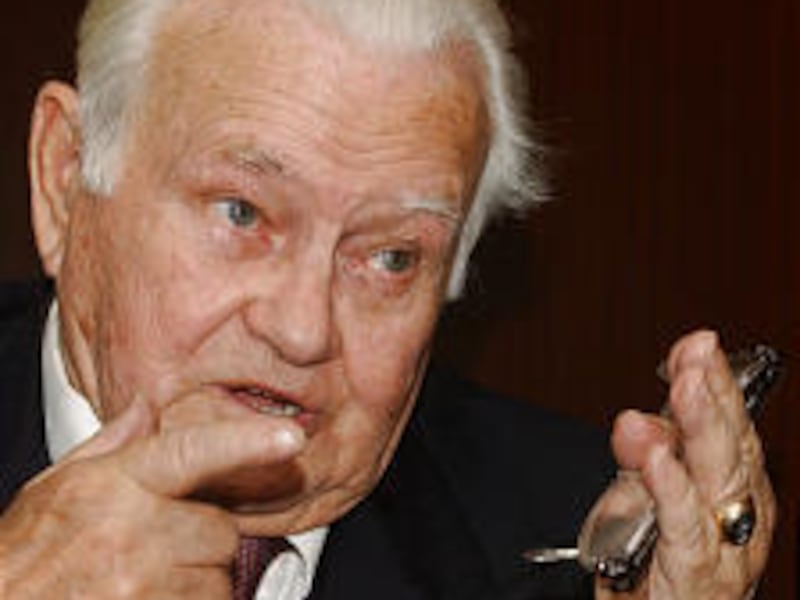
WARSAW, Poland — During Germany's World War II occupation of Poland, Jerzy Kowalewski paid a heavy price for helping the resistance.
The Nazis knocked out all of his teeth, then packed him in a cattle car to the Auschwitz concentration camp, where they ordered him to clean streets in 15-hour shifts and turned him into a human guinea pig in medical experiments.
Six decades later, the 83-year-old Kowalewski gained a small measure of compensation for that suffering — about $20,000 — from a German fund set up to help survivors of the Nazis' forced labor program. After compensating nearly 1.7 million people in recent years, the fund is sending out its last checks to meet today's deadline set by German law to finish its work.
"This isn't just about money," said Guenter Saathoff, director of the Remembrance, Responsibility and Future foundation that administers the fund. "It's much more about morality. These payments are one way that Germany recognizes the wrongs inflicted on its victims."
Whether the payments brought the victims any solace is another question.
Interviews with a handful of survivors throughout eastern Europe suggest the money met with gratitude, but also with bitterness as being too little, too late. And even with enduring rage.
"The Nazis burned my relatives to death before my eyes," said Markiyan Dimidov, a Ukrainian whose grandmother, great-grand-mother, 3-year-old sister and 2-year-old cousin were immolated by the Nazis in 1943 in what is now Belarus.
"Our tragedy cannot be compensated by any money," he said.
Dimidov, who was 8 years old at the time, was sent to a concentration camp and did forced labor in Latvia. He received $10,000 from the German fund.
Most of the recipients of the money were non-Jews in Poland and Ukraine, who were exploited in large numbers working in Germany's wartime industries. Unlike Jews, who were often killed in concentration camps, many of these victims survived their ordeals.
Kowalewski, a soft-spoken man of aristocratic ancestry, said the money meant a lot to him — it just wasn't enough. He spent it on physical therapy and other medical treatments for his son, Adam, who was born with epilepsy and cerebral palsy — disabilities Kowalewski blames on either the typhus injections he was given at Auschwitz, or a later experiment inflicted on him at Dachau.
"I am thankful for what I got," said Kowalewski, looking dapper in a dark suit and vest, his gray hair combed back neatly, as he told his story over a coffee in a Warsaw hotel.
"But Germany is rich — richer than us — and I think people who underwent pseudo-medical experiments should be getting payments until the end of their lives," he said.
The fund — which follows some earlier German compensation programs — was endowed with $6.7 billion, half coming from the government and the other half from companies that profited from forced labor during the war, among them Volkswagen, DaimlerChrysler, Bayer and Deutsche Bank.
German lawmakers approved the fund in 2001 following two years of intricate negotiations and months of legal wrangling over the dismissal of U.S. lawsuits against some of the German companies.
Millions of dollars remain in the fund, which the foundation says will go to other humanitarian projects.
"This money helped me a lot — without it I could have just died," said Yakov Sivakov, a 75-year-old from Belarus, who used half his money on cancer treatment. The rest went to fixing up his vintage, 1960s house in Vitebsk, about 185 miles northeast of Minsk, the capital.
"In Germany they treated us worse than slaves," said Sivakov.
In the former Soviet Union, the payments also served as a form of "moral rehabilitation" for a group that suffered double persecution, said Saathoff, director of the foundation that administers the fund. Many who returned to lands ruled by Soviet dictator Josef Stalin were abused as traitors simply for having been in enemy hands.
One such victim was Anita Liepa, a Latvian who was sent as a teenager to work in a military hospital kitchen in Flensburg, Germany. The Soviet Union, which had annexed her country after the war, accused her of "spying for the fascists" and sentenced her in 1953 to seven years of imprisonment and three years of exile in Siberia and the Ural Mountains.
Liepa is saving the more than $2,620 she got from the fund to pay for her burial.
"I am thankful to Germany," said Liepa, the author of 15 books. "I don't expect to see similar compensation for the forced labor I endured in the forests and peat bogs of Russia."
Contributing: Natasha Lisova in Kiev, Ukraine, Gary Peach in Riga, Latvia, and Yuras Karmanau in Minsk, Belarus.