

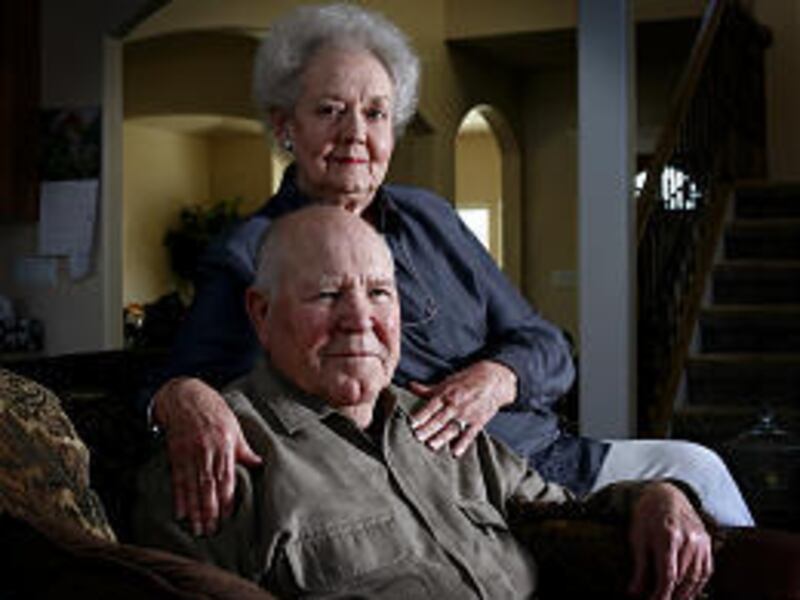
HIGHLAND — Army Air Corps 2nd Lt. Emmett Smith Davis, 22, was sound asleep shortly before 8 a.m. in an officers' club 12 miles from Hawaii's Pearl Harbor 65 years ago when a lieutenant shook him and yelled that the Japanese were attacking.
It was an awakening to World War II on Dec. 7, 1941.
Davis ran to a window and could see smoke over the Wheeler Field flight line about a quarter-mile away. He saw a Japanese pilot go into a dive bomb where about 150 planes were parked.
Davis, now 87, is one of the estimated 4,000 to 6,000 veterans of the surprise attack still living, although most are nearing 90 or older, according to the Pearl Harbor Survivors Association.
Davis remembers putting on a pair of flight coveralls and meeting another lieutenant at the front door of the club.
"He said, 'C'mon, Cyclone,"' Davis recalled this week at the home of one of his three children. The other pilots had called him "Cyclone" because he routinely outflew other airmen, and the nickname stuck over the years.
Davis and the other two lieutenants then jumped into a convertible and started driving to the flight line.
"We could see all the smoke from Pearl Harbor coming up from the ships," Davis said.
On the way, a Japanese fighter pilot saw the moving car, turned his plane around and tried to kill the three men.
"He shot up the road," Davis said. But the pilot missed his mark.
They headed for a hangar, and they were shot at a second time along the way by what Davis figured were a plane's .30-caliber machine guns.
Many of the estimated 150 U.S. planes lined up next to each other throughout the Wheeler Field flight line were now on fire. Davis jumped in one plane, then another and another. He moved them all to relative safety away from burning debris.
The dance at the club the previous night, the card game that lasted until 2 a.m. and Davis' lack of sleep were buried somewhere beneath adrenaline and a call to duty by the time he jumped into a fourth plane.
Davis taxied a P-40 to a safe place, hopped in his own car, drove to an armament storage unit and broke the lock on the door with an ax.
He pulled out six machine guns — two .50-caliber and four .30-caliber — and drove back to the plane. It took about an hour to install the guns, a task Davis had never tried before.
As he was working, another Japanese pilot flew in low, about 50 feet off the ground, aiming for Davis.
"I could see the rear gunner," he said. "He had the most devilish grin on his face."
While Davis' memory of the day is still sharp, he can't recall what, if any, emotions were swirling about in his head at the time, or why the Japanese were attacking.
"There wasn't any time to think about that," he said. "You had a job to do, and you had to get on with it."
He started up the P-40 again, took off toward some mountains to the west and retracted his landing gear. He was in the air when he tested the guns he installed — and it was a miracle, he said, that all six worked. Cyclone was ready for a fight.
But the fight never came.
The Japanese had done their damage in two waves over the course of two hours on that Sunday morning. More than 3,500 Americans were killed, 350 aircraft were damaged or destroyed and all eight of the Pacific Fleet's battleships were sunk or severely damaged.
Davis flew three missions that day, looking for the Japanese fleet or enemy aircraft. He didn't locate a single plane or ship.
On one mission, he was ordered to head toward Pearl Harbor to escort B-18 bombers in search of Japanese ships. But as he neared his destination about 3,000 feet above the harbor, he was fired upon from below.
"The U.S. Navy was shooting at anything that flew," Davis said. "Can't blame them, either."
Still, Davis, who retired as a decorated colonel in the Air Force, was one of the few pilots able to get off the ground that day.
He would go on to fly 267 combat missions in World War II, including one of the last missions in the air attack on Kumamoto, Japan, four days before the Japanese surrendered. He is credited with destroying at least three enemy planes and possibly four others during the war.
On Jan. 23, 1946, Davis married Marjorie Poulton, and together they raised two daughters and a son. But for years, Davis would not talk about his war experience, and his children knew that the war haunted him, beneath the surface.
Pamela Mull remembers how her mother used to poke her dad with a broomstick if he fell asleep in a chair, keeping a safe distance for fear of being struck, because Davis would sometimes wake up swinging his fists. "I knew there were some funny things about my dad," Mull said.
But with time, the walls Davis had built around his war experiences came down. Memorabilia from the war, kept in boxes and bags, began to take on more meaning for his family. As his grandchildren grew, Davis spoke about the war during their high-school history classes.
On Dec. 12, Davis, now mostly blind due to macular degeneration, will turn 88. And his own children admit they are still learning about their dad.
"He's kind of a hero to our family," Mull said. "For me, World War II is very much alive because of my dad and the experiences he had."
Contributing: McClatchy-Tribune Information Services
E-mail: sspeckman@desnews.com