

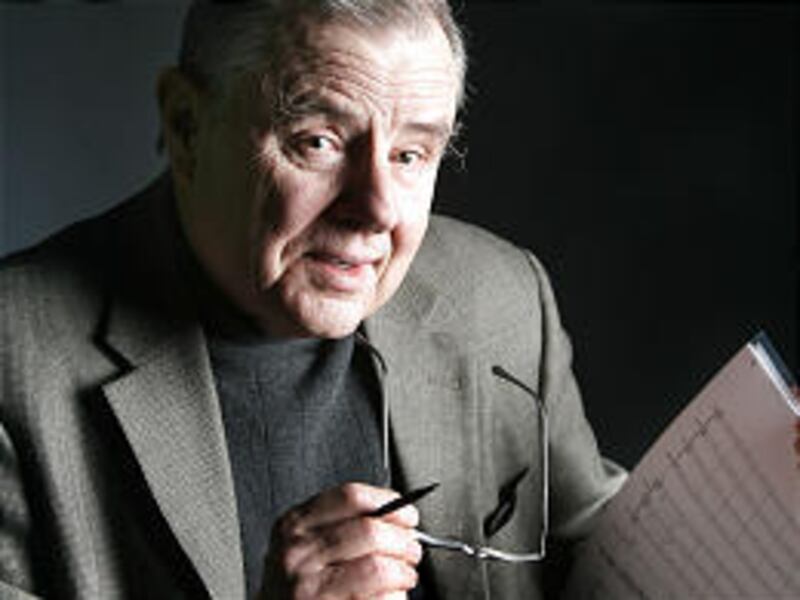
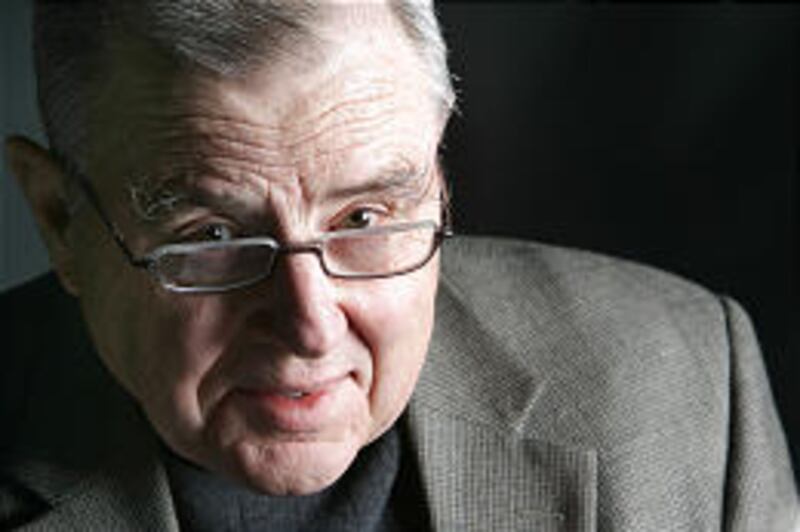
As Utah composer William Wallace is fond to point out, he's not the Scottish William Wallace.
Having two composers with the same name can be a bit confusing for people not familiar with either one. Of course, a little research clarifies things immediately.
The Scotsman Wallace refers to lived from 1860 to 1940, spent his creative life in Great Britain and wrote music on Scottish subjects.
His namesake, on the other hand, is still very much alive and divides his time between homes in Salt Lake City and Jackson Hole, Wyo. And his music is distinctly a product of the 20th century.
"My prime influences are Brahms and Bartok," he told the Deseret Morning News during a recent visit to Salt Lake City. These are seemingly contradictory musical stimuli to be sure, but they're easily explained once one has heard Wallace's music.
Wallace writes in a style that is easily accessible because of its genial melodicism. "My music is not very dissonant," he said. "I'm a sucker for a good tune." That's the Brahms influence.
Yet he still considers himself a modernist. "What makes me modern are my rhythms. I'm stimulated by irregular meters." Like Bartok, Wallace consistently uses meters that don't fall into any symmetrical pattern, such as 5/8 and 5/4.
When the Utah Symphony premiered his Second Piano Concerto a few years back, music director Keith Lockhart had an apt analogy for the irregular beats in the score. "Keith compared it to having one short leg," Wallace said. "And I think that's apt."
Wallace was born in Salt Lake City in 1933. He studied with Leroy Robertson at the University of Utah, earning his doctorate there in 1962. He also spent a year at Oxford University in England, where he studied with Egon Wellesz and Edmund Rubbra.
After receiving his doctorate, Wallace spent a few years teaching at Rutgers University before moving north of the border and accepting a position at McMaster University in Ontario, Canada. Wallace retired from academia in 1989 to devote himself full time to composing.
And now, at 72, Wallace hasn't slowed down one bit. His creative juices still flow, and he just completed his Prelude and Vivace for Rachel Varat-Navarro, widow of local arts patron Rocky Navarro.
Another recent work is his Concertino for Viola and Chamber Orchestra, which he wrote for Joel Rosenberg, who, besides being a violist, is also the director of the Paradigm Concerts and music director of the Orchestra and Chorus of Sandy City.
"Joel is an excellent conductor, who is very much admired by everyone," Wallace said. "He is also a very fine violist, and I wanted to write something that would show off his technical capabilities."
Originally, Wallace wrote a single-movement work for Rosenberg, which Rosenberg played several times. But both he and Wallace agreed that there should be more. "The piece I wrote became the first movement of the Concertino," Wallace said, after expanding the work by adding a slow movement and a fast tarantella-like finale.
Wallace became acquainted with him after Rosenberg's mother, pianist Gladys Gladstone, began playing Wallace's Viola Sonata with Sally Peck, who at the time was principal viola with the Utah Symphony. "That was around 1960," Wallace said. "They were the first top-class musicians I worked with."
Gladstone loved the sonata so much that she always referred to it as "my piece," Wallace said. A few years later, Rosenberg picked up the sonata and played it on several occasions.
Last year, Rosenberg traveled with Wallace to Slovakia to record the Concertino with the Slovak Radio Symphony Orchestra. "Joel is a superb violist," Wallace said. "He gave me what I wanted. It was a pleasure to work with him."
This CD is the second all-Wallace album and the first featuring the Slovakian orchestra. But Wallace refers to it as Rosenberg's CD. "For me, it's a way of honoring Joel — that is its most significant purpose. Joel is an exceptional musical personality who has done so much for music in our community. I wanted to honor all the work he has done here."
E-mail: ereichel@desnews.com