

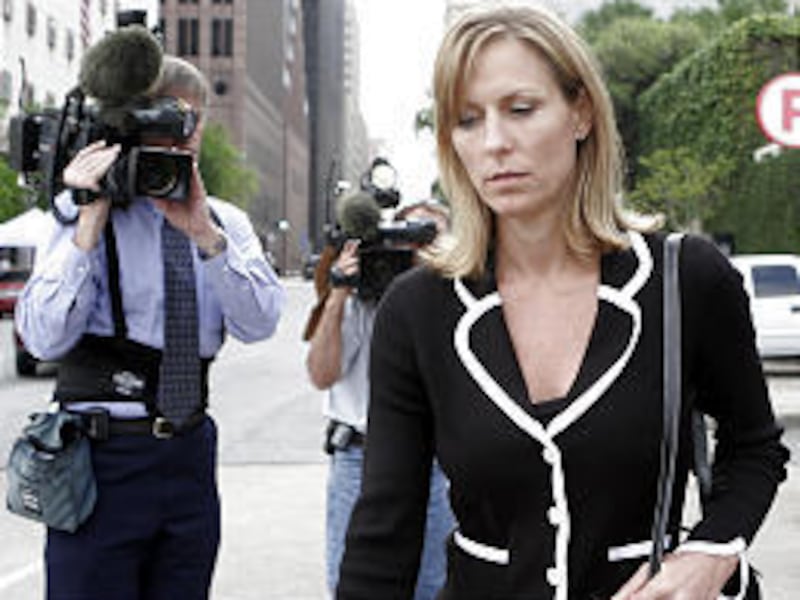
HOUSTON — Lawyers for former Enron Corp. chiefs Kenneth Lay and Jeffrey Skilling launched their case Monday with the two men's former assistant, who said she believed a key prosecution witness lied about his involvement in company-related crimes.
As they did during the first 2 1/2 months of the fraud and conspiracy trial of the two former chief executives, defense lawyers sought to erode prosecution testimony with their first witnesses.
Joannie Williamson served as an assistant at various times to Skilling, Lay and former investor relations chief Mark Koenig, a key prosecution witness.
Koenig pleaded guilty in August 2004 to aiding and abetting securities fraud and testified for the prosecution that he lied to investors about Enron's finances. During more than seven days in the witness chair in February, he denied claims that he had told Williamson he pleaded guilty to a crime he didn't commit.
The defense teams maintain that most ex-Enron executives who admitted to crimes did so out of fear of prosecution and in hopes of receiving lenient punishments rather than because they broke the law.
Williamson said Koenig, whom she described as a close family friend as well as a former boss, called her the day he pleaded guilty.
"I said, 'You're not guilty,' and he said, 'I know that, but in order for this to work, everyone needs to believe that I am.' "
She added she did not believe he was guilty, even though Koenig told jurors in February, "I pled guilty because I am guilty."
Williamson said yes when prosecutor Kathryn Ruemmler asked if she thought Koenig lied during his testimony, which implicated Lay and Skilling in a string of falsehoods.
"Did he tell you he was pressured?" Ruemmler asked.
"No, he did not," Williamson replied.
Rogers Herndon, a former top risk analyst in Enron's trading unit, Enron North America, at first began to contradict prosecution testimony about why Enron folded the risk and trading portion of its retail energy division, Enron Energy Services, into his larger, profitable unit. But under government questioning, he also revealed chaos in the retail unit.
David Delainey, former CEO of the retail unit, had testified for the prosecution that in March 2001 he reluctantly agreed to a Skilling-approved plan to move part of Enron Energy Services into the wholesale division that housed Enron North America to hide $200 million in losses. Delainey pleaded guilty to insider trading in October 2003.
That move came after Wanda Curry, the former chief accounting officer for Enron North America, found wildly overvalued contracts and uncashed checks from customers in Enron Energy Services, she testified for the prosecution.
But Lay and Skilling told investors the move was designed to increase efficiency and combine like trading functions — not to hide losses in a profitable division.
Herndon testified similarly Monday — that the move combined like functions and could allow the retail unit's sales and dealmaking side to grow — and he explained the move to employees as such.
But on cross-examination Herndon acknowledged he didn't know about Curry's analysis when he began to re-evaluate retail contracts and also found overvalued contracts.
"Is it fair to say that EES's risk management functions were a mess?" prosecutor Sean Berkowitz asked.
"They were inadequate," Herndon replied.
Skilling lawyer Daniel Petrocelli said Monday that Skilling could testify as early as Wednesday afternoon, depending on how long other witnesses take on the stand. Lay's testimony will come later.
Lay's lead lawyer, Michael Ramsey, was absent from the trial Monday, undergoing outpatient tests on a stent he had inserted in his chest on March 24. Lay spokeswoman Kelly Kimberly said the attorney will have "an invasive procedure" Tuesday during which doctors can evaluate the stent.
"We are hopeful that he will be back at the trial soon," Kimberly said. The trial will continue despite Ramsey's medical condition.