

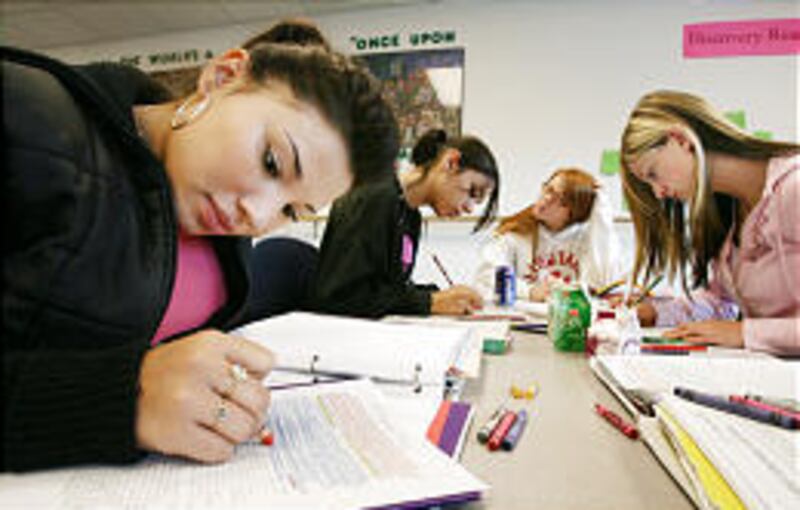

KAYSVILLE — Everyone knows your name at Canyon Heights, a specialty high school in Davis County. There are no cracks to fall through, and students who are up against tremendous odds do what it takes to attend.
Tardies don't exist at the school, and students call teachers by their first names. Falling asleep in class is understood and it's always OK to cry.
Canyon Heights is one-of-a-kind in Utah. It has become a haven for students who are parents and emotionally fragile students who are fighting mental issues and internal battles with issues such as depression, anxiety, school phobia, post-traumatic stress and suicide.
"Here, everybody's been through a lot of the same situations, and we can relate to each other," said senior Andi Martin. "They show you what strengths and abilities you have and show you how to work through it all."
Canyon Heights was established in the 1970s to meet the needs of young student-parents and expectant mothers.
With an Early Head Start program at the school, counselors, social workers and a schedule that worked around the needs of new parents, students were able to get their diplomas despite the early thrust into adulthood.
But as pregnancy rates dropped, Davis District decided to include other students who were dealing with emotional issues, which increased the opportunity for district students.
"It's an incredible mix — there are a lot of similarities between the two groups, and it has been a great blending," said Canyon Heights principal Judy Nixon. "A lot of times the emotionally fragile kids will reach out to the young parents and they help each other."
Right now the school mix is about half and half, but Nixon said it's hard to categorize the students and says most of them are friends who support each other regardless.
The majority of students at the school have been referred by a school counselor or a therapist. Once students are referred, they undergo interviews with Canyon Heights leaders to make sure the school will meet their needs.
Most years students must be turned away for lack of room.
The building that the school now inhabits was built about six years ago and is designed specifically to promote a happy positive environment for the students and their babies.
The walls are painted in soft pastels, and there is lots of natural light. Along the halls are colorful park benches, and large plants pepper the corridors and commons areas.
School starts a little later than most high schools to accommodate students with sleeping disorders and parents who are up in the night with children. If they are late for class it is universally understood, and yoga is offered to help soothe students.
And their symbol is the phoenix — a mythological creature that died, then arose from its own ashes.
Students don't like their school tagged as an "alternative."
"Alternative programs take all kinds of kids, and a lot of them have behavior problems and act out externally. You may find some kids with mental health issues here, but we are very specifically designed for kids that are internalizers," Nixon said.
The school has about 100 students and 12 teachers, some of them part time, equaling a total of 7.5 full-time teachers. Three social workers and a counselor work with students on a weekly basis. They try to keep class sizes around 17. The girl-to-boy ratio is 6:1.
About a third of the students are on home/hospital leave, but teachers visit them outside of school, allowing them to continue with their course work.
Students say they are able to talk to teachers and counselors about everything and they are comfortable opening up.
"It's not hush-hush about drugs, alcohol, sex and other things and we are not afraid to be ourselves," said Anna Nielson, a senior. "It's like Relief Society (the LDS Church women's organization), only cooler and not censored — we've got it good."
The students say many of them come to the school hopeless. They can't handle being at a big high school. They feel like outcasts or as if they were invisible, and college is far from their minds.
"A lot of kids are told 'You're dumb, you are never going to make it.' Here you regain hope," Martin said.
There are still many similarities between Canyon Heights and traditional schools. They have prom, dances, social activities, student government, clubs and field trips.
"I don't feel I am missing out — we get involved," Nielson said. "At the other schools, I would never have been in student council, let alone prom queen."
Students are aware they can be stigmatized by attending Canyon Heights — going to the "pregnant school" or a school where students have problems. But it bounces off them.
"We don't really care what people say — it doesn't really matter," Martin said. "We are getting diplomas; we'll have futures."
When they become seniors, teachers take the students on field trips to colleges and to look at different careers. As part of graduation they are required to work in an internship for a quarter, and counselors work closely with those who want to go to college.
The school also offers ACT, GED and state graduation test preparation courses to ensure students have the help they need to get a diploma and move on.
About 57 percent of them are making it, Nixon said.
And some even come back and try to remain an active part of the school because it also has doubled as their family.
"You come here really confused and not knowing who you are and you find yourself," Nielson said. "This is a big support system."
E-mail: terickson@desnews.com