

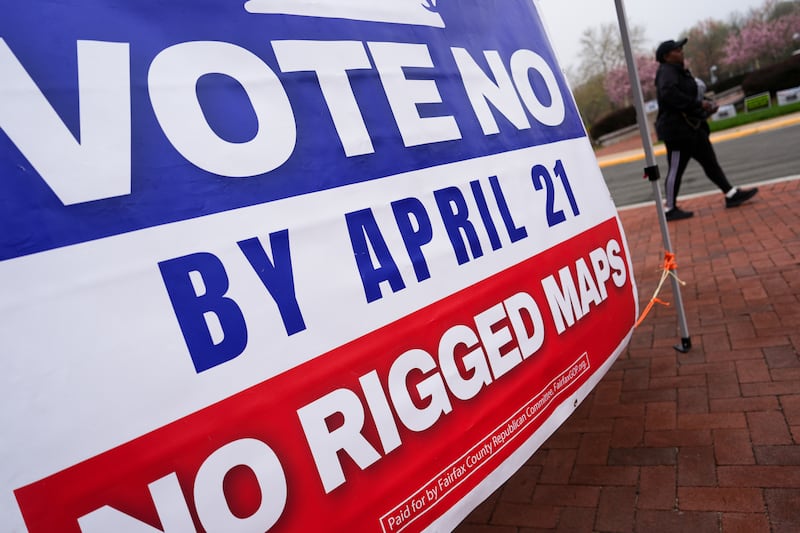

Virginians are heading to the polls to vote “yes” or “no” on a ballot initiative in a high-stakes special election that could upend this year’s midterm elections.
Voters on Tuesday will decide if they want to move forward with Democrats’ redistricting plan which would significantly change the state’s congressional map, giving Democrats a 10-1 advantage instead of the current 6-5 Democratic to Republican split.
Virginia is one of many states that took a look at their congressional maps this year after President Donald Trump encouraged Republican-led states to redraw their maps ahead of the 2026 midterms.
Both parties in Virginia are pushing get out the vote efforts as early voting lags behind previous years and a huge amount of cash is flowing into the mid-decade redistricting effort.
Here’s what to know:
Democrats try to eliminate several GOP seats
In February, Virginia Democrats finalized an agreement over how to redraw the state’s congressional map. It would lead to eight safely Democratic districts, two districts that lean Democratic and one safe Republican district.
As it currently stands, Virginia has six Democrats and five Republicans in the House.
The amendment passed by Democrats in February would temporarily bypass the state’s typical redistricting process. If voters approve the amendment through the referendum on April 21, Democrats would be able to move forward with their map.
The amendment would put in place a temporary process. After the 2030 census, the state’s standard redistricting process would resume with maps to be decided by a bipartisan commission.
The lead-up to the election has seen an influx of spending, and The Washington Post noted that due to state election records, 95% of the total $93 million raised as of Monday came from nonprofit groups that are not required to disclose their donors.
The leading group, Virginians for Fair Elections, reported raising $64 million in favor of the referendum. About $40 million of that came from House Majority Forward, which is led by House Minority Leader Rep. Hakeem Jeffries, D-N.Y., the Post reported using data from tracking firm AdImpact. The Fairness Project added $11.7 million to the effort. It’s backed by new Gov. Abigail Spanberger.
Virginians for Fair Elections secured a television advertisement for voting “yes” on the ballot initiative featuring former President Barack Obama. He said voting the measure through was the “responsible” thing to do.
The group that wants Virginians to vote “no” on the measure is made up of several smaller groups, including Virginians for Fair Maps. That group took in $22 million and another $7 million was raised by Justice for Democracy PAC, an anti-redistricting group, Cardinal News, a southern Virginia outlet, reported.
According to Cardinal News, the $7 million donation to the PAC was given by a nonprofit, which didn’t have to disclose its donors. However, that same nonprofit was used by billionaire Peter Thiel in support of Vice President JD Vance’s 2022 Senate campaign.
Even if Virginians pass the measure, the process putting in place the new map is still under judicial review, with the state Supreme Court hearing a challenge later this month.
The Deseret News has reached out to both Virginians for Fair Maps and the Fairness Project for comment.
How did we get here?
Trump kick-started the redistricting battle last year with the Texas Republican congressional delegation and told them the state should seek five new seats that the Republican Party could win through redistricting.
It was a sign that Trump was looking to not have a repeat of his first presidency, when Democrats flipped the House two years into his term.
In response, California Gov. Gavin Newsom declared “game on” and instructed the California state Legislature to redraw the state’s maps to find five additional seats for the Democrats.
Californians overwhelmingly passed Proposition 50 in a special election last year.
Missouri followed, calling a special session to redraw its state map, looking to gain one GOP seat. North Carolina was next, announcing new plans for a redistricting session last October.
Several other states have joined the nationwide fight, wotj varying outcomes, including Ohio, New York, Maryland, Florida, Alabama, Louisiana, Illinois, Indiana, Nebraska, Colorado and Kansas.
What does it mean?
Historically, the party that controls the White House almost always loses ground with voters in the midterm elections. In the last 20 out of 22 midterms dating back to 1938, the president’s party has lost ground in the House; the only exceptions were due to unusual circumstances like the 9/11 terror attacks and former President Bill Clinton’s impeachment.
Upon returning to the White House, Trump has had the benefit of a slim Republican majority in both the House and Senate. In the House, there are currently 217 Republicans, 213 Democrats, one independent that caucuses with the GOP and four vacancies.
While the GOP looks to gain about 15 new seats through redistricting, Democrats may come out on top. According to RealClearPolitics’ polling averages for generic 2026 congressional voting, Democrats have a 5.6 percentage point advantage, up 2.9 percentage points from last October.
It’s a trend that may change over the next several months, particularly as the Trump administration aims to make its case with voters that the Iran war was necessary and consumers see gas prices stabilize.
However, it is something that has Republicans concerned. They’ve shown enough concern that Democrats could flip the House and even the Senate — where the GOP has a 53-45 majority — that they are preparing for a Supreme Court justice retirement in the coming months. They know that if Democrats control the upper chamber and a retirement happens, there’s no way one of Trump’s appointees would be voted through.