

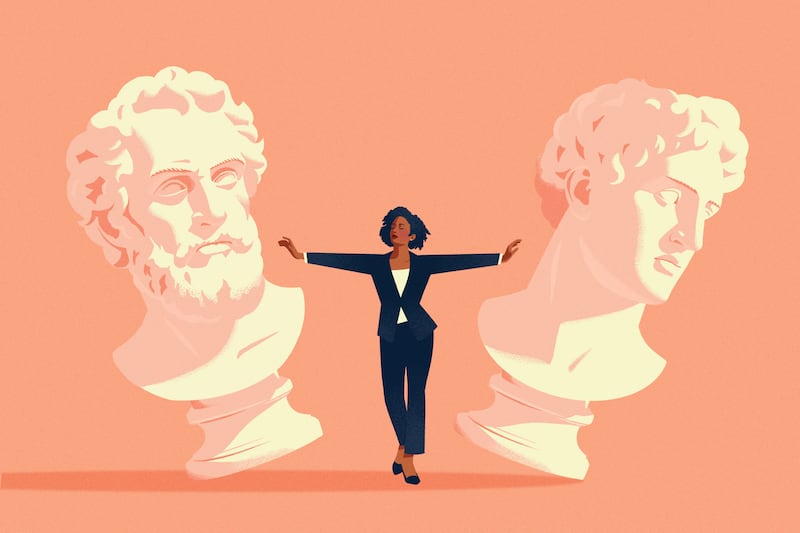

Scholar and author Camille Paglia has long taken women to task for their rhetoric about men. In a speech at the Seattle Public Library in 2017, Paglia said, “Women are well launched now. This reflex — snide put-downs of men that are everywhere — this has got to stop.” She went on to say that “feminists have to stop blaming men for their own unhappiness.”
Nearly a decade later, research from the Survey Center on American Life shows that the blame game is still going strong, at least among young Democratic women.
According to the center’s report, a majority of Democratic women under the age of 50 agree with the statement “the challenges that women face in society are in a great deal due to the behavior or actions of men.”
The youngest Democratic women, ages 18 to 29, were the most likely to agree with the statement, at 66%.
In contrast, a quarter or fewer of Republican women said that men are responsible for the challenges women face.
The findings show that there are considerable pockets of animosity toward men, even as women have overtaken them in college enrollment and may soon do so in professional and management jobs. (In 2023, 46% of all managers in the U.S. were women, up from 29% in 1980, according to Pew Research Center.)
This animosity isn’t limited to the U.S. The New Statesman reported earlier this year that 21% of British women had a negative view of men, while just 7% of men said they had a negative view of women. And these negative views are spilling into family life. Researchers at the American Enterprise Institute found that half of college-educated women “said they were single because they had trouble finding someone who meets their expectations, versus one-third of men,” Anna Louie Sussman wrote for The New York Times.
The “men ruin everything” ethos can be found on TikTok and other social media platforms, where young women blame men for everything from war to the death of Lindsay Clancy’s children.
“It’s not that they don’t care about white men. It’s that they actively hate them,” said Sasha Stone, a writer and podcaster who follows this trend.
But why do Democratic women, in particular, blame men for their problems? The theories range from the effects of feminism to critical gender theory in higher education to social media to President Donald Trump.
‘The anti-male’ party?
The anti-men sentiment is so prevalent that it’s been said that the Democratic Party has become “the anti-male party.” This has occurred as increasing numbers of young women align with the party.
According to Pew’s 2026 National Public Opinion Reference Survey, 66% of young women identify as, or lean toward, Democrats, compared to 44% of young men.
Writing on these findings in his newsletter “American Storylines,” Daniel Cox observed, “In 2026, nearly half of young men are Republicans, a greater share than identified this way in 2020, and only down slightly since 2024. Whereas for young women, Republican identity has plummeted.”
Cox posits that the presidency of Donald Trump has something to do with this, with different feelings about Trump driving women to the Democratic Party and men to the Republican Party. But both young men and young women express gender-related grievances, he says.
“In our recent survey of teenagers, we found that a majority of teen boys felt that girls received preferential treatment at their school. More girls today believe that the world is a perilous place, and that men are largely the reason why. These feelings of grievance may have completely legitimate origins, emerging through lived experiences or filtered through curated media channels, but they are also easily manipulated by self-interested politicians and online grifters,” Cox wrote.
The idea that men are making the world unsafe for women was put forth in one Facebook video in which a woman said, “War is just an extension of patriarchy.”
That said, there are plenty of men blaming women for their problems, too.
As Stephanie Slade recently wrote in The Wall Street Journal, a subset of men called “vitalists” complain about the “gynocracy,” the rule of women over men. Their “Bronze Age” beliefs get oxygen, Slade writes, “from the egregiousness of left-wing excesses” and the sense that heterosexual white men are no longer welcome “in academia and other loci of cultural power.”
But the second Trump administration has ushered in a new appreciation for conservative viewpoints in academia — Johns Hopkins, for example, is the latest university to say it needs more ideological balance — and it swept away DEI initiatives that at times resulted in discrimination against white men.
Because of that, many young Democratic women have the sense that Trump’s two terms as president turned back advances that women had made over decades, Stone, the writer and podcaster, said.
“I think when Trump won, it gave a permission structure for all the minority groups to decide that white men are the problem. They needed an oppressor and a villain, and they taught it in schools and they put it in movies,” said Stone, a former Democrat who came to support Trump because of her discomfort with extremists on the left.
Between Trump, the #MeToo movement, the “Great Feminization” and the internet, we’ve arrived at a place where it’s perfectly OK to talk about white men as the cause of war, poverty and all the problems stemming from capitalism, Stone said. “They say this freely on TikTok,” she added.
Mary Ziegler, a professor at the University of California, Davis, School of Law, said the trial of Lindsay Clancy (the Massachusetts woman accused of killing her three children), has become something of a Rorschach test, exposing gender divides. “People are looking at the same facts and seeing diametrically opposed things.”
To her, the center’s findings reflect the partisan divide, with Democratic women seeing men in positions of power passing laws they believe either don’t help, or actually hurt, women. Then there is the talk of repealing the 19th amendment. “There’s radicalization on both sides, and it creates a vicious cycle,” she said.
“I don’t think all women think all men are the problem, but I do think a more divisive politics is sometime pursued on the left and the right at times.”
A ‘much more selfish politics’
The data on blame comes from the Survey Center on American Life’s Civility and Morality Survey, which examined generational differences in attitudes on a wide range of subjects.
In interviews with 5,451 adults conducted in the summer of 2025, researchers found that 66% of Democratic women said that the challenges facing them are “a great deal due to the behavior or actions of men,” compared to 18% of Republican women. Among women ages 30 to 49, 54% of Democratic women and 23% of Republican women agreed with the statement.
The share of Democrats who agreed with the statement fell below 50% after age 50, but still outnumbered Republicans. Among those 50–64, Democrats came in at 47%, Republicans at 25%, and among those 65 or older, 48% Democrats and 16% Republicans.
Cox, the director of the Survey Center on American Life and a senior fellow in polling and public opinion at the American Enterprise Institute, has done a deeper dive into the Gen Z gender divide in his forthcoming book, “Generation Uncoupled.”
In an interview, he said that the book is not just about the political divide between young people, but the relational divide between genders, which is driven in part from people pursuing individual goals and interests rather than relational ones. In this mindset, Cox said, other people can be seen as less of an “avenue to live a good life” and more of a barrier to it.
In that worldview, men writ large can be seen as disposable, reminiscent of the quote that Gloria Steinem popularized, “A woman without a man is like a fish without a bicycle.”
At the same time, America has seen the rise of “a more selfish politics” with less emphasis on sacrifice, service and others, Cox said.
“It’s a really unique place to be. And for young adults growing up, for some of them, it’s all they’ve ever known,” he said. “Their political socialization was, in large part, Trump. Trump has been front and center in politics for a decade.”
Social media, where so much of the anti-men conversation takes place, can nudge both men and women into gender silos, resulting in what some call “gender polarization.” And Cox said that the research of Jonathan Haidt and others has established that “there is a fragility to this generation” that has been exacerbated by the increase in time spent alone.
“In the book, I talk about rising concerns about sexual assault among young women, expressed post-#MeToo, post-Trump 2016. For men, I talked to so many young men who are concerned about having their behavior, or anything they say, forever catalogued and posted online, that depicts them in the worst possible light.”
He added: “I think there’s this sense that there’s a lack of understanding, and so anyone is a potential threat. Our social interactions are increasingly removed from institutional context, where there are more established norms of behavior, more predictability about what you can expect from people. And that’s scary if you don’t have shared understanding of what you can expect from people.”
Social media, Cox said, has “effectively segregated the formative experiences of young people.”
Brad Wilcox, a senior fellow at the Institute for Family Studies, agreed.
“The digital revolution has divided the sexes, pushing young women to the left and young men to the right. Social media algorithms have fed young adults negative messages about the opposite sex. This negativity bias helps explain why so many young women feel aggrieved — disrespected and put upon — even as their relative status in education, the economy and the political arena is rising, not falling,” Wilcox said.
Social media also amplifies the angriest voices and mutes those who point out that societies work best when men and women work together.
As Valerie Hudson wrote for the Deseret News last year, “We don’t need or want a return to male dominance, and we don’t need or want female dominance in its stead. The obvious alternative is a sincere, meaningful, equal partnership between men and women, the two halves of humanity that constitute human societies and literally create the future of the species together.”
Cox said we are seeing one of the “downstream effects” of what Robert Putnam wrote about in his book “Bowling Alone,” which examined the effects of the loss of community in America.
“Your view of the opposite sex is informed, not by regular social interactions, like doing group projects or playing coed sports, but what you’re seeing online. And you’re seeing the very worst portrayal of human behaviors because it’s meant to agitate and provoke a response, but it also gives us a very skewed view of the world in the process.”
Ziegler, at the University of California, Davis, said it’s important to remember that a lot of this is driven by “keyboard warriors who make gross generalizations about men or women that they would never say if they had to say it to someone’s face.”
“And of course, the reality is, whether you’re conservative or progressive or independent or whatever, you’re not going to get anywhere politically without men and women.”