

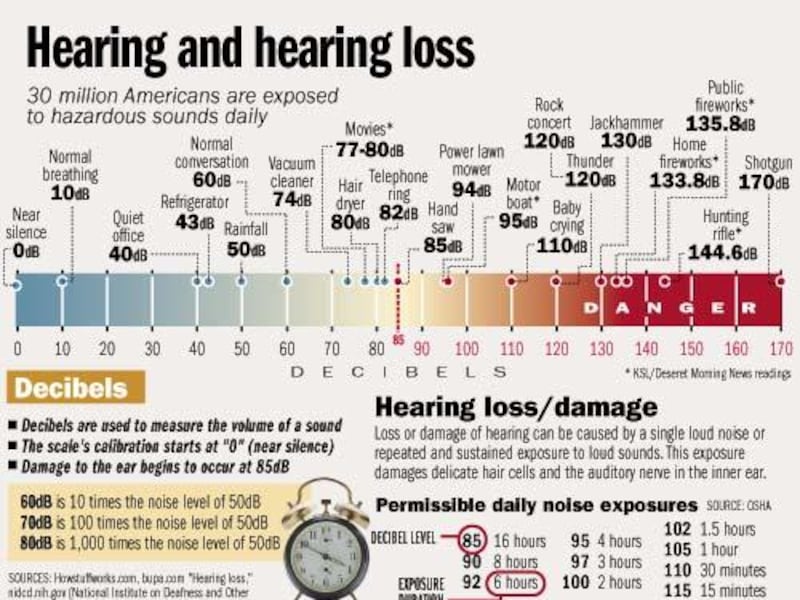
When the University of Utah's football team scores a touchdown, the roar of the crowd is as loud as an F-16 flying overhead. The fireworks display at the park produces, at times, the equivalent of a gunshot. And 15 minutes at a rock concert — or using a leaf blower — can reduce hearing permanently, although it may be too slight to notice it at first.
It's called noise-induced hearing loss. And it seems to be built into the American lifestyle.
"People just abuse their ears," said University of Utah physics professor Orest Symko, who teaches the physics of audio and video. "I have a feeling people all will eventually become deaf. . . . It's called evolution."
So-called age-related hearing loss may, in fact, be noise induced. Aboriginal tribes and folks in quiet areas don't lose any hearing over time.
Certain hearing loss is largely preventable, experts agree.
Recently, the Deseret Morning News and KSL-TV took "readings" of sound levels at popular entertainment venues, using equipment and expertise provided by the Rocky Mountain Center for Occupational & Environmental Health. We found many exceeded the 85 decibel threshold where prolonged exposure can cause damage.
A popular Salt Lake-area public fireworks display on the Fourth of July averaged 87 decibels (dB) over time and peaked for a split second at 136 dB, a level OSHA forbids in the workplace without hearing protection.
The movies "Cars," "The Fast and the Furious: Tokyo Drift" and "Poseidon" ranged from about 77 dB to 80 dB over time, with "Poseidon" hitting a split-second peak of 114.3 dB — about as loud as a rock concert.
A boat that seemed quiet maxed at 95 dB while pulling a skier.
A 3006 hunting rifle peaked at 144.6 dB — more than 10 times louder than what's called the pain threshold.
Utah-legal fireworks lit at home maxed at 101.6 dB, and for a split-second, 133.8 dB. Experts say illegal fireworks are louder.
Minimal exposure to movies, fireworks and boating probably isn't going to hurt you. But doing these types of activities — and many other ordinary tasks — often, or for long periods of time, could. And for some, a single gunshot blast can do damage. It's just hard to say who is susceptible until it happens.
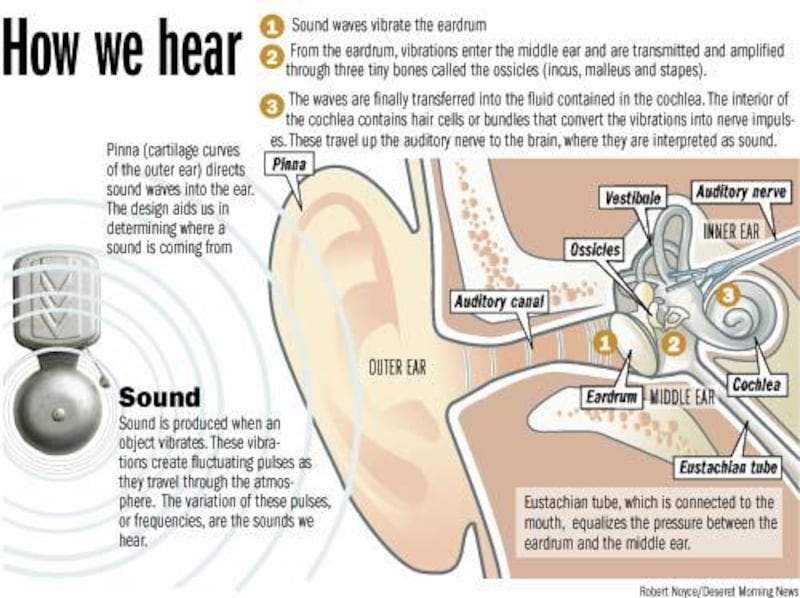
You have to understand hearing, the process that converts sound waves into electrical signals the brain translates as sound, to understand how it gets broken.
The eardrum and the three tiny bones in the middle ear amplify vibrations and carry them to the inner ear, where the bone nicknamed the stirrup sends them through a little opening into the fluid that fills the inner ear. The vibrations pass through that fluid in the cochlea, moving the tops of the hair cells located there, called a hair bundle, and sparking nerve impulses. Different sounds move the hair bundles in different ways, allowing the brain to distinguish between them.
Exposure to loud sounds damages both those sensitive hair cells and the hearing nerve. It's a process of destruction that can be kicked off by a single, loud impulse noise such as a gunshot or by too-long exposure to loud continuous noise. Think band saw. Or revving motors during a race. Or that ride on the power boat. Even a vacuum cleaner, used too long, can damage ears forever, depending on how loud it is.
Dr. Don Worthington, audiologist and director of the Intermountain Hearing and Balance Center, likens hearing damage to the path between friends' houses. Walk on the grass a couple of times, and the blades spring back up. But do it repeatedly, and the grass wears away.
Hearing experts say they can spot loss that's noise-induced by its pattern: Typically the high frequencies go first because the high-frequency hairs at the end of the cochlea are most susceptible.
Audiologist Alan Young said he's seeing the first signs in patients in their late teens and early 20s. Worthington says he diagnoses what will be a lifelong problem in lots of patients in their 30s and 40s.
Genetics also play a not well understood role in some hearing loss, audiologists say.
The Occupational Safety and Health Administration sets standards for how long someone can work in a noisy environment without ear protection. Damage is believed to start at 85 dB with daylong exposure. The louder things are, the less time you can safely be around them. At 100 dB, OSHA says you can't work more than two hours without hearing protection over the course of a day. Spend more than 15 minutes where the noise reaches 115 dB and you risk hearing loss. Interestingly, that's about where rock concerts fall on the noise-o-meter. And a loud explosion or the crack of a rifle close to the ear can cause instant, irreversible damage.
But the numbers are confusing. Decibel measurements are logarithmic, so pumping up the volume a few decibels brings exponentially more sound. A difference of 10 dB is actually 10 times louder. That means that a snowmobile, at 100 dB, is 10 times louder than a power mower at 90 dB. And a chainsaw or rock concert is 1,000 times louder than the power mower. Even heavy traffic — 85 dB — clocks in close to the danger level if you hear it for long periods of time.
Under OSHA, employees exposed to more than 85 dB — about as loud as a crowded restaurant — throughout the day must protect employees' hearing and manage their noise, said Rocky Mountain's Leon Pahler, assistant professor in the Department of Family and Preventive Health at the U. If it reaches 90 dB, employers must alter the work environment.
"It's the minimum the employer has to do, but the maximum this division can enforce," said Larry Patrick, Utah Occupational Safety and Health administrator.
There's some debate about where the floor should be set; OSHA uses 85 or 90 dB for different purposes. Audiologists, who care for damaged ears, use 85 dB. And they use 3-dB increments to estimate how long someone can safely be exposed to loud sound.
Based on federal safe-duration standards, people attending a rock concert, which may measure up to around 120 dB, can listen for only a few minutes without hearing protection if they want to keep their ears safe. But the government does not regulate sound levels for the public. OSHA deals only with work sites.
"For individuals and homes and hobbies . . . it's left up to the individual to maybe have an idea of their noise exposure and how to protect themselves," said Pahler. "Do people know when it's noisy? Yes. Do they do anything about it? Probably not."
If you leave a concert with a clogged feeling, muffled sound or ringing, "there's a pretty good chance it's causing damage to the inner ear," audiologist Young said. Some of it may be temporary and will resolve in a day or even weeks. But what's left after 60 days isn't going to get better. And the degree of loss that gets people's attention when they're older is quite likely a
matter of a little damage here and there adding up to a life-altering deficit, he said.
People aren't taking many precautions to protect their ears, either.
"It doesn't feel loud to me," said Andrea Webber, driver of the boat that maxed at 95 dB while pulling a skier. "When you're water-skiing, you're only in the boat while it's going, for like, five minutes at a time. You're not always sitting with that noise."
"I think about noise, usually if it feels loud, but I don't really do much about it unless it's extreme," said Jessica Greene, during Fourth of July festivities in Ogden. "I've never left some place because of it."
At the same celebration, a reporter sitting in the stands during the demolition derby tried to strike up a conversation with the woman behind her. "Do you worry about your hearing?" she asked loudly, pointing to her ears. The woman smiled and touched her earrings. "Thanks," she yelled. "My sister made these for me. I love them."
The National Institute on Deafness and Other Communication Disorders has a list of activities that can impair hearing, including target shooting and hunting, snowmobiling, riding go-carts, woodworking and playing with power horns, cap guns and model airplanes. Noisy devices include vacuum cleaners, garbage disposals, gas-powered lawn mowers, leaf blowers and shop tools.
Many people complain about the volume at which movies are played, but the reality is they're quieter than most people think. And movie trailers, traditionally viewed as louder than the flick itself, in two of three cases were softer than the movies were.
Stephen Pendrey, a projectionist at the local Megaplex theaters, said most movie houses follow a "very well set standard." Theater levels are set at 85 dB (over time) with a fader set at 7, to match the levels at which a movie was actually produced. "That way, you are hearing it as the producers intended and theaters nationwide are set to that level."
There's some variation, but it's usually in a downward direction, he said. Most of the local complaints are about the previews before the movies, which are recorded louder. Megaplex usually turns those down to about 75 dB, which may be why they came in softer than the feature films. And since the theaters went digital, "we've had fewer volume complaints than fingers on my right hand," Pendrey said.
Century theaters use a slightly less precise formula but also get few complaints, said Stephen Collins of the chain's corporate office. The sound level used "varies based on occupancy," since more bodies absorb more noise.
An F-16 flyover in Rice-Eccles Stadium registers 102 dB, said Mike Halligan, associate director for environmental health and safety at the University of Utah. A Utah touchdown registers at 101.7 dB — a noise level that includes the announcer's voice and screaming crowd when measured in the fourth-floor box seats.
"It's loud, but we don't always score touchdowns," Halligan joked. But his point is clear: You won't be subjected to a non-stop 102 dB at every game, just loud spurts.
It's hard to say whether people could hurt their ears at a fireworks show. Fireworks experts pay attention to sound when they create shows, with particular worries about eardrums and not breaking any windows in nearby buildings, said Ken Lantis, owner of Lantis fireworks.
"Part of the tradition of fireworks are the booms. Without them, we've had major complaints, because it's lacking something, no matter how pretty it was," Lantis said. "I would be very suspicious if someone came up to me and said, 'We were at one of your shows and we broke an eardrum.' I would say, there's probably no way . . . it would register that high."
But that doesn't mean fireworks are totally safe.
Fireworks and guns often were mentioned as the noise sources that caused hearing loss in a study conducted by Worthington, Dr. Patrick E. Brookhouser and master's degree holder William J. Kelly and published in Laryngoscope in June 1992.
A firecracker thrown through a car window exploded in a 14-month-old baby's ear, causing irreversible damage. Another boy suffered hearing loss after hunting and riding on dad's motorcycle repeatedly and compounded the problem by refusing to wear ear protection.
"That children as young as 14 months of age are sustaining irreversible noise damage to their auditory acuity is an alarming finding. Older youngsters who accompany parents on snowmobiles and motorcycles, or ride in 'boom' cars without ear protection are clearly at risk for noise-induced hearing loss," the study states. "Wearing a child-size motorcycle helmet or sitting in a safety seat in a boom car does not address an important health risk, namely, noise."
There has been a push to limit noise levels of children's toys. Specifications laid out by the American Society for Testing Materials in 2003 limit sound pressure to 90 dB on hand-held, table-top and crib toys when measured just under 10 inches away from the source. But those standards are voluntary.
Critics have targeted iPod personal stereo systems because people can play them far too loud. But you can regulate how loud yours goes with new software Apple introduced last spring. Or you can just use good judgment and keep the volume down, experts say.
Young tells patients with early signs of noise damage to "do everything you can to avoid the loud noise." Repeated exposures compound hearing loss.
He and Worthington both recommend that everyone invest in hearing protection, ranging from the cheap little foam inserts to a pair of electronic ear muffs, used at shooting ranges to boost soft sounds and muffle loud ones. Keep them handy and use them if noise is uncomfortably loud.
It's advice that Worthington wishes he'd followed.
"I used to be young and dumb at one time," he said, "and I used to hunt everything there was a season for, and I've got high frequency loss right now."
E-MAIL: lois@desnews.com; jtcook@desnews.com