

MEXICO CITY — Mexico's presidential election was too close to call Sunday, with a leftist offering himself as a savior to the poor and a conservative free-trader both declaring themselves the winner.
Officials said they won't know who won for days, raising fears of instability and violence.
Electoral officials said they could not project a winner, which they previously said would happen only if the leading candidates were within 1 percentage point of each other in a scientific sampling of votes.
Luis Carlos Ugalde, president of the Federal Electoral Institute, said an official count would begin Wednesday and a winner would be declared once it's complete.
President Vicente Fox appealed for calm, telling Mexicans that officials have "complete confidence that each one of our votes will be properly counted and respected."
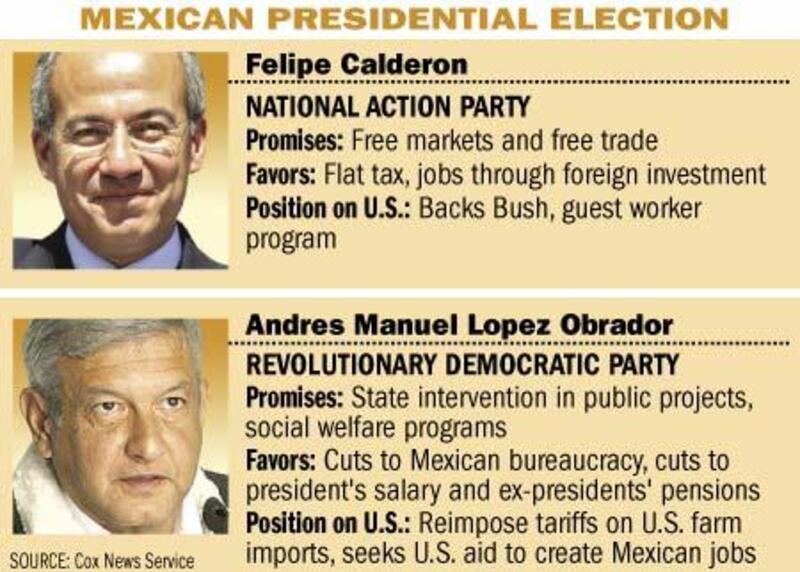
Leftist candidate Andres Manuel Lopez Obrador said he would respect the delay but went on to give a rousing speech about how he will carry out his presidency. "We will defend our victory," he vowed. "I want the Mexican people to know that our figures show we won."
Thousands of his Democratic Revolution Party supporters, waiting for hours in the cold rain in Mexico City's central plaza, began shouting "Fraud! Fraud!" when the delay was announced.
Across town, Felipe Calderon of the ruling National Action Party told his supporters that he would also wait but added: "We have no doubt that we have won."
A drawn-out period of uncertainty could rock financial markets and unsettle Mexico's maturing democracy.
Preliminary results posted by the electoral institute showed that, with 44 percent of polling stations counted, Calderon had 38 percent, Lopez Obrador 36 percent and Roberto Madrazo of the Institutional Revolutionary Party with 19 percent. Those results were tallied at polling stations and had yet to be certified.
The vote was the first since Fox's stunning victory six years ago ended 71 years of rule by the Institutional Revolutionary Party, or PRI, and it could determine whether Mexico becomes the latest Latin American country to move to the left.
Electoral officials said voting was relatively peaceful, although many voters complained polls opened late or ran out of ballots. Ugalde said only eight of more than 130,488 polling stations failed to open — the fewest in Mexico's history.
In Guerrero state, two poll workers were shot to death before the polls opened, according to Lopez Obrador's party. Electoral officials said they were investigating, but the killings appeared unrelated to the vote.
"We've had an exemplary election day, of which all Mexicans can be proud," Ugalde said.
Thousands of Mexicans living in the United States traveled by plane, bus and car to Mexican border cities to vote in Sunday's hotly contested presidential election.
The Mexican government set up 86 polling places along the 2,000-mile border, mostly for migrants who missed out on the country's historic absentee ballot campaign.
Across the border from San Diego in Tijuana, a sprawling city of more than 1 million people, out-of-town voters arrived Sunday by bus from Los Angeles and other California cities. Many said they made the trip because they received little information about how to request absentee ballots, lacked the correct voting card or did not fill out their applications correctly.
Maria Salome Rodriguez, a 38-year-old farm worker, drove eight hours with her husband from Fresno, Calif., and waited for two hours to vote at a polling booth outside Tijuana's airport. She and her husband decided to make the trip to the border after their applications for absentee ballots were rejected because they wrote down the wrong address.
"We want to vote so Mexico can improve and offer jobs to people here, because even though we're far away, our heart is still with our homeland," said Rodriguez, who declined to name the candidate she voted for.
Lawmakers approved a law last year to allow the estimated 11 million Mexicans living in the United States to vote by mail for the first time. But the effort was thrown together to beat electoral deadlines, and only about 32,632 absentee ballots from 71 countries were mailed to the Federal Electoral Institute.
Of those, 479 did not meet requirements and were rejected, electoral officials said.
In addition to Tijuana's regular polling centers for residents, 20 special centers were set up across the city for migrants as well as active-duty soldiers, factory workers and others who have come to the area recently from the interior of the country.
More than 24,000 observers were monitoring the vote, which also will determine three governors, Mexico City's mayor and both houses of Congress. The congressional races are key, determining whether the next president will face the same battle Fox did in trying to push through reforms.
Exit polls by the two major Mexican television networks showed Marcelo Ebrard of Lopez Obrador's party easily winning the Mexico City mayor's race, and Calderon's party holding on to Fox's home state of Guanajuato and the western state of Jalisco, where the race had been expected to be tighter.
In the third governor's race, Morelos, one poll showed Calderon's party slightly ahead, while the other said it was too close to call.
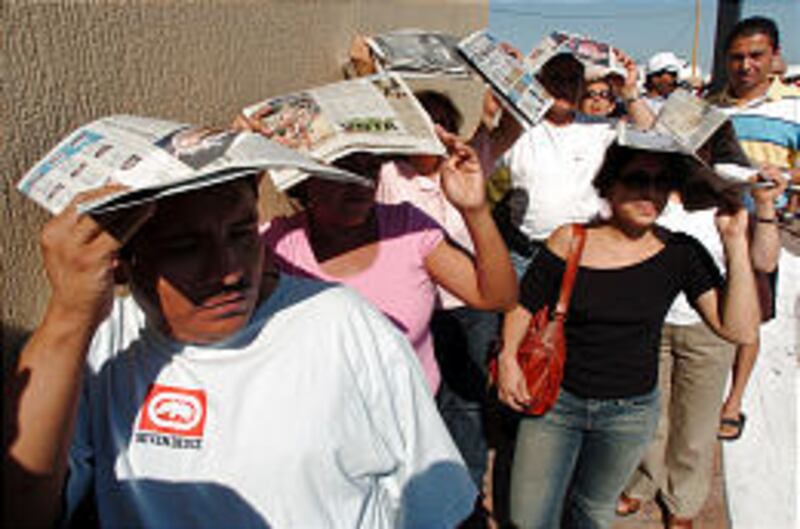
Voters waited in long lines during the day, some complaining that there weren't enough ballots. One group even briefly blocked a major Mexico City thoroughfare in frustration at being turned away. Several polling centers in southern Oaxaca state, the scene of violent clashes last month, did not open because of security concerns.
"We have not seen widespread problems, but we've seen a lot of confusion," said Ted Lewis, who was coordinating a team of 25 observers from the San Francisco-based Global Exchange.
After a six-month campaign marked by mudslinging and a polarized electorate, Mexicans greeted Sunday's vote with relief. "Finally, a decision!" read the front-page headline in the Reforma newspaper.
Carolina Nougue, 35, a perfume factory manager, sat frustrated outside a poll in an upscale Mexico City neighborhood. Nougue, who reluctantly voted for Calderon, described herself as a leftist but said she worried Lopez Obrador would govern like radical Venezuelan President Hugo Chavez, and was turned off by his pledge to put the poor first.
"The division isn't between the rich and the poor," she said. "It's between the ignorant people and those who think."
In Mexico City's Nezahualcoyotl slum, polls were delayed by flooding from a powerful hailstorm Saturday night. Juana Velasquez, 63, and other residents spent the morning bailing water from their homes before voting.
"Every year, it's the same. You just vote for someone who doesn't do anything," said Velasquez, who was casting a protest vote for Roberto Campa of the minor New Alliance Party.
Others simply refused to take part.
"We aren't going to vote," said protester Maria del Carmen, a 24-year-old student marching down Mexico City's Reforma Avenue with Zapatista rebel leader Subcomandante Marcos and hundreds of supporters. "We don't believe in the system, and we are going to show our strength."
Early riser Lopez Obrador, dressed in a brown leather jacket, was the first candidate to cast his ballot, and had to wait nearly an hour before volunteers were ready.
"We did our part," he said. "We are going to wait to see what the people of Mexico decide."
During his campaign, Lopez Obrador accused Calderon of catering to the rich and promised that he would govern for Mexico's 50 million poor. Many followed his message like a religion, crowning him with flowers at rallies and plastering cars with his slogan: "Smile. We are going to win."
Calderon has warned that Lopez Obrador's proposals, including handouts for the elderly and poor, would bankrupt the nation. Wearing a suit and tie, he showed his right palm before voting in Mexico City, a reference to his "clean hands" campaign slogan.
"It has been a tense, competitive campaign," he said. "Tomorrow, we have to start a new era of reconciliation."
Madrazo has painted himself as the alternative to the "radical left and intolerant right" — but many have questioned how long his party, which has suffered infighting and defections, would survive past the election.
Mexican law limits presidents to one term, and Fox plans to retire to his ranch in December after his successor is sworn in.
On Sunday, which happened to be his 64th birthday, Fox gave an ink-stained thumbs-up to prove he voted and said: "I know that there are no Mexicans who want to go against democracy."
About 71 million of Mexico's 103 million people were eligible to vote.
The estimated 11 million Mexicans living in the United States were allowed to vote from abroad for the first time, but the 32,632 ballots they cast weren't likely to make much of a difference.
Thousands who missed out on the new mail-in vote — including farm workers and construction laborers living in California — traveled to Mexican border cities on Sunday to cast their ballots at polling stations.
Contributing: Associated Press reporters Mark Stevenson, Will Weissert and Kara Andrade in Mexico City and Ioan Grillo in Villahermosa, Mexico.