

Some people don't mind leaving their work at the office; Detective Todd Park doesn't fit that profile.
"There's not a day that goes by when I'm not thinking about a case I'm working on," said Park, the lone cold-case detective for the Salt Lake County Sheriff's Office. "It's my job and I'm trying to give (victims') family members peace of mind."
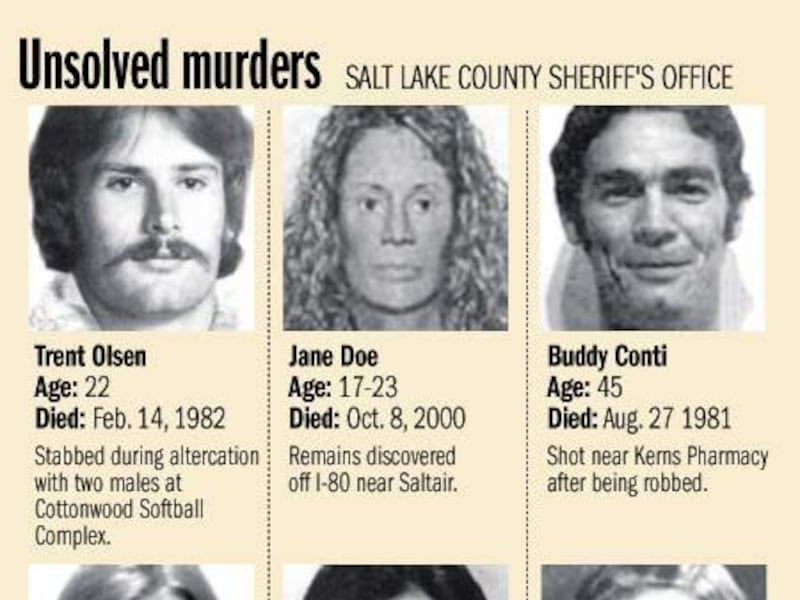
Park's beat encompasses 40 unsolved homicides throughout Salt Lake County over 32 years. The oldest crime is the May 25, 1969, murder of 47-year-old Robert Daly, while the most recent case is the slaying of 24-year-old Doris Anna Vasquez on Christmas Day 2001.
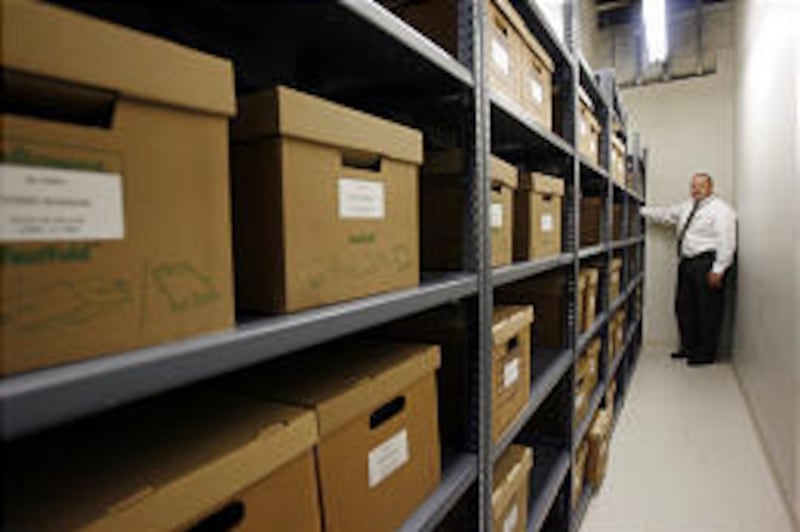
At present, Park has five unsolved-murder case files stacked beneath his desk. When Park isn't re-examining a case, it's kept in a box on a shelf in a storage room outside the Investigation Division. Forty boxes for 40 victims.
"It's kind of a juggling act and it's one of the frustrations of a cold-case guy," he said. "You need to concentrate on one cold case at a time — there's just so much to them."
Park doesn't have a specific, one-size-fits-all approach to investigating each cold case. If a new lead comes in, he'll reopen a case and see where the clue leads him.
"Once you follow up on a lead, it comes to other leads," Park said.
Or he'll re-examine a case at the request of a victim's family. Some family members call each anniversary of the death of their loved ones, he said.
"Those are heart-breaking calls," Park said. "You want to break the case, you want to bring it to a conclusion, but I can't work 40 cases at a time."
Two detectives were originally assigned to the Cold Case Unit in 2004 — Park and Det. Cord Skinner. But Sgt. Kris Ownby said the unit was reduced to just one detective due to budget constraints.
The number of cases is just one of the frustrations that muddles Park's job. Cold-case investigations are tedious. Since he wasn't on scene for the initial investigation, Park reads the case file — a folder that is usually several inches thick — an average of 10 times to familiarize himself with all the facts of the crime.
As he scans the information, Park focuses on the most minute of details. For instance, he doesn't just read or view a witness' answers in an interview, he also tries to get at why the witness said what was said. If it raises a red flag in Park's mind, he'll find the person to re-interview them.
There are myriad reasons why homicide cases go unsolved in the initial investigation. Officer Robin Snyder of the Salt Lake City Police Department said six of the last eight unsolved homicides in Salt Lake City since 2003 are drug-related. This makes it difficult to find witnesses who are willing to talk to police officers.
Park agreed some witnesses are unwilling to tell police everything they know because they either fear the perpetrator, or they might be protecting him. But as time passes, he said, tight lips tend to loosen.
"There's a whole host of reasons people talk now than years ago," Park said. "Maybe it's just their conscience."
Park also said new technologies weren't available to help investigators solve cases in yesteryears. Park has been able to close several cases due to witnesses opening up or because of advances in forensic technology.
Since his assignment to the Salt Lake County Cold Case Unit in 2004, Park's work led to arrests in several unsolved homicide cases including the slayings of Chris Mosier and Bryan Ruff. In the case of Mosier, 14, who was stabbed to death Dec. 30, 1993, investigators at the time identified several suspects, but they lacked sufficient physical evidence to make an arrest.
Nine years later, Park took the items tested in 1993 and used advanced DNA technology to retest them for more definitive DNA evidence.
With the help of local police, Park then tracked Terry Louis Johnson to Kansas City, Mo. Although Johnson would not confess to the crime, the interview helped Park establish a timeline that placed Johnson in Mosier's apartment when the murder occurred. The case came to a resolution more than a decade later in 2004, when Johnson was sentenced in 3rd District Court for five years to life in prison on a first-degree felony murder conviction stemming from the teenager's death.
In the more recent case, Park is credited with solving the murder of Bryan Ruff, 22, a Kennecott security guard who disappeared Dec. 10, 1991 from his guard shack. Campers found Ruff's body — still wearing his tattered uniform — in a shallow grave in July 1993 near Fairfield, Utah County.
Dale Bradley Jr., a former co-worker of Ruff, became a person of interest in the slaying last April. Park matched a 3-inch scuff of red paint found on Ruff's shoe with the paint on Bradley's 1974 Chevrolet Camaro. Park said the totality of the physical evidence and the latest testimony of Kristi Bradley, Bradley's first wife, helped him break the case.
"You just put it all together and look at the picture," he said.
Prosecutors charged Dale Bradley Jr., 37, in 3rd District Court with first-degree felony murder in September. A judge ruled in April there is sufficient evidence for Bradley to stand trial, which is slated to begin in January next year.
Despite all the frustrations that vex him, Park gets a good measure of satisfaction out of his job. He enjoys getting a good lead that "breathes life into a case," when charges are filed and when the final disposition comes in. But there's one satisfaction that outweighs all the rest.
"The ultimate satisfaction," he said, "is being able to tell the family that their family member's killer is caught and is doing jail time."
E-mail: jdana@desnews.com