

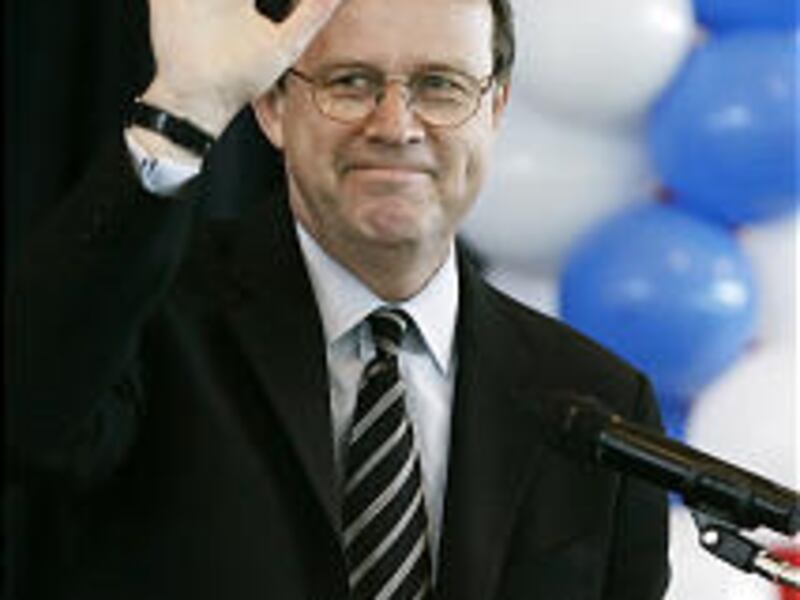
Wall Street is increasingly asking questions about Dell Inc.'s Kevin Rollins.
Since Rollins became chief executive in July 2004, the world's largest personal-computer maker by number of PCs shipped has hit a series of speed bumps. In the past five quarters, Dell has missed earnings and sales projections several times and posted disappointing financial results. On top of that, the company has grappled with poor customer service, personnel defections and the recall of 4.1 million laptop batteries that potentially could overheat and burst into flames. Overall, the Round Rock, Texas, company's once-robust stock is down about 60 percent since Rollins took over.
Now, Wall Street is openly wondering if the fault for Dell's woes lies with the chief executive. Some large institutional investors have sold Dell stock, including Fidelity Investments, Wellington Management Co. and OppenheimerFunds Inc., according to Securities and Exchange Commission filings.
"Clearly, (Rollins) has to take some responsibility," says Sunil Reddy, a fund manager at Fifth Third Asset Management unit of Cincinnati's Fifth Third Bancorp, which manages $22 billion. While Reddy says his funds don't own Dell stock, Fifth Third had about 442,000 Dell shares as of late June, according to SEC filings.
Andrew Neff, an analyst at Bear Stearns Cos., adds that Dell needs to get a "real sense of urgency. You're going to need that either from Kevin Rollins or his successor." And so far, Neff says, "you're not seeing that" from Rollins. The analyst rates Dell a "peer perform," the equivalent of "hold." Bear Stearns currently doesn't have an investment-banking relationship with Dell. Bear Stearns says Neff or someone in his household currently owns shares of Dell.
Neff notes that it often takes a chief executive change to get things back on the right track. He points to two examples: Hewlett-Packard Co. and Sun Microsystems Inc. Under former Chief Executive Carly Fiorina, technology giant H-P posted some inconsistent financial performances. Her ouster last year prompted a one-day 7 percent jump in H-P's stock. New H-P Chief Executive Mark Hurd has since launched a corporate restructuring, laid off nearly 15,000 employees and has beat Wall Street profit expectations for five consecutive quarters. Since Fiorina left H-P, the company's stock has risen about 75 percent.
Meanwhile, after Scott McNealy retired as Sun's chief executive this year, the company's stock also rose, notes Neff. McNealy's successor, Jonathan Schwartz, has since said the company will cut as many as 5,000 jobs. Sun recently posted a 29 percent jump in quarterly sales, its best quarterly sales performance since mid-2001. Sun's stock is down about 6 percent since McNealy left the chief executive post.
Rollins, 53 years old and a graduate of the Brigham Young University Marriott School of Management, appears to have retained support from at least one quarter, however: Michael Dell, who founded the PC company from his University of Texas dorm room in 1984 and remains an active chairman of the firm. In some recent comments to reporters, Dell said, "Kevin Rollins is an outstanding executive" and suggested that no imminent management change will take place.
"Michael Dell has clearly shown his support" for Rollins, says Bob Pearson, a Dell spokesman. Pearson adds that "98 percent of shareholders voted in favor of Kevin Rollins" at the company's last shareholder meeting in July. "The result speaks for itself."
This isn't the first time that a PC company has slipped after its founder left the helm. Apple Computer Inc.'s business languished for years after co-founder Steve Jobs was ousted from the company in the mid-1980s. Jobs returned to Apple in 1997. And PC maker Gateway Inc. also hit turbulence after its founder, Ted Waitt, retired from the chief executive role in 1999. By early 2001, Gateway's stock had slid 75 percent, compelling Waitt to return as chief executive.
Rollins appeared to have a better chance than most at sidestepping such turmoil. The onetime Bain & Co. consultant, who plays the violin in his spare time, worked closely with Michael Dell to devise strategy for Dell after joining the company in 1996. The duo have essentially shared an office since Rollins joined, and together helped guide Dell through the treacherous waters of the tech-stock bust earlier this decade. During those tough economic years, Dell outgrew the market while rivals such as H-P struggled.
It has been a different story since Rollins became chief executive. Last week, Dell not only announced the laptop-battery recall, but also reported a 51 percent drop in fiscal second-quarter profit. In contrast, H-P on Wednesday posted surging profits. While total revenue for both companies increased 5 percent, Dell's PC revenue rose 1 percent while H-P's PC sales climbed 8 percent, according to Sanford C. Bernstein data and H-P.
Analysts say Rollins hasn't helped his own case by articulating a clear turnaround plan. While Dell has made some moves — by pledging a total of $150 million to improve customer service, for instance — the company doesn't appear to have addressed deeper issues, such as its laggard position in selling laptops to consumers. Dell has pointed to its overseas growth and improving trends from studies in customer satisfaction and purchase preference as positives for the company.
"Dell's management has really struggled to find the right formula for them to sustainably gain share," says Toni Sacconaghi, an analyst at Sanford C. Bernstein. He rates Dell an "outperform," which is equivalent to a "buy."
Meanwhile, some Dell moves that Wall Street recently has applauded appear to have been spearheaded by Michael Dell rather than Rollins. In March, Dell bought Alienware Corp., a maker of high-end-videogame PCs, for an undisclosed sum, boosting the company's products for consumers. Dell has said that deal was pushed by Michael Dell.
"People have a lot of regard for Michael Dell," says Goldman Sachs & Co. analyst Laura Conigliaro, who last week downgraded Dell to "sell" from the equivalent of a "hold." "He's made a lot of strategic decisions for Dell recently that people generally have liked." Goldman has an investment-banking relationship with Dell. Conigliaro doesn't own any shares.
Ultimately, says Marty Shagrin, a research analyst at Victory Capital Management, "No one is happy (with Dell's stock price). ... At the end of the day, someone has got to fix the problem. If the person in charge doesn't fix them, then someone else will." Victory, with $58 billion under management, held around 10 million Dell shares as of the end of June, according to SEC filings.