


I first learned about the opioid crisis three presidential elections ago, in the fall of 2011. I was the domestic policy director for Mitt Romney’s presidential campaign and questions began trickling in from the New Hampshire team: What’s our plan?
I was the domestic policy director for Mitt Romney’s campaign and questions began trickling in from the New Hampshire team: What’s our plan?
By then, opioids had been fueling the deadliest drug epidemic in American history for years. I am ashamed to say I did not know what they were. Opioids, as in opium? I looked it up online. Pills of some kind.
I was no outlier. America’s political class was in the final stages of self-righteous detachment from the economic and social conditions of the nation it ruled. The infamous bitter clinger and “47 percent” comments by candidates Barack Obama and Romney, respectively, captured the atmosphere well: delivered at private fundraisers in San Francisco in 2008 and Boca Raton, Florida, in 2012, evincing disdain for the voters who lived in between. The opioid crisis, which claimed nearly 22,000 lives in 2012, gained more attention in the years after the election.
Of course, 2015’s most notable political development was Donald Trump’s presidential campaign launch and subsequent steamrolling of 16 Republican primary opponents committed to party orthodoxy. In the 2016 general election, he narrowly defeated the former first lady, senator and Secretary of State Hillary Clinton, who gleefully classified half of the voters who supported Trump as “deplorables,” as her audience laughed and applauded. That year saw more than 42,000 deaths from opioid overdoses.
In a democratic republic such as the United States, where the people elect leaders to govern on their behalf, the ballot box is the primary check on an unresponsive, incompetent or corrupt ruling class. If those in power come to believe they are the only logical options, the people can always prove them wrong. For a frustrated populace, an anti-establishment outsider’s ability to wreak havoc is a feature rather than a bug. The elevation of such a candidate to high office should provoke immediate soul-searching and radical reform among the highly credentialed leaders across government, law, media, business, academia and so on — collectively, the elites.
The response to Trump’s success in 2016 and again in 2024, unfortunately, has been the opposite, with most elites doubling down. We have not failed, the thinking goes; we have been failed, by the American people. In some tellings, grievance-filled Americans simply do not appreciate their prosperity. In others, they are incapable of informed judgments, leaving them susceptible to demagoguery and foreign manipulation. Or perhaps they are just too racist to care — never mind that polling consistently suggests that most of Trump’s supporters are women and minorities, or that polling shows he is attracting far greater Black and Hispanic support than prior Republican leaders.
Trump is by no means an ideal tribune of the popular will, especially considering his own ongoing efforts to defy it after the 2020 presidential election. But the nation, given full opportunity to assess that conduct, voted him back into office. Somehow, the response of elites to that humiliating indictment of their leadership is a redoubled obstinance: Democracy itself is at stake, they lecture, even as they pursue plainly anti-democratic strategies.
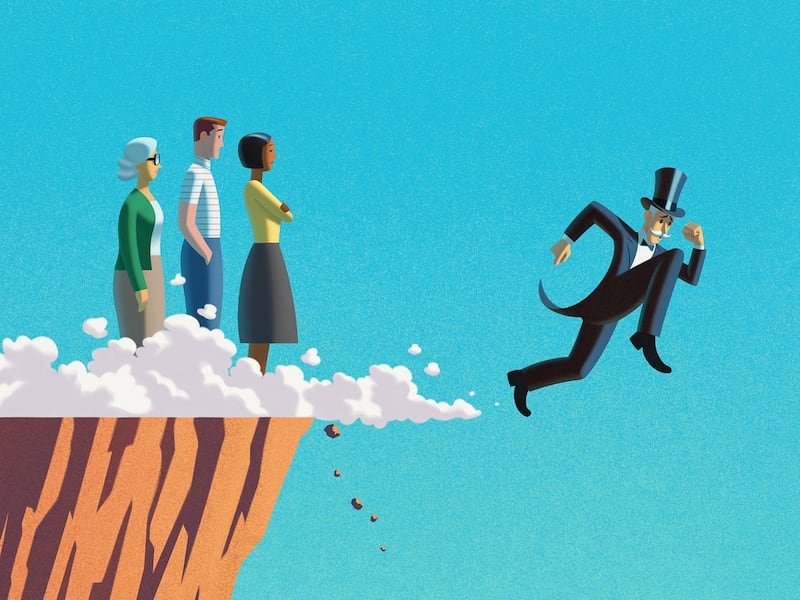
The result is a shockingly irresponsible national game of chicken. Barreling from one side are elites who remain fully committed to their own preferences and pulling the levers of power for their own benefit. Barreling from the other are ordinary people, the majority of Americans, who reject elite preferences but feel unable to assert others, except through the last resort that democracy affords them. Both sides are honking as loudly as they can.
The people do not pull to the side, nor should they. “The administration of the government, like the office of a trustee, must be conducted for the benefit of those entrusted to one’s care, not of those to whom it is entrusted,” observed Cicero more than 2,000 years ago. Anyone worried about the future of American democracy should be concerned foremost with the elites’ bizarre belief that the road is theirs. This is the root cause of present instability and poses the most serious long-term threat to the republic.
The Constitution is designed to bend without breaking regardless of any one election’s outcome. It has done so before and it will do so again. In words widely attributed to James Madison, “dependence on the people is no doubt the primary control on the government; but experience has taught mankind the necessity of auxiliary precautions.” Thus the separation of powers, the checks and balances, the countervailing state and federal power. But no system can save a nation from a ruling class so unresponsive that it would choose to accelerate toward political collapse.
Community over individual priorities
Taking the majority’s preferences seriously, even when they conflict with the preferences of more sophisticated experts, is often disparaged as populism. But while elected officials and their technocratic advisers may have special insight into how the people’s goals are best achieved, only the people can determine what those goals should be and whether they are being met.
Wages for the typical worker have stagnated for decades, and research I conducted at American Compass has found that the typical worker no longer earns enough to provide middle-class security for a family. We also found that only around 1 in 5 young Americans makes the transition smoothly from high school to college to career, and for young men the figure is lower still. The anti-poverty scholar Scott Winship has shown that for men ages 25 to 29, inflation-adjusted median earnings and compensation were lower in 2020 than they were 50 years earlier.
Measured in flat-screen televisions owned, healthcare treatments received and calories consumed, Americans have been on an upward trajectory. But while popular media often translates the American dream as being better off than your parents in materialistic terms, polling conducted by American Compass in partnership with YouGov indicates that Americans between 18 and 50 were more than twice as likely to say “earning enough to support a family” is what’s most important. Related, our polling has found that the vast majority of American parents consider “being able to support your family on one parent’s income” to be an important or essential marker of middle-class life.
No system can save a nation from a ruling class so unresponsive that it would choose to accelerate toward political collapse.
Note the contrast with the small cohort of upper-class Americans with college degrees and the highest incomes, who see the American dream more in terms of going as far as their talents and hard work take them than as either supporting a family or even getting married and raising children. They prefer having both parents work full time and using paid childcare full time, and regard the chance for their children to pursue postsecondary education that would offer “the best possible career options but was far from home” as more desirable than one that would offer “good career options close to home.” All other groups said they preferred the latter.
The same pattern repeats itself on issue after issue. While policy initiatives so often seek to maximize efficiency and growth, move people to opportunity and redistribute from the economy’s winners to the losers, the typical American has an attachment to place, a focus on family, a commitment to making things, and would accept economic trade-offs in pursuit of those priorities.
Public education devotes disproportionate resources to getting students into and through college as compared to the other pathways most ultimately take. But an American Compass survey found that American parents say nearly 3 to 1 that the more important task should be to “help students develop the skills and values needed to build decent lives in the communities where they live,” compared with helping students “maximize their academic potential and pursue admission to colleges and universities with the best possible reputations.” Most would prefer to have their children offered three-year apprenticeships that lead to good jobs over full college scholarships.
Another American Compass poll found that Americans agree by 10 to one that “we need a stronger manufacturing sector,” most often because it “is important to a healthy, growing, innovative economy.” Asked to choose, most say they would much rather pay higher prices to strengthen domestic manufacturing than to combat climate change. Only the upper class was evenly split on this question. Is America a “nation of immigrants”? Perhaps. But while most Americans believe that immigration is a good thing for the country, at no time on record have more than around one-third wanted to increase immigration levels; support for decreasing the level is almost always much stronger.
The important feature of all these preferences is that they are inherently valid. No set of facts or statistical analyses, to which an expert might have superior access, overrides what people actually value and what trade-offs they would choose to make. Leaders might seek to shape public opinion and alter preferences — indeed, that is part of leading — but they must yield to the outcome. Their obligation is to pursue the community’s priorities, not their own.
Looking beyond preferences of the elite
The promise — and necessity — of the more populist mode of economic policy gaining momentum in the United States is that it chooses differently on immigration, education, family, employment, business regulation and other fronts. Trump himself represents that movement imperfectly, and most often just by rejecting the old regime. Like an earthquake triggered by the shifting tectonic plates of American politics, he disrupted a great deal. And in shaking existing structures to their foundations, he exposed and collapsed those that were outdated or poorly constructed. But his manner is not that of a rebuilder.
Two threads run through more populist, conservative economics, and they offer the best hope of rebuilding a capitalism that first and foremost serves the prosperity, liberty and security of the American people. The first thread is creating productive markets, which starts with an acknowledgment that many are anything but. The key to capitalism, as Adam Smith observed with his metaphor of the invisible hand, is that private actors pursuing their own self-interest can behave in ways that advance the public interest as well. But this holds true only if the activities that yield the greatest profit are also ones that yield broad benefits. Smith was quite explicit: For the invisible hand to work, the capitalist must prefer “the support of domestic to that of foreign industry” and “direct that industry in such a manner as its produce may be of the greatest value,” which would also “give revenue and employment to the greatest number of people of his own country.”
The typical American has an attachment to place, a focus on family, a commitment to making things, and would accept economic trade-offs in pursuit of those priorities.
Those are substantial constraints, which modern economists managed to miss. When larger, easier profits can be achieved by offshoring production to countries that exploit workers or bringing foreign workers who will accept lower wages into the country, corporations will do just that. When the highest compensation goes to Wall Street speculators and the developers of addictive social media algorithms, the most promising business leaders will pursue those careers. What share of Ivy League graduates bring their talents to vocations that will improve the productivity, and with it the earning potential, of anyone without a college degree, or create booming new businesses in struggling regions? It should be no surprise that the productivity growth necessary for rising wages has slowed and, in manufacturing, turned negative, that the longtime pattern in American economic development of poorer areas catching up with richer ones no longer holds.
The tragedy, but also the good news, is that these trends are not inevitable. They represent foolish policy choices, which means we can choose differently. Instead of the globalization that casts aside workers like unsold inventory and hollowed out communities, we can structure our trade and industrial policies to ensure the path to profit runs through domestic investment that creates productive jobs throughout the country. Instead of allowing migrants to enter the country illegally and employers to exploit them, we can enforce our laws rigorously and further restrict entry into the labor market’s low end, forcing employers to offer good, highly productive jobs to American workers instead of undercutting them.
In the financial sector, deregulation, tax and bankruptcy laws, international agreements, and the mismanagement of public pensions have all encouraged the smart money and top talent to gravitate toward manipulating and trading piles of assets rather than building anything.
Capital markets that once served to deploy the nation’s accumulated wealth broadly now extract value from enterprises and communities to reaccumulate it in narrow enclaves. The financial sector keeps growing, salaries and profits keep rising, and yet my research has shown that actual investment has been weakening. This is not the capitalism that any coherent economics would celebrate. Some leaders on the right have now joined those on the left in arguing that its excesses must be discouraged, regulated, taxed and perhaps banned.
The second thread that runs through this new conservative economics is supporting communities. People rely on the institutions around them, beginning with their families, to form them as productive citizens, to help them build decent lives and to prepare them to raise children of their own.
But it is the Americans most in need of supportive communities who are often least likely to have them. The elite conception of support for families tends to be paid leave and childcare subsidies that push toward the career-optimizing and GDP-maximizing arrangement of all parents in the workforce. Proper family policy, as a range of Republicans have now proposed, would provide funds directly to working families to help with the cost of raising children and let them arrange their lives as they themselves prefer. Public education, likewise, would focus less on filling the high-school-to-college-to-career pipeline that benefits so few and more on improving the range of pathways that most people travel.
Another key institution is the labor union. Organized labor can be a vital force for giving workers power in the labor market, representation on the job, and support in the community. Unfortunately, in the United States, the labor movement now often operates as a force for progressive political activism unrelated to the priorities of most workers. Some conservatives are making progress by working directly with less partisan unions and proposing alternative forms of representation that might put worker representatives on corporate boards or encourage industrywide bargaining rather than company-by-company fights.
These trends are not inevitable. They represent foolish policy choices, which means we can choose differently.
In 2023, the United States saw nearly 80,000 deaths from opioid overdose. Other forms of drug overdose are climbing faster: Fatal cocaine overdoses rose sixfold in the past decade, to 30,000. Psychostimulant deaths rose tenfold, to 36,000. All told, the rate of drug overdose deaths in the United States is now similar to the average death rate from alcohol use disorders in Russia during the decade after the Soviet Union’s collapse.
Are American elites capable of seeing beyond their own preferences? Can they admit that what they value is not what’s best for everyone — shoddily constructed rationales notwithstanding? Their moment of decision — like an oncoming car — feels like it is fast approaching. The off-ramp is available, but only they can decide to take it.
Excerpted from “The New Conservatives: Restoring America’s Commitment to Family, Community, and Industry” by Oren Cass, available now wherever books are sold. Copyright © 2025 Oren Cass. Printed with permission of the publisher, Radius Book Group. All rights reserved.
This story appears in the June 2026 issue of Deseret Magazine. Learn more about how to subscribe.