

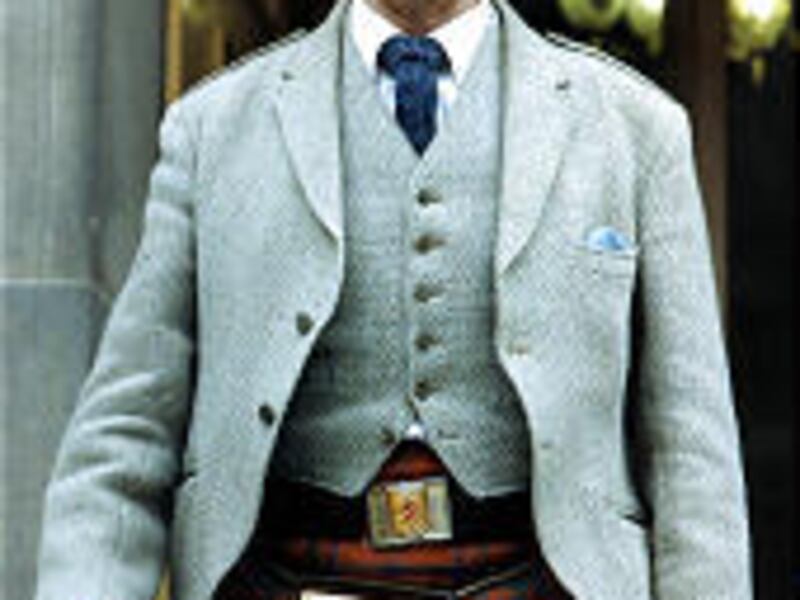
EDINBURGH, Scotland — In days of yore, clan chiefs ruled rugged swaths of Scotland as their fiefdoms, collecting taxes, calling men to arms, and deciding land disputes.
These days, clan chiefs get little more than a coat of arms, a motto, and a personal tartan for kilts — although the title does carry considerable prestige.
But that didn't stop Ranald MacDonald from waging a bitter two-decade-long court battle to be named chief of Clan MacDonald of Keppoch — a title that has been dormant since 1848 when the 21st chief died without a male heir.
Persistence paid off for the 75-year-old MacDonald: The Highland clan installed him as its leader on Wednesday.
"The record has been set straight," the retired hearing aid specialist told The Associated Press. "That is the point."
MacDonald's claim was contested by clansmen who claim that his ancestor, Alexander MacDonald, was born out of wedlock in 1832 and corrupted the bloodline.
Rory MacDonald, a historian of the Keppoch clan that is a branch of the larger Clan Donald, said many clansman will continue to refuse to recognize MacDonald as their leader.
"You cannot become clan chief without the acceptance of your clan. We will not recognize this," he said.
But Hugh Peskett, an expert on Scottish heraldry and editor of the Scottish edition of Burke's Peerage, said the matter has been settled beyond any doubt.
While investigating MacDonald's claim, he looked at old papers at the New Register House in Edinburgh, which has public records dating to the 1550s. The genealogist was able to trace MacDonald as a direct descendant of Donald Gorm MacDonald of Inverroy, who was the fourth son of Alistair Buidhe, the 14th chief of the MacDonalds of Keppoch.
"This case is proven," Peskett said. "I do not think any chiefship has been so soundly tested in the courts for a long, long time. But there are people who do not like the decision by the court. This is just sour grapes by bad losers."
MacDonald's case rested on the concept of "sloinneadh" (pronounced SLO-ny-ug) — a Scottish Gaelic word referring to the genealogy of the male line handed down orally. Peskett said he tracked MacDonald's birthright through an old woman who had lived in clan territory all her life and had carried on the oral tradition of keeping local history alive.
The court case wasn't quite as simple, however.
It began in 1986 and twice went before the Court of the Lord Lyon, Scotland's heraldic tribunal. From there it went to the Court of Session in Edinburgh. In 1990, the Lord Lyon ruled against MacDonald on the grounds that his ancestor was an illegitimate child. MacDonald appealed, presenting further evidence in 1995, but again lost. He was then able to take his case to the Court of Session, and in 2004, the judges said sloinneadh could be relied on to prove MacDonald's heritage.
There are 247 clans in Scotland — half of which don't have a chief. Clan disputes are notoriously fierce and have often ended in bloodshed in years past.
In the 17th century, Alexander MacDonald, chief of the MacDonalds of Keppoch, and his younger brother Ranald were stabbed to death by rivals seeking to usurp the title. Their murderers were hunted down and beheaded.
The MacDonalds of Keppoch — whose motto is "By Land And Sea" — were the first clan to rally to the Scottish Jacobite cause that sought to restore the Stuart kings to the thrones of England and Scotland. Hundreds of members of the clan, including the chief, were wiped out at the Battle of Culloden in 1746 when the uprising was crushed by forces of the Duke of Cumberland.
Although their role in Scottish society has been marginalized, many look at family bloodlines with pride.
"Clan societies give a sense of belonging to something in the past — a sense of identity," said Roddy Martine, a social commentator and author of "Scottish Clan & Family Names, Arms, Origins & Tartans." "That is presumably the reason why over 15 million people in the USA claim Scottish descent."
MacDonald was presented with a parchment from the Court of the Lord Lyon, which officially recognizes him as the clan chief. He was given the parchment by Sir Crispin Agnew of Locknaw, a member of the Lyon Court for the Rothsay area of Scotland.