

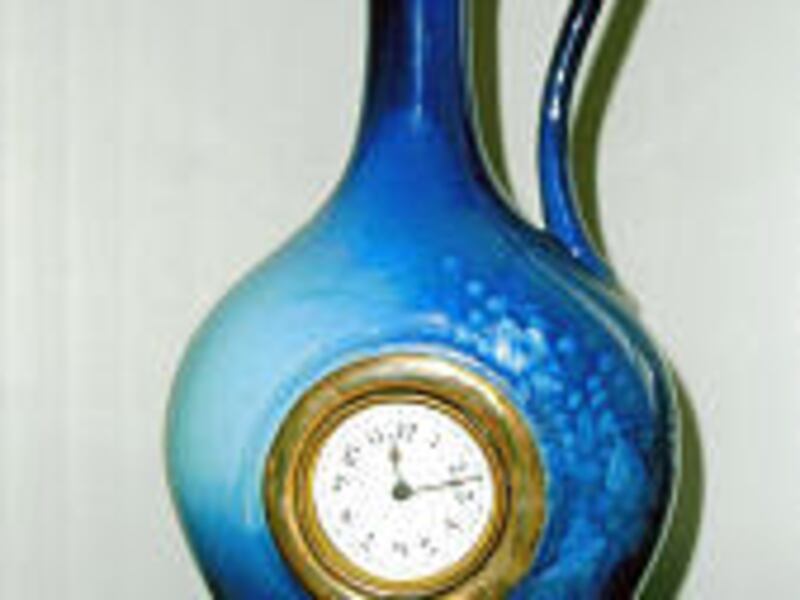
Dear Helaine and Joe: Impressed on the bottom of this piece of pottery is "Louwelsa Weller 626." Could the word "Louwelsa" be the name of the piece? It is 13 1/2 inches tall and the clock works. Is it possible for you to give me some information on my piece? — PLP, Joliet, Ill.
Dear PLP: We have discussed the Weller Pottery of Zanesville, Ohio, before, so we will keep the history of the company to a minimum.
There is no doubt that Samuel A. Weller was an entrepreneur — but there is also no doubt that he was somewhat ethically challenged. He opened a pottery in Fultonham, Ohio, in 1873 (some say the year was 1872), where he made ordinary flowerpots he slathered with paint and peddled door-to-door in nearby Zanesville. Weller prospered, and in 1882 he opened a showroom in Zanesville. That was followed in 1888 with a new pottery making facility in that city.
In 1884, Laura A. Fry of the famous Rookwood Pottery in Cincinnati developed a process that applied glaze using an atomizer (some say an "airbrush"). This process allowed for subtle shading in the background areas, with the major decoration done with colored slip (liquid clay) painted on by hand.
Around 1889, William A. Long of Steubenville, Ohio, perfected a similar glaze in the backroom of his pharmacy that could compete with the Rookwood product. Long and partners formed the Lonhuda Pottery and went into production in 1892. That same year, Laura Fry joined the firm and allowed Lonhuda to use her atomizer process.
Weller saw Lonhuda pottery and Laura Fry's process at the Chicago Colombian Exposition of 1893 and somehow persuaded Long to move his operation to Weller's new factory in Zanesville. That was the proverbial spider inviting the fly into his parlor.
Production of Lonhuda, which was a shaded, high gloss brown ware with underglaze slip decoration, began in 1895, but Long and Weller parted ways less than a year later — some say because Long had taught Weller all he needed to know about how to make the ware without any help.
In any event, Weller named his high gloss brown pottery "Louwelsa," which was a name taken from the first three letters of his daughter Louise's first name coupled with the first three letters of Weller's last name and finished off with Weller's initials — S.A. Louwelsa was made in relatively large quantities until about 1924. The vast majority of it is high gloss and brown — but there are at least two important variations.
One is a matte glazed Louwelsa and the other is a blue glazed Louwelsa. Of the two, the matte Louwelsa is the rarer, but blue Louwelsa is very uncommon and can be rather pricey. It should be noted that the brown Louwelsa decorated with flowers is very easy to find, and right now the pieces are not in favor and so the prices are soft.
PLP's ewer-shaped item with the clock in the center is a very special piece of blue Louwelsa and, at 13 1/2 inches tall, it is considerably taller than most pieces of blue Louwelsa that turn up. We wish the slip decoration were a bit stronger, but the floral design is nicely done.
The insurance replacement value for this circa 1905 piece of Weller blue Louwelsa is $3,000 to $3,500.
Helaine Fendelman and Joe Rosson are the authors of the "Price It Yourself" (HarperResource, $19.95). Questions can be mailed to them at P.O. Box 12208, Knoxville, TN 37912-0208.