



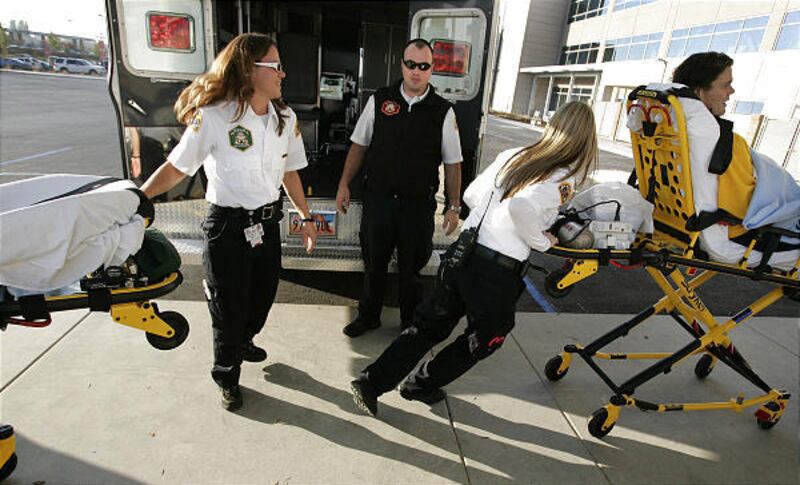
MURRAY — The new Intermountain Medical Center in Murray opened today with the first emergency-room patient arriving by ambulance at 6:18 a.m. and two expectant mothers in labor by 9 a.m. and its first baby — a girl — born at 11:56 a.m.
Outside, LifeFlight helicopters ferrying intensive-care newborns being transferred from LDS Hospital swooped in low across State Street to the helipad on the east side of the new hospital complex.
On the ground, a steady stream of Gold Cross ambulances brought patients from LDS in a well-rehearsed transfer operation that will see 158 patients shuttled to the new hospital during the day.
Transfer patients began leaving LDS Hospital just before 6 a.m. in trips spaced 10 minutes apart to avoid congestion as the ambulances made the route along I-15 to the new medical campus, located just west of State Street off 5300 South.
The first helicopter arrived just after 6 a.m. carrying triplets Natalia, Conner and Janessa Nagel. Their father, Paul Nagel, was on hand with a camera, watching the helicopter's pre-dawn arrival. "It was pretty exciting," he said. "I got here just before 6 o'clock and took a picture of them coming in on LifeFlight."
Several sets of twins also made the helicopter trip together; other babies from LDS' critical care nursery arrived at the new hospital one at a time.
Cottonwood Hospital staff delivered that hospital's last baby this morning and then began shutting down the hospital's women's center for good. Mother and baby were then transferred to the new medical center.
David Grauer, administrator of the new medical center, greeted patients at the door as the flights and ambulances began arriving just after 6 a.m. He and others on the staff of the new hospital were quite emotional as the massive hospital complex came to life with the arrival of its first patients. Grauer said that emotion was expected. "This has been a very powerful morning so far."
By the end of today, a total of 158 transfer patients were expected through the east doors of the new hospital campus, said IHC spokesman Jess Gomez.
Cardiac patient Glenna Quigley Baker was one of the first patients transferred from LDS Hospital this morning. She said the staff at LDS awoke her a little before 6 a.m. A short ambulance ride later, nurses were tending to her in a private patient room at the new medical center. "I'd heard how beautiful the facility is, and now I know," she said.
Families of the incoming babies took turns lining up for pictures just off the helipad. Chris and Shantel Conradi of Bountiful said hospital staff gave them a tour of the new facilities several days ago then called this morning to tell them when their baby girl, Capreis, was scheduled to arrive. Jet wash from the arriving helicopter blew tears from their cheeks as they photographed Capreis' arrival.
"I was supposed to deliver here," Shantel said, "in December." But Capreis instead was born eight weeks early at LDS Hospital, which put the family among the group making today's transfer.
On top of the flurry of activity transferring patients, the new medical center is still an active construction site where the number of workers wearing hard hats rivals those wearing scrubs. From inside one of the visitor elevators, the view changes dramatically each time the doors open and close.
A polished, inviting lobby comes into view as the elevator doors open on the ground level. Up a few flights, the opening doors are blocked by a worker troweling cement just outside. Landscapers and other tradesmen surround the outside of the complex.
Across 5300 South, Murray High School was quiet because of the UEA holiday. School administrators concerned about the additional traffic the new medical complex will bring began announcing the hospital activation to students last week.
Grauer said he was glad the rush of helicopters and ambulances was not competing with school traffic today.
LifeFlight finished its runs from LDS Hospital about 2 p.m. then moved itself — transferring operations to the more centrally located medical center in Murray. LDS Hospital will continue to have an emergency room, but Intermountain Medical Center will be IHC's premier trauma center.
Ambulances finished shuttling patients from LDS Hospital about 3 p.m. and then shifted their attention to Cottonwood Hospital, moving 37 patients. Unlike LDS, which will remain open as a community hospital, Cottonwood is now closed; only The Orthopedic Specialty Hospital and doctor's offices in the high-rise connected to the hospital remain open.
The Intermountain Medical Center is actually five different centers, each focusing on a particular area of care, placed mostly side-by-side on a sprawling, 100-acre campus. The $560 million facility has been 10 years in the making, according to H. Gary Pehrson, chief executive officer of Intermountain's Urban Central region, who has overseen the project since its inception.
IMC includes a women's and newborn center, heart-lung center, patient tower and trauma facilities, outpatient center and cancer specialty center. It has a central lab, its own utility plant and an education center. There's a TRAX stop a few hundred feet west of the centers.
Its opening marks the end of a long era. LDS Hospital, long the flagship of Intermountain Healthcare's hospital network, now becomes a community hospital. Cottonwood is now officially closed, although The Orthopedic Specialty Hospital and a physician's office tower will remain.
It's unusual, Murray said, in that most hospital moves involve transferring patients from one facility to a new one nearby when a hospital opens. But because this move involved two other hospitals and some distance, it is more complex.
They are relying on about 125 hospital employees, 30 LifeFlight team members, 65 Gold Cross ambulance employees and 40 people from Allied Hospital Service, a professional medical equipment mover. But they couldn't have done it without about 150 community volunteers directing traffic in the new facility, manning elevators and generally trying to help smooth the transition for patients and their families.
Intermountain chose to place the buildings near, but mostly separate from each other — they are connected on one level and share a long utility tunnel that moves essentials like steam and soft water. Each center has its own parking area and a separate look and feel.
Grauer said recently that the design itself promotes healing, with nice add-ons such as fountains and a labyrinth.
The new center is home to some of the latest technology, including two linear accelerators, the new-generation gamma knife — it removes a brain tumor without incision — digital mammography and a room-sized hyperbaric chamber. Patients and the public have separate hallways and elevators, patient rooms are private with a fold-out sofa so a family member can stay over and the entire medical center is wireless.
The newborn intensive care has been completely redesigned, as well, to ensure a tranquil setting. And in the emergency room, trauma and less serious injuries won't compete for staff time; they each have their own dedicated staffs.
The hospital was built to San Francisco-code earthquake specifications and designed by architectural firm Anshen and Allen, which is located there.
E-mail: sfidel@desnews.com; lois@desnews.com