

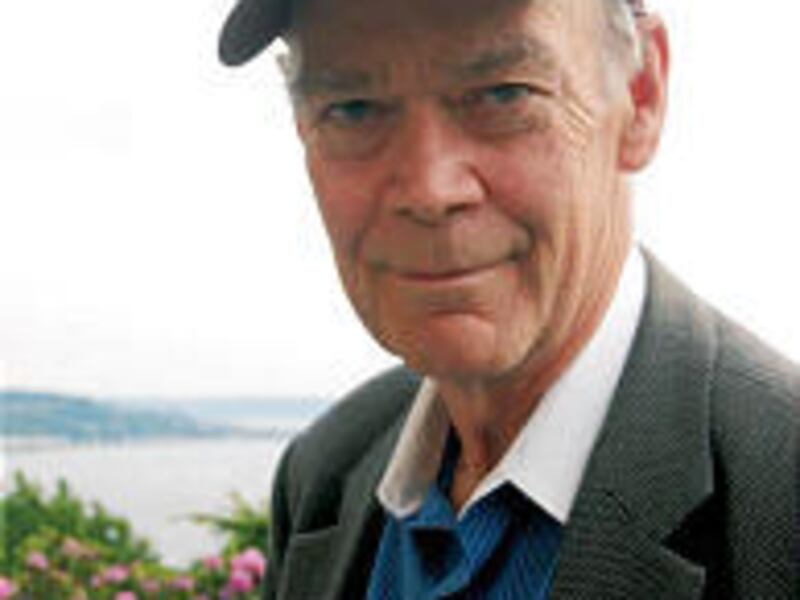
Perhaps no one but the highly acclaimed Jonathan Raban would dare write such a novel as "Surveillance."
Who else would take on, in Raban's own words, "a subject so grim as the war on terror and turn it into a comedy of manners."
But that's exactly what he's done.
A native of England, Raban now makes his home in Seattle, and he has written a great deal about the Northwest. But his literary touchstone is Evelyn Waugh, the iconic British writer who wrote in a similar tone about England's approach to Hitler, "Put Out More Flags."
The 64-year-old Raban was brought up in an English vicarage and is actually related to Waugh. "I thought of him then as a right-wing hyena," Raban said by phone from his home. "I was heavily to the left, so I usually went fishing when he came around. I was in my 20s before I discovered Waugh as a writer, and by then he was dead.
"Today I value him tremendously — he's one of my favorites. And I can read 'Put Out More Flags' for the 20th time and still find it touching and very funny, even though he focuses on social London and some ghastly evacuees."
In Raban's book, America has become obsessed with intelligence gathering. (He is describing the present day or the near future, to include Homeland Security and the Bush administration, though he never uses the name "Bush.")
The long arm of the government is everywhere, the average person freely indulges his curiosity on the Internet, journalists pursue investigations doggedly, children snoop on their parents, and everyone manipulates technologies.
It is life as we know it. And into that milieu comes Tad Zachary, an Internet aficionado and unemployed actor who now performs mostly in films made by Homeland Security, depicting fictional disaster scenarios, as well as Lucy Bengstrom, who works as a freelance journalist and lives in the same apartment complex with her 11-year-old daughter, Alida.
Lucy is assigned by a magazine to write a profile of August Vanags, a retired professor who has unaccountably written a best-selling memoir of his childhood during World War II. The more she sees of the professor, the more she doubts the veracity of his memoir.
Then there is the creepy new landlord, Charlie O, who has recently purchased the apartment building and hopes to spruce it up and increase his income. He is determined to "protect" his tenants through the use of a surveillance camera.
All of the characters are trying to find out more about each other, and they are all a little obsessive. But then, as Raban says, "Aren't we all?"
"Charles O is monstrously vulnerable. The characters end up getting everything wrong. But a story ceases to be interesting unless the characters are vulnerable."
Raban is serious about this. "I have a strong feeling that we have been sleepwalking into a controlled society without privacy. Before you called me, I Googled you — as you no doubt Googled me. We have the technology at our fingertips to find out about each other. We live more public lives than we have ever done.
"My 14-year-old daughter has a MySpace page. I'm worried about this new world, created by the Internet."
According to Raban, cyberspace houses "the most trivial things — somewhere there is a data base that contains almost everything we do. This telephone call is being logged somewhere. Should we be worried about this? I think we should. We would not want to destroy the technology, but we do need to face up to a new reality."
Raban seriously doubts the ability of the Bush administration to be "a responsible steward of democracy. But I'm more concerned about the surveillance we do to ourselves. If you have someone's address you can use Google
.Earth and find the person's house, inspect the roof, see if it needs repairing, look at the garden — we can all busily inspect each other's houses. It's becoming second-nature to us. ...
"If I go to a garden center online and order a dozen bags of lawn fertilizer, that is recorded in a data base, and if my bank account is credited with a large amount of money from another part of the country, and if I visit a jihadistic Web site, the government can connect the dots and say 'Aha!'
"Sometimes you would be grateful they could do that — but other times it might produce an answer that is utterly untrue."
Still, Raban hopes that readers of his book will see it in comedic dress. "If this book does not raise a smile, then it's not working. The line between farce and nightmare is very thin. I hope 'Surveillance' walks that thin line." In fact, Raban believes that climate change is a bigger threat to our society than terrorists.
"Surveillance" is masterful in its ability to get the reader inside a "sleepwalking society," in which technology has changed everything.
His ending is explosive, and he knows that readers will be shocked and possibly even angry by the time they reach it — which only underlines his point.
E-mail: dennis@desnews.com