

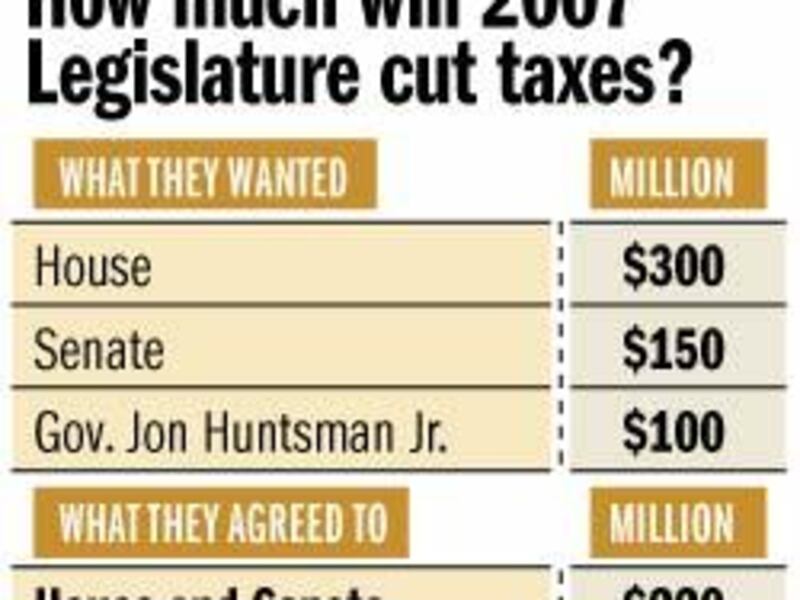
Utahns will get a $220 million tax cut — probably coming this year.
That idea sounds easy enough. But Utah GOP lawmakers' politically painful road to an agreed-upon total for tax relief was not easy, coming with some bruised egos and ruffled feathers.
Now come even tougher decisions on exactly how the state's two personal income tax systems will be changed and what food sales tax cuts must come to achieve the $220 million.
The tax cut number didn't come without theatrics. First, House Speaker Greg Curtis, R-Sandy, walked out of a leadership meeting last night. He came back only to get into an argument with Senate President John Valentine, who then walked out himself.
"At least I went back. He just left," Curtis joked Friday afternoon as he explained to an open House Republican caucus exactly how leaders and Gov. Jon Huntsman Jr. reached a total amount to reduce taxes by this session.
Valentine, R-Orem, made a rare visit to the House GOP caucus to announce that his caucus, too, had agreed to the $220 million tax cut. "We're buddies now," said a smiling Valentine.
But he hadn't been gone long when various GOP House members started criticizing the senators' budget and tax stands.
And while House Republicans were grousing about the "journey" Huntsman, who is also a Republican, and the Senate seemed to be steering them on, GOP senators said that with tax cuts now in hand, the majority party can build the $10.9 billion budget for 2007-08.
"There was a strong sense of urgency to have the budgets done in a timely fashion," Valentine told reporters. "We felt like we were getting down to the point of crunch time."
He said GOP senators, who met in closed caucus, weren't easily persuaded that the size of the tax cut should be larger than the $150 million they'd agreed upon at the start of the session.
"It was very difficult to move the Senate caucus to the higher number of $220 million," Valentine said. "We felt the other needs of the state were very important," including transportation, higher education and state employee pay raises.
Valentine said that thanks to new revenue estimates that bumped up the state surplus by another $149 million, the caucus should still be able to boost public education funding by at least $300 million.
Whether there will be an agreement on which taxes will be cut before the 2007 Legislature ends at midnight on Feb. 28 is another matter, however. Valentine and other Senate leaders acknowledged there's a chance the tax cuts won't be decided until a special session.
No one really wants that, but it appeared Friday night that the House and Senate were fairly far apart on how to change the new flat-rate income tax, modify the old multi-deduction income tax system, and reach the right level of the food tax cut.
Still, Valentine said waiting to decide until a special session likely wouldn't delay when any of the cuts take effect. Any reduction in income tax rates, the Senate leader said, would not take effect January 2008. Reductions in the food tax would take effect July 1, the beginning of the budget year.
Sen. Pete Knudson, R-Brigham City, was optimistic there was enough time left in the session to reach agreement on the cuts.
"I think we've made some significant progress," Knudson said. "Twenty-four hours ago, we didn't have an agreement for the amount of money that would be set aside for tax cuts — far from it."
A few lonely voices are saying that the new Huntsman income tax proposal has real problems.
Keith Prescott, chairman of the Tax Review Commission, was on Capitol Hill Friday afternoon with a few other tax experts warning about the complexities and the volatility of several of the suggested tax changes.
"The TRC has recommended a single personal income tax system, not two," said Prescott, who is also Huntsman's personal tax accountant. "And (legislators) have not addressed the volatility issue."
In good times, Utah's personal income tax revenue has shot up rapidly, and in bad economic times revenues drop quickly. Since the constitution gives all income tax revenues to public and higher education, such critical programs shouldn't have such a fickle tax system, tax experts say.
If changes to the new flat-rate system suggested by Huntsman are adopted, then the state's Rainy Day Funds should be three or four times larger than they are now to deal with a severe tax shortfall, the experts said.
Here's where the tax cut disagreements stand now, with only eight days left in the session:
Both the House and Senate GOP caucuses seem to agree that the current flat-rate income tax of 5.35 percent should be lowered to 5.0 percent.
House Republicans want the current old-system rate of 6.98 percent to be dropped to 6.7 percent. But GOP senators and Huntsman disagree. The lower the old rate is dropped, the fewer Utah taxpayers will move over to the new flat-rate tax — a goal of the governor and senators.
"We should move the rates down in both systems," said Rep. Jim Dunnigan, R-Taylorsville. "Yes," said Curtis, "a dollar-for-dollar reduction seems fair."
Tying what happens in the income tax to any food sales tax cuts is wrongheaded, House members said. But it is unclear if senators will agree to a food tax reduction without an accompanying income tax reform.
A number of House Republicans think maybe they were hoodwinked last summer when, in a special session, they adopted an alternative flat-rate income tax system.
"We were sold a flatter tax (system) last year to bring in wealthier people to Utah" for economic development, said Rep. Gage Froerer, R-Huntsville. "That was a palatable mix. But now we're just on a slippery slope of social re-engineering moving everything to the middle" of the income tax payers through the governor's tax reform plan.
"We thought the Huntsman plan was a simpler state income tax system," said Rep. Sheryl Allen, R-Bountiful. "But we're (looking at) making it more complex, more mathematical calculations" in filling out your tax return. "My constituents aren't going to like it."
It's not just cuts in the personal income tax and the sales tax on food that's on the table. Senate Republicans are pushing several business tax credits, including one for research and development. Valentine said any business credits would come out of the $220 million set aside.
Huntsman was out of state Friday, visiting his daughters who are attending school in the East. But his spokesman, Mike Mower, said the governor "is pleased that the Legislature has arrived at a number so the budgeting process can continue."
Mower said the governor is hoping to avoid a special session. "At this point we're focused on getting all issues resolved by the end of the legislative session."
E-mail: bbjr@desnews.com; lisa@desnews.com