


Two men injured Saturday in an avalanche near one of the Wasatch Mountain range's highest peaks were taken to the hospital following a daring rescue operation.
One man was listed in extremely critical condition at LDS Hospital, and the other was in serious condition Saturday evening. Both were in the intensive-care unit and were unable to be interviewed by deputy sheriffs, who were still trying to collect details about the accident.
The men were identified by the sheriff's office as Brian Dutton and Joe Bullough, both 42, from Salt Lake City. Because of federal privacy rules, the hospital was unable to say which man was the one more seriously injured.
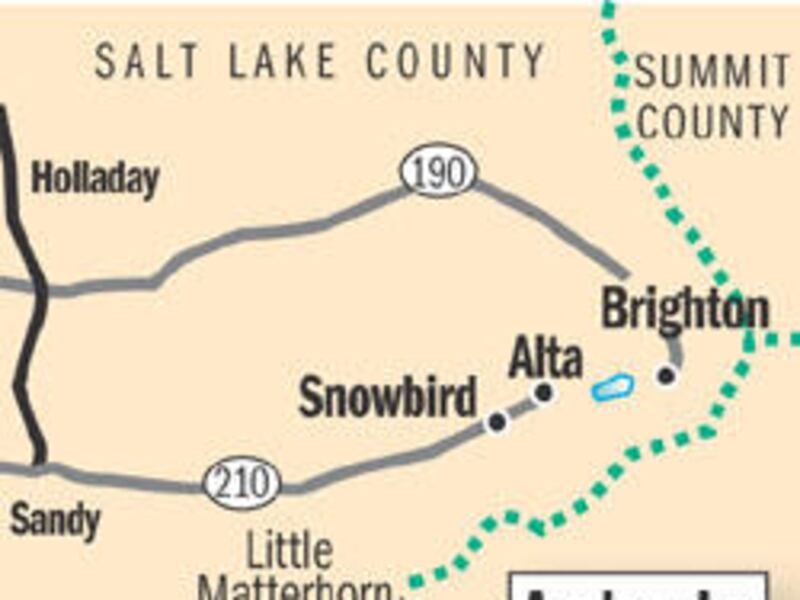
The men were backcountry skiing near the Pfeifferhorn, also known as the Little Matterhorn, just above Little Cottonwood Canyon. They were skiing near the 11,000-foot mark when an avalanche broke loose near the peak, said Salt Lake County Sheriff's Lt. Paul Jaroscak.
"They were way up — about as high as you can get," he said.
Both men were caught in the slide and injured, but it was unclear Saturday if either had been buried or partially buried. By the time rescuers found them Saturday afternoon, they were on the snow's surface.
One of the skiers called 911 about 10:15 a.m., just after the slide occurred. Helicopter crews assisting with the rescue estimated that the avalanche was about 90 feet wide and 210 feet long.
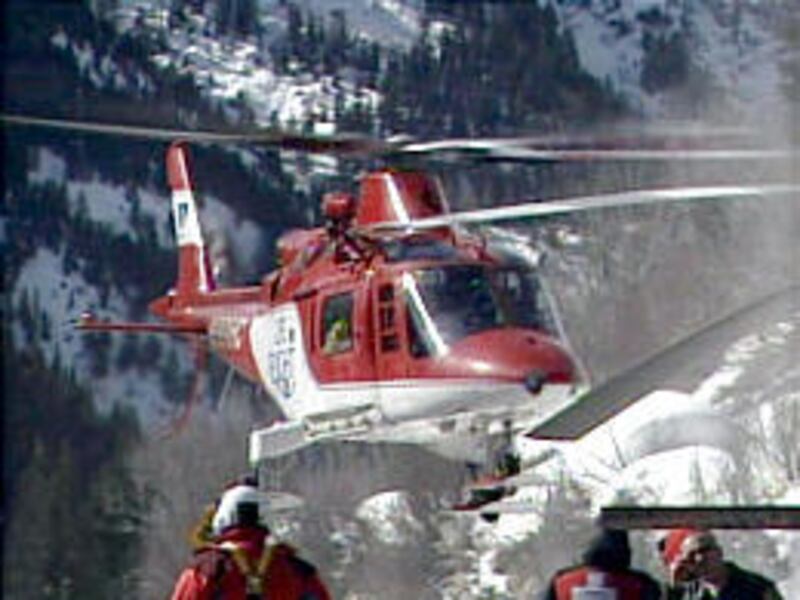
The biggest challenge for rescuers Saturday was the wind, which was gusting up to 80 mph, Jaroscak said. Because of the remote location where the skiers were trapped, approximately 50 search-and-rescue team members from Salt Lake, Utah and Wasatch counties responded, along with two Life Flight helicopters and one Department of Public Safety helicopter.
"There was a tremendous amount of difficulty for search and rescue," Jaroscak said.
Russ Thacker piloted the first Life Flight helicopter to arrive. The specialized K2 chopper was designed for high-altitude rescues. But because of the winds, Thacker said, it was impossible to use the helicopter's hoist to either lower rescue crews or lift the victims.
Thacker ended up taking six search and rescue members to the north side of the summit. From there, the rescuers had to hike over a mile, about 1,000 vertical feet up, while battling slick terrain, howling winds and dangerous wind chill, and carrying the additional weight of backpacks and rescue gear.
"Those guys are phenomenal. I can't believe the time they made," Thacker said. "Those guys are heroes."
The rescue crews got a big break late in the afternoon when the winds died down and provided a window of opportunity for the helicopters. One of the choppers landed in a nearby clearing just downhill from the slide. The rescuers who had hiked to the victims were able to transport the injured men to the helicopter by using skis and a sled. Once they were loaded into the helicopter, they were taken immediately to LDS Hospital.
The more seriously injured of the two men was not conscious when he was flown away, Jaroscak said. That man was believed to have two broken legs, as well as abdominal and chest injuries.
The second man's injuries were not believed to be life-threatening, but the kinds of injuries he had were not known Saturday night.
The second victim was taken off the mountain about 4:30 p.m. But Jaroscak said the dangerous operation still wasn't over at that point.
"The last phase of the operation was rescuing ourselves — getting our people off the mountain before it got dark," he said.
By 5:30 p.m., the helicopters were able to get the last search-and-rescue team members off the mountain.
E-mail: preavy@desnews.com