


Third in a five-part series
"M1/2 told complainant if she called police he would kill her." — Salt Lake City Police Department report, May 25, 2006
· · · · ·
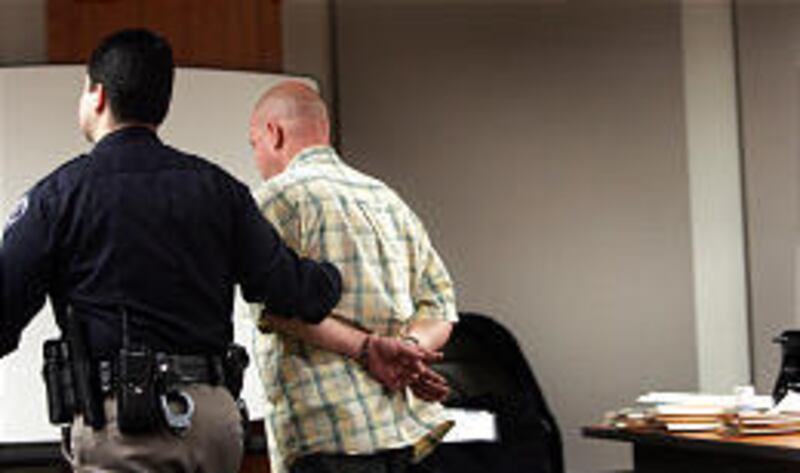
Rodney J. Gehlen entered the courtroom wearing a tan jumpsuit, orange canvas sneakers and a smirk.
Seated at a table with his cuffed hands resting in his lap, he turned toward Donna Walters, the live-in girlfriend who accused him of beating her. He stared at her as 3rd District Court Commissioner Thomas N. Arnett Jr. reviewed police reports detailing Gehlen's alleged physical abuse.
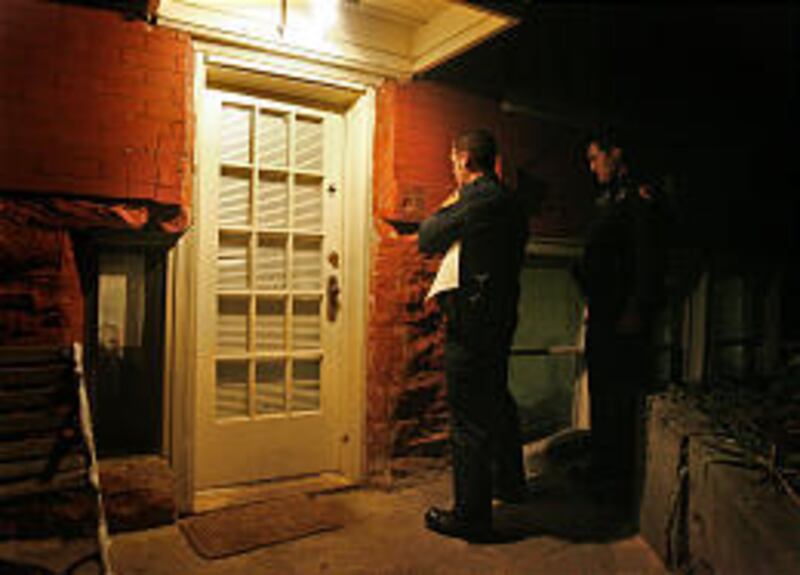
According to the May 25, 2006, report, Gehlen, 41, threw a cell phone at Walters during an argument. When she picked up the phone and walked into a bedroom, he tackled her from behind. They wrestled on the bed until she was able to break free and run to a neighbor's house.
Gehlen chased her to the neighbor's porch, calling her names and making threats. "I will (expletive) kill you b----," a witness told police he heard Gehlen shout. "If you call the police, it will be your death sentence."
Walters' 12-year-old son and three neighbor boys told police they heard the threats.
· · · · ·
Treating perpetrators is the primary key to the domestic violence conundrum, says new Salt Lake County Attorney Lohra Miller.
"The reality is that the majority of women go back to their perpetrator," she said. So a good chunk of the solution lies with them.
And eight hours of anger management isn't going to cut it, nor is a 36-hour domestic violence course.
In a few months on the job, Miller has been molding her strategies for addressing a domestic violence problem that threatens to overwhelm the system.
It will cost money, Miller said. But because children exposed to domestic violence so often turn to criminal behavior, Miller says her efforts will pay off in the long run.
"We will be devoting significant resources to holding the offender accountable and following through on the terms of their probation," said Miller, a prosecutor for 15 years in Taylorsville, Holladay and West Valley City justice courts.
She was at it long enough to see a second generation of abuse victims and perpetrators make their way into the system in those communities. "It brings home how much impact violence has on the children."
So she wants to re-order the treatment protocol. Drugs and alcohol are involved in a large number of cases, she said, so you've got to get abusers sober first.
"If you are drunk or high or strung out, you really aren't able to do anything about your domestic violence," Miller said.
The abuser has to address his addiction, get a job, come to court — not just do a quick plea deal and pay a $300 to $500 fine.
"We have to use the hooks we have in them," Miller said. Then you can begin to treat the baffling assortment of control and behavior issues associated with these crimes. Miller calls that cognitive restructuring — changing the way a person gets mad, changing the way he behaves.
· · · · ·
If Walters saw Gehlen's grin in court, she didn't acknowledge it. She kept her eyes on the judge while her Legal Aid Society attorney Keri Gardner made a brief case for a protective order to keep her alleged abuser away.
Asked for his response in court, Gehlen rambled on about how he thought the "no contact" order was too severe, that they could work out the relationship on their own. But he conceded to the court, "I'll respect her wishes and not come around."
He then again glared at Walter and smirked.
The bailiff finally tapped him on the shoulder and gestured for him to keep his eyes forward.
Commissioner Arnett issued a protective order and court recessed. During the break, court staff commented on Gehlen's creepy stare. They figured that should he be released from jail, it wouldn't be long before he violated the protective order.
The court staff gets to know people. Gehlen's case was one of 1,231 domestic violence cases filed in Salt Lake City Justice Court in 2006.
So who are these perpetrators?
· · · · ·
"We will be devoting significant resources to holding the offender accountable and following through on the terms of their probation." — Lohra Miller, Salt Lake County attorney
· · · · ·
Abusers are fearful, angry people who feel powerless in their world, domestic violence prevention advocates say. They seek control and respect by threatening and inflicting harm on the only people available as victims: their families.
Offenders are typically 18 to 38 years old, with those in the 25 to 31 age group being the most common abusers.
According to Salt Lake City Justice Court statistics, the typical perpetrator is a white male age 25 to 34 who has no more than a high school degree and earns less than $20,000 a year.
G.M. — a 32-year-old Salt Lake Valley man who asked that his full name not be used — attends a domestic violence offender counseling group once a week because of a fight with his wife.
During an argument about money, he said, she blocked him from leaving their house to take a walk. She had hold of his forearm when he yanked it away, pushing her back. He tried to leave but again he said she stood in his path, so he called police.
Police determined he was the primary aggressor and cited him on domestic violence-related charges. A justice court judge imposed a $300 fine and required he attend a 16-week domestic violence awareness course, which is common for first-time offenders.
"How come I have to go to counseling and she doesn't?" he said in an interview with the Deseret Morning News.
G.M. admits he pulled his arm away but said he did nothing to injure his wife. He believes police identified him as the perpetrator because he comes from a foreign country and his wife is American. He also had consumed three beers that day. Police and prosecutors, he said, treated him like he hit his wife often.
"I had never had a problem in my life. I've never been in jail. I don't do drugs," he said.
G.M. is about halfway through the counseling class. He said he's learning how to react to problems, set family rules and ways to stay calm. But he doesn't find the course particularly useful.
"I don't think the class is helping at all because I was calm before," he said.
G.M. says police and prosecutors went overboard in his case.
"They're just out there for the money. Our problem was really simple. I'm not saying guys don't hit their wives and that wives don't hit their husbands. I see it. It's not always the man," he said.
· · · · ·
Not always but almost always.
Statistics range widely on the percentage of male offenders, but 85 percent appears to be the most generally accepted.
Former Utah Attorney General Jan Graham, who made domestic violence prevention a hallmark of her tenure, says there is a dearth of expertise or focus on treatment for abusers.
" ... Yet the abuser is the only one who can stop the abuse. Victims can't, and that is a truth often ignored," she said.
The gender issue is tricky one, Graham said.
"I used to raise the issue in speeches this way: 'Why do so many men hurt their families, and what are men going to do about it?' It's an uncomfortable speech to give to the Rotary Club."
It's why she has always felt men could play a huge role in solving this problem, and it's why she is now working with Joe Torre, the New York Yankees manager who grew up in a home where his dad beat up his mom.
The domestic violence, not baseball, defined Torre's childhood,
Graham said.
"As you have seen — the vast majority of people working in prevention and prosecution are women," she said. "Few men are going to choose this as their issue.
· · · · ·
"They absolutely choose to do it. It's not a mental health issue. It's not a substance abuse issue. It's a choice." — Gina Painter, clinical social worker, Salt Lake County Probation Services
· · · · ·
The prescription for perpetrators of domestic violence remains elusive, Salt Lake Justice Court Judge John Baxter said.
Take an alcoholic. If that person comes before a judge and does exactly as the judge orders, research and experience demonstrate a certain degree of treatment success.
But there are personality disorders based in control that are predominant in these domestic violence cases, he said. "I see people at the podium in court trying to control me," Baxter said. "This guy is manipulative, he's obsessive." And he may think he's done nothing wrong, which makes sentencing, treatment and solutions difficult.
"You are having to change a whole learning paradigm," Baxter said. "The perp probably grew up in a house where this is acceptable, and unfortunately you often have a victim who grew up in a house where it happened, too."
He knows what courts are doing is only partially successful.
"I'll see them again and again."
· · · · ·
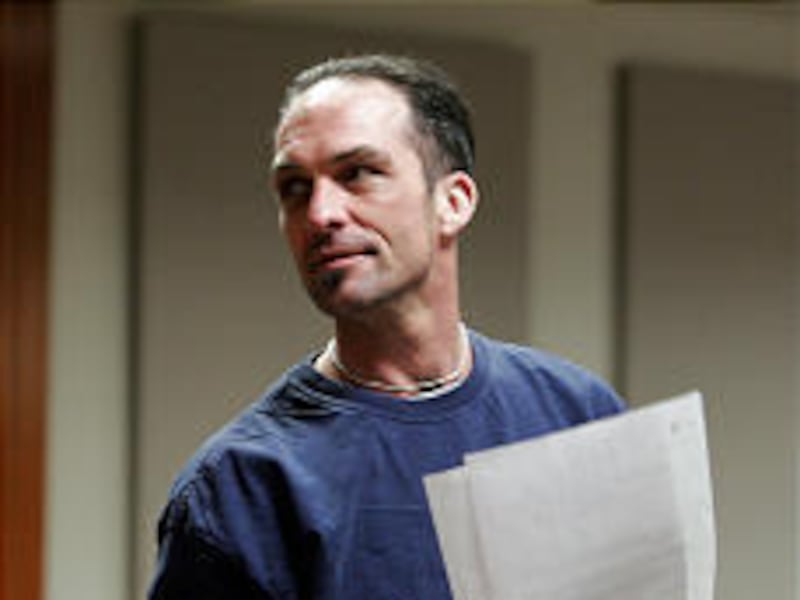
Two months after his hearing, on Jan. 19, Rodney Gehlen was out of jail and talked to a reporter. He said he hasn't violated the protective order, at least he doesn't think he has. He saw his former girlfriend outside the Matheson Courthouse after a recent hearing. He said he waved to her but nothing more.
He appeared in Salt Lake City Justice Court that day to answer charges stemming from the May incident. He faced charges of domestic violence assault, domestic violence in the presence of a child, unlawful detention and threats against life or property. He ultimately pleaded guilty to the latter charge while the others were dropped. He was placed on probation and ordered to undergo counseling.
Outside the courtroom Gehlen's explanation for what happened that May evening last year is simple and contradictory.
"Drugs," he said, adding that both he and his then-girlfriend struggled with drug problems. "She railroaded me out of my house."
Gehlen said he and his girlfriend did argue the day the police came. Reminded of details in the police report, he says that's not really what happened. Asked what did happen, he concedes he probably did grab the phone and he probably did threaten her. But he said he's not a violent man.
"There's no hands-on in any of my charges. It's all verbal. I know better than to hit a woman," he said.
Gehlen said said he grew up with sisters and has daughters. He has been married three times. "I have relationship issues," he said. But, he said, hitting women, including his recent girlfriend, isn't one of them.
"She's not the victim," he said. "I am."
Four days after that interview, Gehlen was arrested for possession of drug paraphernalia and taken back to jail.
Next month, Gehlen will stand trial in district court for two other domestic violence-related charges that occurred at the same address. He also is charged with violating a protective order.
· · · · ·
Offenders tend to minimize and deny, said Gina Painter, a licensed clinical social worker with Salt Lake County Probation Services.
"To me that shows someone who knows that it's wrong," she said.
They typically avoid responsibility for their actions, said psychologist Steve Kay. They fault the victim by saying "She's crazy" or "She made me do it." They blame it on being drunk or high.
Victims are the opposite. They blame themselves and see the violence as their fault. They think if they did better, they wouldn't have been hit. Perpetrators know that and prey on it.
· · · · ·
"The perp probably grew up in a house where this is acceptable, and unfortunately you often have a victim who grew up in a house where it happened, too." — John Baxter, Justice Court judge
· · · · ·
Hitting a spouse or girlfriend doesn't stem from a bad relationship or unmanaged anger. It all comes down to two things, said Amy Jensen, who worked with offenders, victims and children in a Salt Lake supervised-visitation center.
"It's an addiction to power and control," she said. "They get a rush from it just like if I shot up with heroin."
Substance abuse, mental-health problems and the availability of weapons are factors in domestic abuse but not the cause, social scientists say.
"They absolutely choose to do it. It's not a mental health issue. It's not a substance abuse issue. It's a choice," said Painter, who works with offenders in the court system.
Jensen agrees.
"We don't say, 'What causes robbery? We don't say, 'What causes car theft?"' she said. "These guys are offenders. They choose to offend in the family."
Local courts refer many offenders to the Sandy Counseling Center, which runs a program called Pathways to Peace.
Clinical director Kent McDonald said clients have to want to change. Rather than hold them accountable for their abusive actions, which makes them defensive, his approach makes them accountable for solutions.
"Confrontation is the game of the abuser and as such creates motivation for resistance to change," he said.
Most abusers, McDonald said, want a peaceful, happy home but don't know how to achieve it.
The program's goal is help them alter their thinking about family life, communications, problem solving, freedom and equality.
· · · · ·
Every day, in courts all over Utah, daunting numbers of domestic-violence cases are aired.
In West Jordan, a disagreement during a home improvement project turned violent.
A man and his wife argued while installing a heavy cabinet. She left the room, leaving him to put the cabinet up himself. He couldn't manage the weight alone and says he called "40 times" for help, but she didn't come back.
Angry and carrying a cordless drill, the man went looking for his wife. He found her in the shower. He hurled the drill through the glass shower door. She suffered cuts on her ear, foot and arms and also had a bruise where the power tool hit her arm.
"I'm guilty and I need help," he told West Jordan Justice Court Judge Ronald Kunz during a hearing on his domestic assault charge.
The man explained his behavior by saying he had not taken his anxiety medication.
He and his wife are now separated. But studies show it takes at least seven violent episodes before a woman decides to leave. After the West Jordan court hearing, the man told a reporter he and his wife might reconcile.
"We're going to try to work it out, supposedly."
Why men don't tell
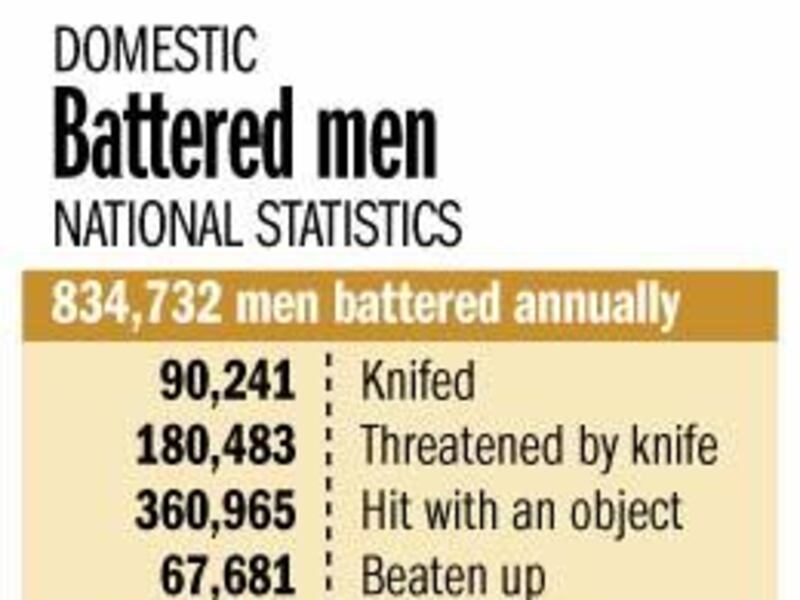
Men typically face disbelief and ridicule when reporting abuse. As a result, male victims of domestic violence tend to make excuses for injuries — "it was an accident" — when questioned by friends or medical personnel, which only allows perpetrators to continue the abuse.
Abusers are expert at making victims feel no one is on their side, which creates a spiral of isolation — the more you, the victim, withdraw from friends and family, the less the people closest to you will be able to help.
Though you may have been injured far worse on an athletics field, it is not the same thing as being physically attacked by your intimate partner, which hurts emotionally as well as physically. Allowing this pattern to continue can result in depression, substance abuse, loss of confidence and even suicide.
E-mail: romboy@desnews.com; lucy@desnews.com