

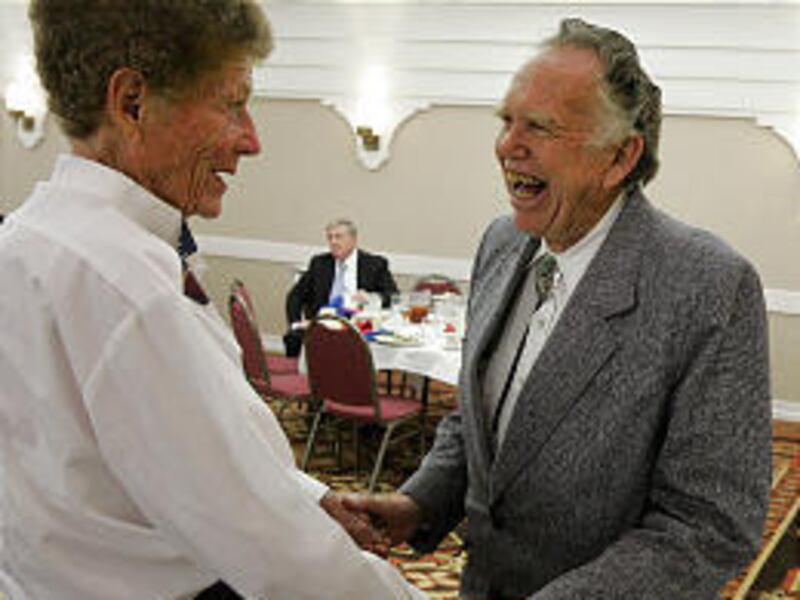
Jay Hess, held prisoner for more than five years during the Vietnam War, had the kind of resolve that Utah National Guard Maj. Gen. Brian Tarbet called on the American public to have in order to get the job done in Iraq.
The reality, however, is that many people today seem more concerned with who may be the father of Anna Nicole Smith's baby, how Lindsay Lohan is doing in rehab or whether Britney Spears has solved her "underwear problem," Tarbet told a room full of former prisoners of war at a luncheon in their honor Friday.
"We're not worrying about what we need to worry about," said Tarbet, who was the featured speaker at the annual event.
To the former POWs, Tarbet said he can be assured that they have their priorities in order in terms of having a focused attention span on events in the Middle East.
While watching news of the Iraq war has dredged up painful memories for many past war veterans, Hess said he hardly ever thinks of his prisoner experience and rarely has nightmares about it.
His ordeal began on Aug. 24, 1967, when he was an Air Force pilot of an F-105 fighter/bomber. He was shot down over northeastern Vietnam, near the Chinese border.
Hess, 76, of Farmington was 37 at the time and had a wife and five children at home in Utah.
After hitting his head while ejecting from his jet, he was knocked out and later came to just as a boy was approaching his landing site on a trail in some foothills. He remembers pointing his pistol at the boy, but he didn't fire a single shot before being captured deep in enemy territory.
In the early days of captivity at the "Hanoi Hilton," Hess was tortured for information in what he called a "rope trick," in which his limbs were tied together in a contorted position.
Hess was forced to answer questions about his father's name, occupation and how much money he made. He was asked about his religion and political party and even the names of his own children.
"I'm sure some guys didn't answer the questions," Hess said in an interview. "I don't think they lived."
When the days of interrogation and the rope trick were over, Hess was left with dislocated shoulders and nerve damage that rendered his hands limp and useless for weeks.
Surviving almost 5 1/2 years as a prisoner meant some days living one minute or hour to the next, at times riddled with boils, heat rash or, without available dental care, a horrible toothache.
"The will to live is pretty amazing," he said. "You don't know when it's going to end."
Hess often made his own meals by boiling dandelions for one of two meals a day while being forced to eat the "swamp-green soup" and rice (with rocks he had to pick out) that his Vietnamese captors served for the other meal. Already a trim man, Hess figures he lost about 30 pounds as a prisoner.
He started out sharing with three other cellmates a small room with four boards for beds and a bucket for their toilet. For about the first three years he was listed as missing in action until he was allowed to write a letter to his family, which changed his status to prisoner of war.
Hess would eventually share a slightly larger cell with seven other men, companions who he said made the experience more bearable.
"I never heard anybody swear that whole time," he said. "We all got along. It was really remarkable."
Hess only thought about trying to escape, knowing that those who did were tortured if caught — he heard about one man who died as a result of such torture.
Hess prayed a lot. He said faith in himself, in God, in his country and in his family helped him cope until he was released in 1973 at age 43. He missed six Christmas celebrations at home. He had a son in grade school when he left for the war who was close to graduating from high school when Hess returned home.
While he dropped bombs over the enemy and as a prisoner spent time in the worst living conditions, Hess said one aspect of his time in Vietnam lessened the blow to his mental stability while trying to adjust back home.
"I never saw anybody die in Vietnam," he said. Hess doesn't have any gory images in his head that "haunt" him.
That's not to say he didn't have some troubles readjusting, a period of at least four years during which he and his wife divorced.
But back home again, he became a "born-again" American, someone who developed a greater appreciation of America and freedom and simple things such as hot water, a soft bed and three square meals a day. He eventually remarried and for about 20 years taught high school students in Clearfield who were part of the Air Force junior ROTC program.
"Once in a while I have a POW dream," Hess said.
The most recent nightmare he had was after the terrorist attacks of Sept. 11, 2001. In that particular dream, Hess said he had the overwhelming feeling he was surrounded by people who hated him. Through it all, being held captive for so long, readjusting back home, Hess considers himself a "lucky guy."
E-mail: sspeckman@desnews.com