

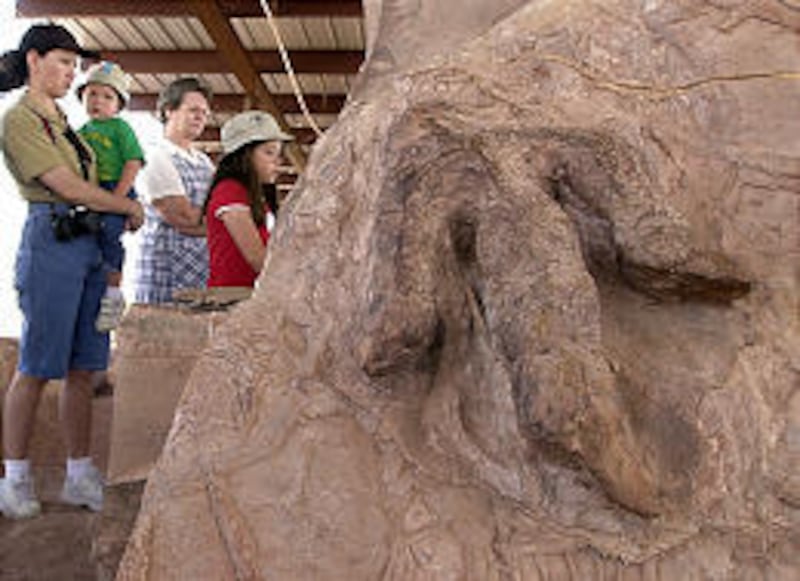

A squatting dinosaur left a butt-print in the mud. A pack of dinosaurs swam in water deep enough that their toes just scratched the bottom. Another was momentarily swept off its feet by the current.
These are among discoveries at the St. George dinosaur track site. Some are mentioned briefly in a new scientific publication, while others there are described in detail. The book is "The Triassic-Jurassic Terrestrial Transition," just printed by the New Mexico Museum of Natural History and Science, Albuquerque.
The book's 650 pages concern other fossil finds as well, but a great deal of information was dug out of the St. George site, which dates to around 199 million years ago. The dinosaur footprints, bones, teeth and other animal and plant fossils fill a gap in the record between earlier and older sites in the Southwest.
Sheldon Johnson made the initial discovery in February 2000, while clearing land at the farm he owns with his wife, LaVerna. Since then other nearby sites have turned up specimens.
Jim Kirkland, Utah's state paleontologist and one of the book's editors, estimated that about 250 pages derived from the St. George discoveries. That so much scientific work has been carried out in the relatively few years since the first discovery is a major accomplishment, he said.
One of the most amazing records of dino behavior is preserved in-situ within the museum itself. "It's a pretty impressive trace" fossil, said Andrew R.C. Milner, paleontologist for the city of St. George, another of the editors, who mentioned the find in the book.
"At the time when it was discovered it was the fourth known specimen in the world of a sitting meat-eating dinosaur trace." Since then, another has been discovered.
At the end of a trackway, a three-toed dinosaur sat down. The three-toed variety are theropods, meat-eaters that walked on hind legs. This one may have been searching for fish to snap in what has been dubbed ancient Lake Dixie.
"What makes it really unique is that it actually places its hands down in the sediment, so it rested its hands down on the muddy surface," said Milner.
The fossilized mud preserves the impression of part of the dinosaur's lower leg, from when it leaned back.
"There's a circular mark ... basically it's a butt print," he said. After the dinosaur touched down on the mud, "it shuffled itself forward. It didn't put its hands down on its second squat. Then it stood up and it stepped forward with its left foot first."
The trackway has 20 or 23 prints, and the dinosaur's tail dragged periodically, "more when it was going up a slope," he said. Tracks indicate the animal was probably six or seven feet tall at the highest point, the hip, and 18 or 20 feet long. It weighed 750 to 1,000 pounds.
Then there are the swimming footprints, left in the bottom while the beasts swam along with claws barely touching.
"The best-documented swimming tracks in the world," marveled Kirkland. "Clearly some of them are going in deep enough water that they are actually getting swept off their feet by the currents."
Milner said around 3,000 individual claw-marks of swimming dinosaurs have been uncovered. "They're so well-preserved we can see skin impressions." Details of claws, cuticles and toe pads were fossilized.
"They're spectacular," he said.
One trackway shows where a dinosaur was standing in the lake "and was pushed off-balance by the current," Milner said. "You can see where the foot slid laterally." Scratches of its scales are still in the rock.
Fish, dinosaur bones and invertebrates also have shown up from the period, all within about a single square kilometer, within St. George city limits, and of easy access to visitors.
"It's been called one of the top 10 largest collections of dinosaur tracks in the world," Milner said.
The book pays tribute to St. George itself and people who helped in the discoveries. According to a press release from the museum, these species are named in the volume's scientific papers:Ceratodus sterwarti, a lungfish named for Darcy Stewart, who donated land, work and equipment, according to Kirkland.
Milnerite planus, a conifer named for Milner.
Saintgeorgia jensenii, a conifer that would have grown in dense forests beside Lake Dixie, named for the city and Paul Jensen, a nearby landowner who donated specimens.
Lissodus johnsonorum, a small freshwater shark named for Sheldon and LaVerna Johnson.
E-mail: bau@desnews.com