

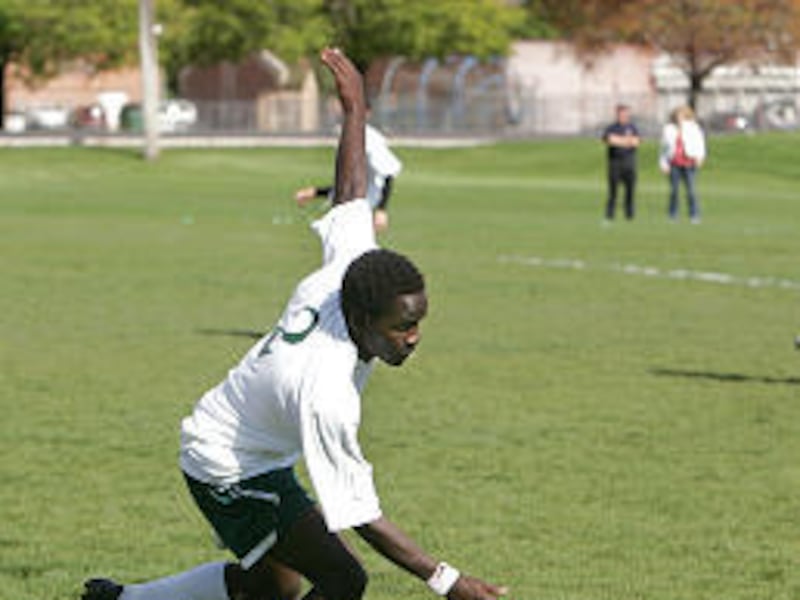


PROVO — A lot of Utah County teenagers can trace their heritage back to pioneers. Going back at least 150 years or so, they'll find the history of ancestors who migrated west — many of whom came from overseas.
But at Provo High School, David and Emily Ojuka don't need to look so far back, and they won't find many of their friends with overseas roots anywhere near their own.
It was only about 20 years ago when their parents arrived in Utah, a world away from their homeland in Uganda, a small impoverished country in central East Africa.
As the story goes, after getting married in Africa, their dad was staying in Australia where he met the Latter-day Saint missionaries. He converted to the church after returning home and later moved to Utah with his family, including three young kids, so he could go to school in Provo.
David and Emily, siblings number four and five, were the first children of the family born in the United States.
David, a senior, has become a three-sport star for the Bulldogs. He'll graduate this month as an All-state football player, a nationally recognized wrestler and a leader on the varsity soccer team. Emily, a junior, is a track star, a talented musician, a performer, and was just elected senior class president.
For the most part they're just normal teenagers. You can regularly find David at home practicing his wrestling moves upstairs or Emily playing the violin. They fit in pretty well with all the other students arriving fashionably late for their after-lunch fourth-period class.
But their unique heritage is never far from the surface of their day-to-day lives. Neither David nor Emily has ever seen Uganda, but it's as much a part of who they are as the Wasatch Front where they were born and raised.
Both of their parents were athletes, and those genes have obviously carried down, along with the family's passion for sports.
"I think definitely we've had athletics in our blood," said Emily. "That's always been a part of my life."
Aside from the natural talent, though, there's still a lot of native culture in their lives that has helped them succeed along the way.
David never wrestled or played football until his freshman year. Picking up two competitive sports relatively late and excelling in them requires a lot of work and focus.
When talking about his accomplishments, David refers to a slogan that is pasted on the wall in the school's weight room: "Champions are made when no one is watching."
It has become a personal theme for him, and he says that it matches one of the qualities he has learned from his family, coming from a place where hard work is simply a way of life.
"It seems like it's more challenging over there (in Uganda)," said David. "You always have to work hard and you always have to give it your all. As you get older you realize more what it takes to succeed. You always have to work."
Emily admits sleep is one of the things she routinely sacrifices.
She plays the violin in the orchestra, participates in drama, runs four different track events, and takes time to be a jazz singer. That's on top of the regular homework and her pending duties as the new class president.
She chooses to fill her time up with most of those things but points to her parents who, back in Africa, didn't have a choice about how hard to work.
"It's like they already have the idea that you need to strive your hardest," said Emily. "It's not really a question."
David and Emily have gotten used to standing out, and for more than just their athletics and extracurricular activities. More than 90 percent of Provo High students are either Caucasian or Hispanic. Growing up, they've been among the few African-Americans around. Their heritage is a source of personal pride but also has its challenges.
"Obviously there's not very many black people in Provo," said David. "So hopefully we're setting a good example."
Even though she's never been there, Emily knows all about the conditions of life back in Uganda from her family. One out of three people in her parents' native country lives below the poverty line, and the country is known for regular ethnic and political civil wars.
It makes her much more aware of the opportunities she personally has.
"I think that's been my motivation," said Emily. "To do the best in everything I can just because I'm able to. I have that opportunity — I might as well use it. Our aunt came and told us how grateful we should be for everything we have. She grew up with basically nothing."
The ambitious goals and high standards stretch far beyond high school. David talks about opening up his own business after college. Emily isn't completely sure where she'll end up, but she wants to make sure it's in a big city.
The two siblings have the kind of goals and dreams not many people with their background have the luxury of working toward. But where their family comes from, making the most of what you have is just taught naturally.
"If we weren't proud of what we come from, we'd be doing something wrong," said Emily. "I feel like all of the stuff we're doing here, it's kind of a way to show them that we are thankful for the opportunities."