

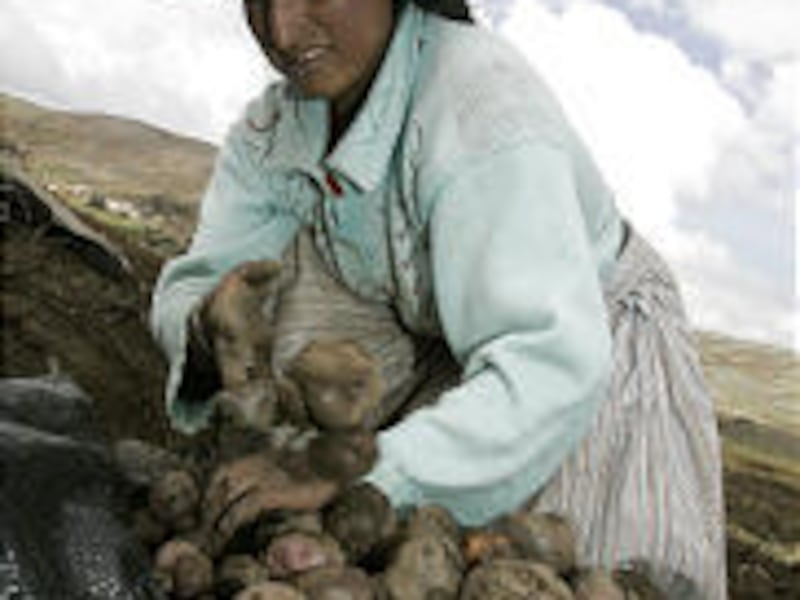
AYMARA, Peru — The humble potato puts on a dazzling display at 13,000 feet above sea level.
Along the frigid spine of the Andes, men and women in bare feet uproot tubers of multiple shapes and colors — yellow, red, blue, purple, violet, pink with yellow spots, yellow with pink spots; round, oblong, twisted, hooked at the end.
Their names in Quechua, the ancient language of the Andes, evoke an intimate human connection: "best black woman," "best red woman," "makes the daughter-in-law cry." "like a deer's white tongue."
Respect for the many variations of potatoes is so profound among Aymara's 650 villagers that it was a natural place for the world's agronomists to produce seeds for a gene bank to preserve their diversity. The cold climate also protects against parasites that infest low-lying potato farms.
In their annual harvest this year, the villagers of Aymara gathered more than 2,000 types of potatoes from a 2 1/2-acre field. Scientists from the Lima-based International Potato Center were there to replenish their bank and provide more seeds to Andean communities.
The center was founded in 1971 as a nonprofit, internationally financed research institution to improve production of potatoes and other root crops in developing nations. It maintains the world's largest collection of tubers — 4,500 types, including 3,000 from Peru.
It's one of some 1,500 gene banks around the world responsible for helping maintain biodiversity of food sources. Their scientists search for plants with certain traits — such as resistance to cold, drought, insects and diseases — that can be bred with commercial varieties.
The U.S. Department of Agriculture, for instance, keeps more than 2,500 apple varieties in Geneva, N.Y.
The potato center's scientists have discovered dozens of varieties of wild potatoes and rescued hundreds of types of domesticated potatoes from oblivion.
Researcher Carlos Ochoa, dubbed the "Indiana Jones" of the potato world, has alone found more than 80 types of wild potatoes.
The potato originated in the Andes near Lake Titicaca and has been eaten for at least 8,000 years, according to the center. It fed Incan armies as they expanded their empire along the Pacific coast of South America, and Spanish conquistadors brought it to Europe, said William Roca, a geneticist at the center.
The potato became the world's fourth most important food source, after wheat, corn and rice, proving so vital that it provoked a national famine when Ireland's potato crop was wiped out by a blight in the 1840s.
The Lima center, which provides seeds to communities that have lost their potato crops to diseases, freezes or a leftist insurgency, began helping Aymara improve its potato stock in 1990s.