

UINTAH, Weber County — The scent of fresh milk hangs in the air at the Beehive Cheese Co.'s store, which is hidden among a group of businesses at the mouth of Weber Canyon.
While the store may be a bit hard to locate, artisan cheesemakers Tim Welsh and Pat Ford found it the perfect place to start their business.
Welsh and Ford, who used to own a software company, wanted to do something different. In reading Steven Jenkins' book, "Cheese Primer" (Workman Publishing Co., $16.95), the pair discovered a renaissance in artisan cheesemaking had taken the country by storm.
According to the American Cheese Society, artisan cheese is produced in small batches, minding cheesemaking traditions with little use of machinery.
Realizing this market was largely unexplored in Utah, Welsh and Ford decided to learn to make cheese.
"I wanted to create something I could touch at the end of the day and feel passionate about," Welsh said. "The satisfaction comes from making something that can be tasted."
The self-proclaimed "foodies" sold their company and took six months to craft a business plan. They visited other cheese factories, learned the science of cheesemaking and designed a facility that would optimize cost and mechanical productivity.
They also had to choose the origins of their primary ingredient — milk.
Working with Gossner Dairy, the pair chose a small West Ogden farm as their milk supplier. The farm's herd is comprised of Jersey and Holstein cows that Ford said are humanely treated and aren't given growth hormones. "They (the farmers) practically know the cows by name," he said.
Their first batch of cheese, which they called Promontory cheddar, was made in September of 2005. They still have two 20-pound wheels of it in their cold-storage room — saved for a special occasion.
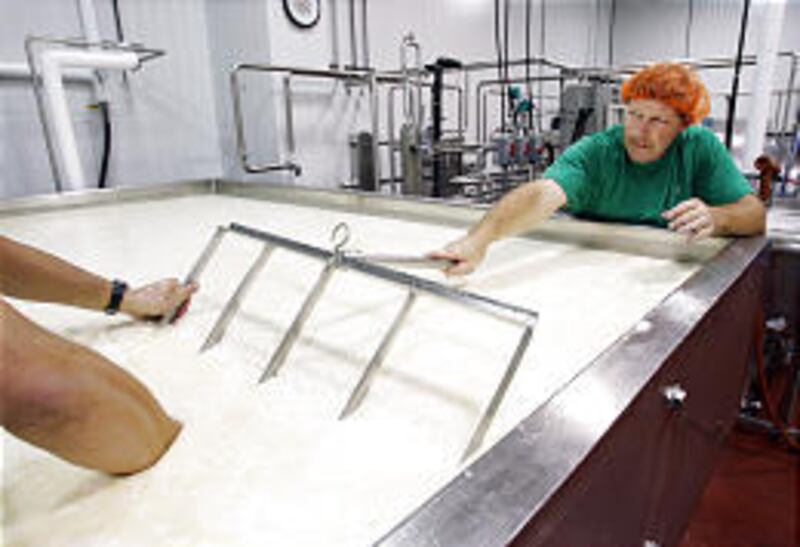
Beehive's cheesemaking process begins in a kitchen lined with a maze of stainless steel pipes leading to a stainless steel tub about the size of a Mini Cooper. During a visit by the Deseret Morning News, Welsh and Ford were making cheddar, which is why they were playing Celtic music in the background.
While it hasn't been proved that cheese is affected by the music, it inspires the makers, Welsh said.
The tub is filled with 4,500 pounds of pasteurized milk (since the cheese is measured in pounds, the milk is measured that way, too) and heated.
Once the milk reaches 88 degrees, "the perfect temperature for the bacterium," Welsh says, he pours a bucket filled with trillions of microscopic lactic-acid bacterium into the tub, which will chemically alter the milk into curds and whey.
"There is something about cheese that is so mysterious," Welsh said. "It's magical — it just transforms."
But the majority of the milk won't become cheese. "Cheddar is 10 percent yield from 4,500 pounds of milk," Welsh said. "You get 400 to 500 pounds of cheese from that."
That leaves 4,000 pounds of protein-rich whey, which Beehive Cheese sells to a local farmer who uses it as pig feed.
After a while, the milk begins to coagulate, and using a knife, Welsh scores the pudding-like mixture to check for firmness.
Once it's reached the right consistency, he and Ford run two large sterilized curd cutters through the tub — first lengthwise and then widthwise — cutting the mixture into fine curds.
Ford and Welsh then take turns pushing a large rake across the bottom of the tub, as the curds continue to set up.
While "raking," the two chat about the batch they're making, which will eventually become "Promontory cheddar" — a mild cheese that is one of their best-sellers.
"Milk changes with the season, and the cheese varies slightly." Welsh said. "Every batch is different — the cows' diets, season all determine the cheese."
As the curds are raked, they get firmer — the stage at which they "squeak" when you eat them. The curds and whey are then emptied into another tub where they are heated and stirred until the mixture reaches 125 degrees; the whey is then drained off.
The curds left in the bottom of the vat start to compact and are cut into slabs about eight inches wide before being "cheddared," the process that gives the cheese its name.
The slabs are then flipped several times to keep the moisture content consistent. Welsh and Ford are careful at first to keep the slabs from breaking apart, but by the final time, they're able to do it with one hand.
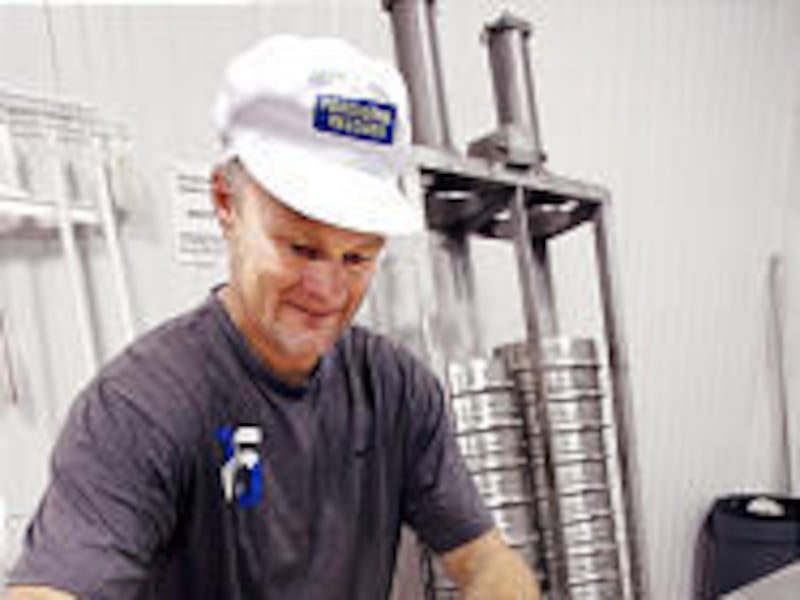
The slabs are then milled into thumb-size curds. They are then salted and shoveled into hoops and pressed. Each hoop of cheese weighs 20 pounds.
The process up to this point takes about six hours.
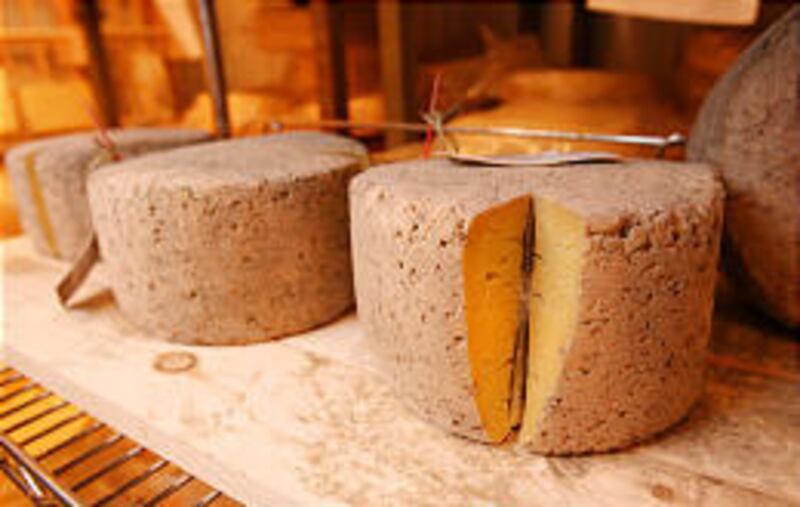
The pressed wheels are then placed into temperature- and humidity-controlled cold storage rooms, where they age. The longer the cheese sits, the sharper it gets. This is because the bacteria in the cheese eat more of the lactose (sugar) in the milk.
Typically Beehive Cheese's cheddar is left on the shelf a minimum of six months, but depending on how it tastes, it can be aged longer — up to a year and a half.
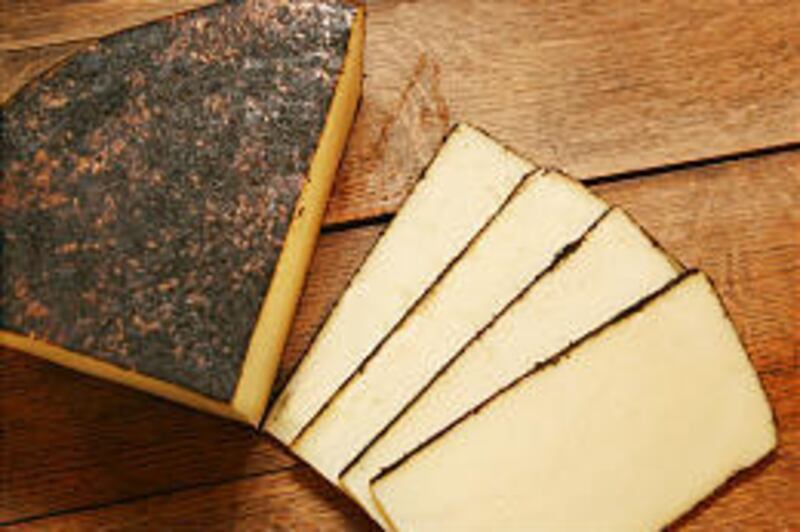
Beehive's storage room is packed with many creations: habanero cheddar, lavender-and-coffee-grind-rubbed cheddar, "Aggi" Ano Parmesan, Uintah Jack and a beer cheddar created for Squatters pub, among others.
Ford said their cheeses are more expensive but worth it. A pound of young cheddar starts at $13.50 a pound, and a year-and-a-half-old Parmesan can fetch $20 a pound. Besides their Uintah location, the cheeses are sold at specialty stores and farmers markets.
Utah is home to other artisan and farmstead cheesemakers who create unusual cheese products.
The Rockhill Creamery in Richmond makes "farmstead" cheese, which means it is produced with milk from a single herd on the farm where the animals are raised.
Rockhill owners Jennifer Hines and Pete Schropp milk their small herd of Brown Swiss cows daily to create their signature cheeses. A one-and a-half-pound sampler of their cheeses is $25.
Hines and Schropp keep a blog about their cows and adventures in cheesemaking. Their fresh, raw milk cheeses are produced in small batches, 40 gallons at a time, and served "European style," meaning it is only aged 60 days to eight months.
"There is a renaissance in cheesemaking all over the country," Hines said. "We are growing rapidly and hope to keep this farm alive in supporting this venture."
West Jordan is home to Drake Family Farms, an all-goat dairy that produces and sells milk, cheeses and soap. The Drake family has owned and farmed the land — now a designated Utah Centennial Farm — since the 1880s.
The farm, which has a herd of 50 Saanem, Nubian and "Snubian" goats (the latter is a mix between the two breeds), began as a 4-H project in 1984 and has grown into a thriving family business.
Shepherd's Dairy in Tooele County is known for its soft goat cheese that exudes a distinct pecan flavor when used in cooking. Owner Vaughn Oborn bought the dairy in 2004 and has since been handcrafting the nationally sold cheeses.
Flavors of roasted garlic, herb and spice, sun-dried tomato and cracked peppercorn can be found in their chevre and feta cheeses, which are sold through Wild Oats and local supermarkets. It costs $3.50 to $4.50 for a 3 1/2-ounce log.
E-mail: nhale@desnews.com