




Is it a good idea for parents to allow their children to be used as ratings fodder for a television network?
The parents of 40 children said, "Yes."
Those parents all had their reasons. The executive producer of the CBS "reality" show "Kid Nation" readily admitted that not all had their offspring's best interests at heart.
"Sure, I mean, there were some parents who ... absolutely thought of this as a 40-day vacation from their children," said Tom Forman.
And all the parents signed 22-page legal documents absolving CBS and the producers of any responsibility for injuries, working conditions or unsafe housing and agreeing not to sue even if their child died during production.
It's not hard to understand why a for-profit corporation would use kids for ratings. But the question of whether parents should send their children — some of them as young as 8 — off for two months is at the center of all the controversy swirling around "Kid Nation."
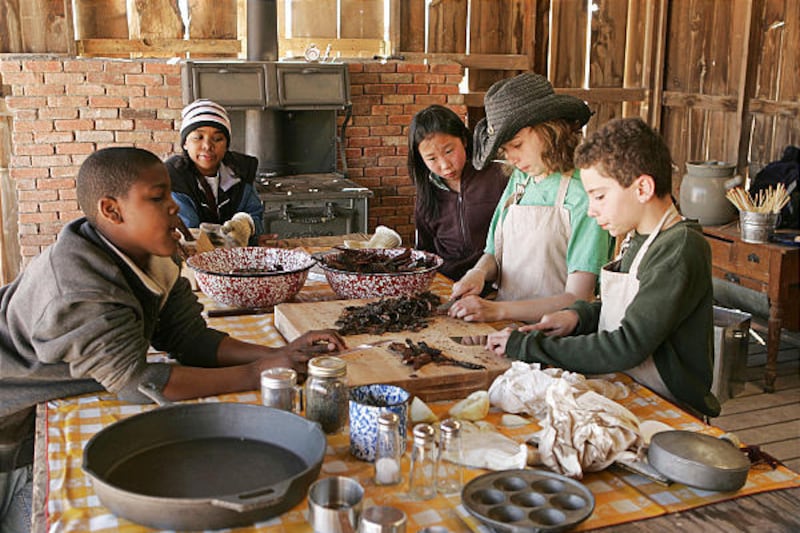
The show features 40 kids between the ages of 8 and 15 "rebuilding" a New Mexico ghost town and building their own society. "Kid Nation" documents their trials, tribulations and triumphs.
It's not a competition. Nobody is voted out, although kids could leave before the six weeks were over. (And, according to Forman, some of them did.)
The kids were not allowed to call or e-mail their parents for two months. (The only exception: the one child chosen each week by his or her peers to receive a gold star — a literal gold star worth $20,000 — was allowed one call home.)
Among the controversies surrounding the show:
• Did the producers and CBS violate New Mexico's child labor laws? While participants were each paid $5,000 — plus those $20,000 bonuses — "These kids were not employees of CBS," CBS Entertainment president Nina Tassler insisted.
"The participants are just that. They're participants. They're not acting," Forman said. "And on that basis, we didn't see a labor problem."
He argued it was like summer camp they just happened to film.
"They woke up whenever they felt like it," Forman said. "They set their own bedtime.... We taped whatever happened."
Others are less sure. Reportedly, kids were being filmed up to 18 hours a day.
Jeff Hermanson, an official with the Writers Guild of America (whose members have lost jobs because of the proliferation of "reality" shows), called the genre "the sweatshop of the entertainment industry" in an interview with the Los Angeles Times. "What's happened with 'Kid Nation' is typical and universal, but it's much worse because it's about children."
The attorney general of New Mexico has re-opened an investigation into the production, and Forman admitted that he could not have produced "Kid Nation" in California or a number of other states because it would have violated their labor laws.
There's talk that, if there's a second season — and CBS is already soliciting applicants on its Web site — it would be produced outside the United States to avoid child labor laws.
• One mother filed a complaint alleging "abusive acts to minors" after her 12-year-old daughter was burned by spattering grease.
The Santa Fe County Sheriff's Office said it found no criminal wrongdoing.
In addition to those (apparently minor) burns, one girl sprained her arm (she was taken to the local emergency room for X-rays) and four kids inadvertently drank bleach (but did not require medical attention).
• Forman was indignant when asked if any of the kids were involved in sex or drugs — a legitimate question, given that some of these kids were 15. And he stated categorically that nothing like that happened.
But his indignation was apparently feigned. That waiver the kids' parents signed included a clause absolving the producers and the network of any responsibility for "emotional distress, illness, sexually transmitted diseases, HIV and pregnancy."
• To defend themselves against charges that the kids were exposed to unsafe conditions, CBS and the producers were forced to admit that — like most "reality" shows — a lot of what we're going to see is, at best, a creative interpretation of the reality.
This was not 40 kids left on their own to build a town. This was 40 kids surrounded by "hundreds" of adults just off-camera.
"A large adult safety net was there to make sure that if anything happened we had a contingency plan in place," Forman said. "There were . . . pediatricians, child psychologists, an animal wrangler ... mostly standing back and watching the kids with instructions to step in if something was going wrong and anybody was in danger."
Whether or not anything went wrong, the fact remains that CBS and the producers acknowledged that possibility going in — and 40 sets of parents didn't blink.
• It's not a question unique to "Kid Nation" — children have been part of "reality" shows ranging from "Supernanny" to "Brat Camp" — but should kids be exposed to the scrutiny and potential ridicule that goes with being on a network show? Even if the kids want to and their parents willingly sign away their rights?
Forman said "Kid Nation" was edited more carefully than other "reality" shows, but, in essence, the producers told the parents, "Trust us," and the parents did.
• If there's blame to be assigned, CBS and the producers are assigning it to the kids' parents.
"They knew full well what was involved, and they embraced this opportunity for their kids," Tassler said. And parents did sign those waivers.
Predictably, the parents
CBS has made available for interview heap praise on the program. Of course, these are the same parents who thought it was OK to send their kids off for two months in the middle of the school year, putting them in the hands of people unwilling to take responsibility for injuries, working conditions or unsafe housing.
And parents signed an agreement putting themselves on the hook for a $5 million penalty if they spoke to anyone about the show without the network's permission.
Reportedly, about a quarter of the parents have expressed concerns about the production, but have been unable to do so publicly because of that penalty.
• By producing the show in April and May, quite obviously kids were yanked out of school. It's hard to argue that taking kids away from their schooling for two months was good for them.
"It was a scheduling decision, and I'll be perfectly honest with you," said Forman, who insisted that "in every case we sat with them and talked to the school district to make sure this doesn't affect them adversely in any way at all."
In a way, all of this controversy is exactly what CBS was hoping for.
"In order for a reality show ... to really get out there and change the landscape of television, you have to sort of stir public debate. We know we're going to create some controversy," said Tassler.
But some advertisers were getting nervous. CBS, which generally doesn't show episodes of reality shows before they air, has screened the "Kid Nation" premiere for several of them to keep them from pulling out of the show.
(The network has yet to screen a full episode for critics, either. What we have been shown is intriguing, but many questions remain.)
CBS's defense in all of this is that this is sort of the way reality shows go — people attack a program before they see it, then the controversy dies down. The network points to last fall's "Survivor," when teams were divided along racial lines, and sister network UPN's "Amish In the City," both of which proved critics wrong.
But those shows featured adults; "Kid Nation" features children. And CBS can't or won't acknowledge that that makes a difference.
Neither can or will Forman, who insisted any controversy over "Kid Nation" has been manufactured.
"I lived it for 40 days, and so I know what happened. I talk to these kids constantly now, so I know how they're doing." he said. "So if I don't seem to share everybody's concerns, it's not that I'm not a parent and not that I don't care. I just have the benefit of a little bit more information."
Forman argued that those who object to the premise of the show "don't give the kids enough credit."
And he defended the project by insisting that the kids "loved it."
"What we have is 40 kids now who wish is wasn't over, who saw this as the greatest chance they've ever had to prove something to the adult world out there — that they could actually show us up.... I think I give them more credit," The question is not, however, how much the kids liked the experience, it's whether kids ought to be used as ratings fodder.
Forman didn't have an answer for that.
E-mail: pierce@desnews.com