

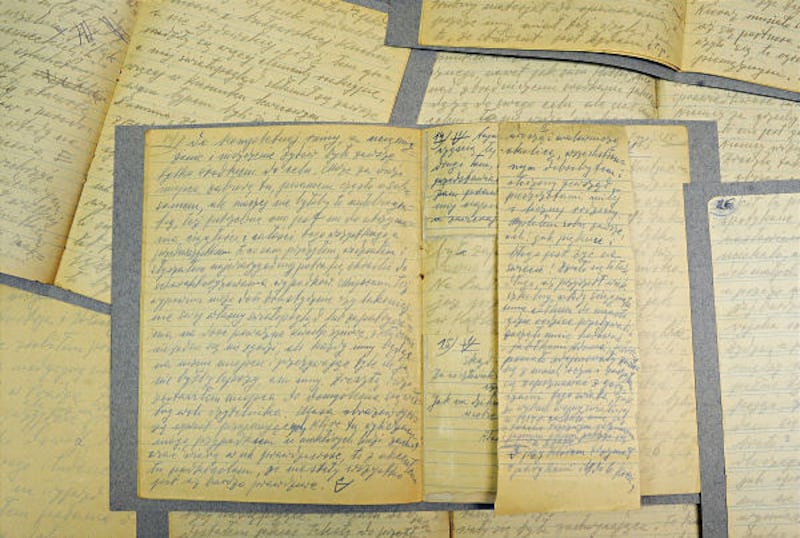
WARSAW, Poland — Baruch Milch was hiding from the Nazis in occupied Poland in the summer of 1943. His wife and 3-year-old son had been killed in Hitler's Holocaust.
All the Jewish doctor had was his diary — a chronicle he hoped would help "take this huge weight off my heart and off my soul." Over 1,600 pages of thin copybooks and slips of paper, he scrupulously recorded his feelings.
Now, his Israeli-born daughter wants Warsaw's Jewish History Institute to hand over the journal so she can take it to Israel. But the institute counters that "the pages should stay where they were created."
Milch's entries make for heart-rending reading.
"I could not cry a single tear, which could have helped me somewhat," he wrote about the day he found his sister-in-law gunned down at the cottage where she had hid with his wife, who, he learned, also had been killed.
"I could not stop thinking about what pain they must have died in, especially my wife, who was very frightened: How much they wanted to live!"
The Jewish History Institute has had the journal since Milch gave it to them. His daughter, Haifa resident Ella Milch-Sheriff, says it is rightfully hers.
"For me, this is the most important thing that was left by my father," Milch-Sheriff told The Associated Press during a visit to Warsaw. "I want to have the diary with me, at home ... I want to be able to see it, to touch it, I want my children to see it."
Milch-Sheriff has been offered a high-quality copy of the diary, but says she wants the original in Israel — either with her family or in a museum.
The institute holds hundreds of artifacts and writings documenting almost 1,000 years of Jewish history in Poland, including some 300 manuscripts written during the Holocaust. It says Milch's words are an important part of that history.
"They were written here, in Polish, and speak about events that took place here," said director Eleonora Bergman.
Before World War II, Poland had a thriving Jewish community of some 3.5 million. Once occupied by the Nazis, the country became home to the death camps central to Hitler's killing machine.
Only 250,000 Jews survived, and many fled after the war.
Milch, who died in Haifa in 1989 at age 81, wrote the journal from mid-1943 to early 1944 — a time when he hid in barns, stables and even holes in the ground.
The diary presents a firsthand account of mass murders by the Nazis and a pervading sense of doom.
"My recent experience and the situation I am in have shaken my mind so much ... that I think that no one has gone through as much as I have gone through," he wrote in July 1943.
"Despair, suffering and the pain of recent days leave me no peace day or night and chase away any other thought. I am afraid that every moment may bring danger and I may not finish this work."
In another passage, Milch recalls hiding in a barn with his wife and her relatives.
Milch's young nephew was making a lot of noise, jeopardizing the whole group.
His brother-in-law grabbed the boy — his only son — by the throat and squeezed.
"Everybody froze, I was running frantically around. Suddenly I ran up to my brother-in-law and I grabbed his hand, and he asked: 'Should I let go?' I kept saying: 'Yes, No, Yes, No,' not knowing what to do," Milch wrote.
"My brother-in-law did not take his hand off his son's throat" and the boy died.
When Milch decided to go to Israel after the war, he entrusted the diary to the Jewish Historical Commission in Poland. It later became the Jewish History Institute.
Excerpts of the diary were printed in 1989 in Poland and an abridged version was released in 2001 under the title "Testament."
Milch-Sheriff agreed to make a written request for the diary after a meeting two weeks ago with the head of Poland's State Archives, Slawomir Radon.
Her request has not arrived, but Radon said the law stipulates that Holocaust documents cannot leave Poland.
"It is a very difficult issue," Radon said. "Privately, I understand that the daughter wants to have a diary written by her father, but according to the law ... we cannot allow this diary ... to be taken away."