

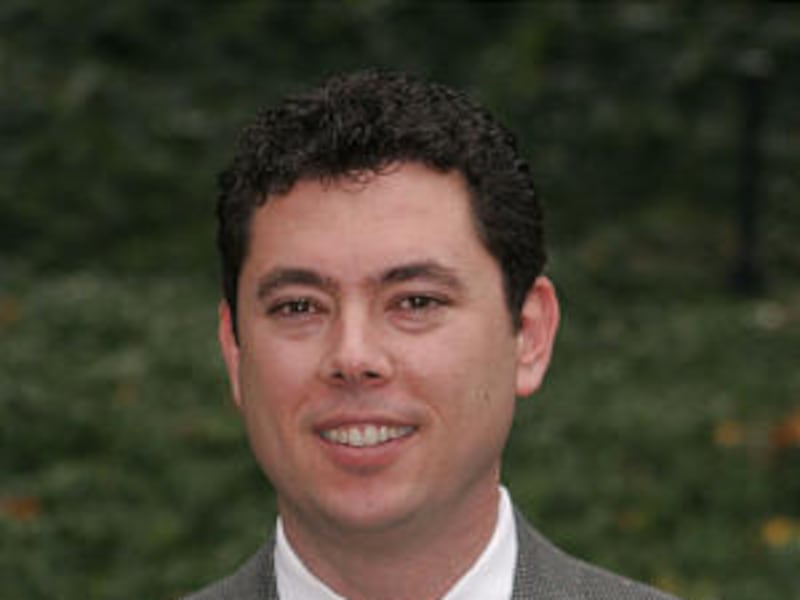

PROVO — Texas Gov. George W. Bush had boots on under his suit and chewed on a cigar he would never smoke. He repeatedly called a Texas TV producer "Benny" instead of Bennion.
Bennion Spencer's visit with the future president of the United States and member of a Republican dynasty launched him down a path that now has him running as a Democrat for Congress in Utah's 3rd District.
A few years earlier and across the country in the Massachusetts home of Michael Dukakis, Jason Chaffetz argued about the death penalty with the Democratic presidential nominee as Dukakis stood on a chair and changed a light bulb.
Soon after, Chaffetz left the Democrats for the Republican Party and, ultimately, a race against Spencer that will determine the successor to six-term Congressman Chris Cannon.
Since Chaffetz and Spencer flip-flopped parties, their similarities are no surprise. As the Democrat in red Utah, Spencer is running closer to his brief Republican past while Chaffetz has bolted far from his old Democratic roots.
Raised a Democrat in Utah, the Republican Party began to reel in Spencer when he was a Weber State College student. He was the news director of a radio station when campaign workers for a wannabe senator named Orrin Hatch asked Spencer to salvage Hatch's radio spots.
"Hatch probably still doesn't know this," Spencer said, "but I rewrote them. I don't know if it made a difference in the election, but now I wish I'd done it differently. You can tell (Sen. Hatch) has been in Washington too long because he cares more about defending a fellow Republican like Ted Stevens than about corruption. It's time to check out and come home. He's lost his moral compass."
Now 56, Spencer earned a degree in broadcast journalism — and promptly took a job with the Republican National Committee, home of Karl Rove and Lee Atwater. His first assignment was to to go San Francisco and work on a special election to replace a murdered congressman. Spencer's RNC team lost badly.
"We just got creamed," he said. "The county chair ran the Democratic campaign against us. She was good. Her name was Nancy Pelosi. A lot of people can hate her in Utah, but I what I saw was a devoted wife and mother, very smart and talented, who was just good at politics."
Spencer left the RNC after three years to work in television news. In 1985 he joined KSL-TV, where he produced the 10 p.m. news for a decade and became close friends with legendary anchor Dick Nourse, who has endorsed him.
As a producer, Spencer was part of interviews with presidential hopefuls like Ross Perot, Walter Mondale and Gary Hart. In the mid-90s, he moved to Texas, where he was the producer for an interview with Bush. During the interview, Spencer recalled, Bush praised the two-party system and told Spencer that his good friend "Mikey" — then-Utah Gov. Mike Leavitt — often whined to Bush that he couldn't get things done in Utah because of the one-sided Republican nature of the Legislature.
Mikey, Bush said, always asked the Texas governor to send him some Democrats.
"Benny, why don't you go home and do it?" Bush said. "I'd like to get on the phone to Mikey and say Benny's coming up to run as a Democrat."
Spencer's contract had a year left, and he had an opportunity to teach at the University of Utah, so he began to think about it. Bush was relentless. He sent a card to Spencer: "Benny, you promised. Signed, W."
Spencer hadn't promised, but he returned to Utah and ran unsuccessful campaigns against Republican state senators Chris Buttars and Howard Stephenson.
Now he hopes to convince 3rd District voters that a conservative Democrat pushed toward politics by President Bush should represent them in Congress.
Chaffetz, Spencer and Jim Noorlander, 49, a Constitution Party candidate who earned 9 percent of the vote two years ago, all support traditional marriage, the death penalty and the right to bear arms. They are all pro-life and oppose fetal stem-cell research and bringing nuclear waste to Utah.
Spencer proposes immigration reform, but Chaffetz is tougher on illegal immigration, so tough that Spencer calls his position offensive. Chaffetz favors keeping the Bush tax cuts while Spencer opposes that. Chaffetz also wants to get rid of earmarks; Spencer says they help Utah. (To learn more, read their bios and responses to the Deseret News questionnaire at deseretnews.com/utah/election/candidate.)
Clearly, Spencer breaks with Barack Obama on a number of issues. Being on the same side of the ballot as his party's presidential hopeful could harm him in Utah, but Spencer is hopeful that his own history as a candidate in part of the district and the popularity of Salt Lake County Mayor Peter Corroon will keep some voters from voting a straight-party GOP ticket.
Chaffetz, 41, has some instant name recognition because the converted conservative was a placekicker for the BYU football team in 1988 and '89. At the 1988 Freedom Bowl, Chaffetz tied the game with a 31-yard field goal with four minutes left, then won it with a 35-yard kick with 2:33 to go.
"Fortunately," Chaffetz joked, "we never lost a game by the margin of one of my kicks, or I'd be living in San Diego."
Just a month before the Freedom Bowl win, he'd wrapped up a stint as Utah co-chair of Dukakis for President. The only reasons he got the job were because he was a "shoestring relative" of Dukakis and had name recognition as BYU's kicker.
His father, John Chaffetz, previously had been married to Kitty Dickson. The couple had a son before divorcing. Kitty Dickson then married Michael Dukakis. Jason Chaffetz spent summers in Maine with his half-brother, John, and the Dukakis family.
After Chaffetz by chance landed a BYU scholarship, joined The Church of Jesus Christ of Latter-day Saints and worked for his half-brother's dad on his presidential campaign, he gradually did a 180-degree political turn. The transformation is so complete that his half-brother John Dukakis shook his head after he looked through Chaffetz's campaign material.
"I don't think I agree with you on any one of these issues," he told Chaffetz.
"Yes!" Chaffetz said he thought at the time. "We're on the right track."
What Chaffetz said he learned from traveling with the Dukakis campaign was that he could do what Dukakis' advisers did.
"At the end of the day, it's just 12 guys in a room showing up," Chaffetz said.
In August, Mitt Romney, the runaway presidential choice of Utah Republicans in the state's primary, endorsed Chaffetz. That endorsement appeared unthinkable a few months earlier. In the spring, many thought Chaffetz was the third wheel in a three-way race for the Republican nomination with incumbent Cannon and Leavitt's younger brother David.
But Chaffetz had been working for more than 18 months, laying the groundwork with convention delegates and creating a message that resonated with voters frustrated with Congress and with Cannon.
With less money but clearly the best grass-roots organization, Chaffetz stunned Leavitt at the convention after a rousing speech scored with state delegates.
"People forget I started long before that speech talking to delegates," Chaffetz said. "I worked two years to make a seven-minute speech, and I put it through the uprights."
In the June primary, Cannon outspent Chaffetz 6-to-1 and had endorsements from nearly the entire Republican establishment in Utah, but Chaffetz won a landslide, 20-point victory.
The hard work doesn't surprise his father, who watched him kick 3,000 footballs a week during high school.
"I'm impressed with how well he's held up," said John Chaffetz, who saw his son at a family gathering in California two weeks ago. "His schedule is punishing, but he is unrelenting. When he sets a goal, he works his fanny off."
On Tuesday all the work will be over, and 20 years after George H.W. Bush defeated Dukakis, either Bush's son or Dukakis will have played a role in the election of a Congressman from Utah — for the opposite party.
E-mail: twalch@desnews.com