

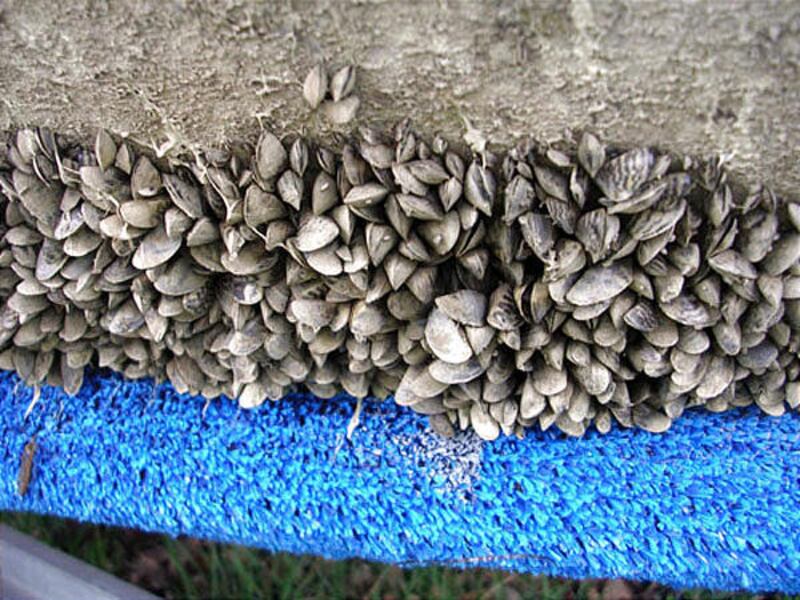
It's no longer a case of if or when the feared zebra mussels might show up in Utah — they're in Electric Lake.
The big questions now are where else they are and how to stop them from spreading?
Division of Wildlife Resources' Larry Dalton said Wednesday anyone who drinks water or goes fishing in Utah could be affected by the spread of zebra mussels to other bodies of water. Once established, adult mussels no bigger than a person's thumbnail can rob a lake of plankton that fish need for food or clog pipes needed to distribute drinking water.
"This is a very big deal," Dalton said. "And it's a teeny mussel that's doing it."
Rigorous testing at two labs in Colorado that began Sept. 10 finally came back positive Nov. 14 for the presence of zebra mussel DNA in Electric Lake, located in central Utah. It's one of 150 lakes Dalton said he'd like to monitor throughout the state, but his budget this past year has afforded testing of only 54 lakes.
Out of that round of testing, additional analysis is ongoing for eight lakes where a "suspicious" finding has indicated the presence of mussels. Huntington Reservoir, which is down stream from Electric Lake, has been dubbed suspicious. Others in that category are Lake Powell, Pelican Lake and Red Creek Reservoir.
There have been "negative" test results indicating no mussels in Bear Lake, Pineview Reservoir, Willard Bay, Utah Lake, Jordanelle and Strawberry reservoirs, Yuba Lake, Fish Lake, Otter Creek, Sand Hollow and Quail Creek reservoirs and the Mammouth and Scofield reservoirs.
"It's very complicated and there's a lot of work out there being done," Dalton said.
The mussels start out microscopic in size and by the time they're about 4 millimeters, roughly the size of a sunflower seed, they can breed. Adults range in size of about 15 millimeters to 20 millimeters.
Electric Lake is above 8,000 feet elevation and cold to frigid throughout most of the year, and in recent years seldom used by boats any larger than one that could fit on the top of a car, Dalton said. All of that added up to Dalton figuring that Electric Lake would have been one of the least likely places mussels would have shown up first in Utah.
Exactly where they came from is still a mystery, but one theory Dalton put forward is that industrial activity in and around the lake could be the culprit. Specifically, drilling by the energy industry or at the dam involves the use of water trucks. Dalton said any one of those water trucks could have hauled water from an infested source outside of Utah. There has been a lot of oil, gas and coal activity in recent years around Electric Lake, whose dam also needed work to fix a leak, he said.
"It's one of many pathways," Dalton said about the water truck theory, which is justification enough for the DWR to consider a new layer of oversight to prevent the spread of mussels.
The DWR's game plan throughout Utah has been to approach boaters getting ready to drop in, asking what other water bodies the boats have been in and decontaminating some boats before their owners are allowed to recreate on a lake.
At Electric Lake, Dalton said the emphasis is now on draining boats there, washing them off and allowing them to dry at home before boating elsewhere. The recommended drying times are seven days in summer, 18 days in spring or fall and 30 days in winter, or until there is a freeze.
Dalton said workers are also looking on logs and rocks at Electric Lake for adult zebra mussels, but none have been found so far. The fact that lab results now show that breeding of mussels has been taking place at Electric Lake means adults may show up within the next three or four years, Dalton said.
E-mail: sspeckman@desnews.com