

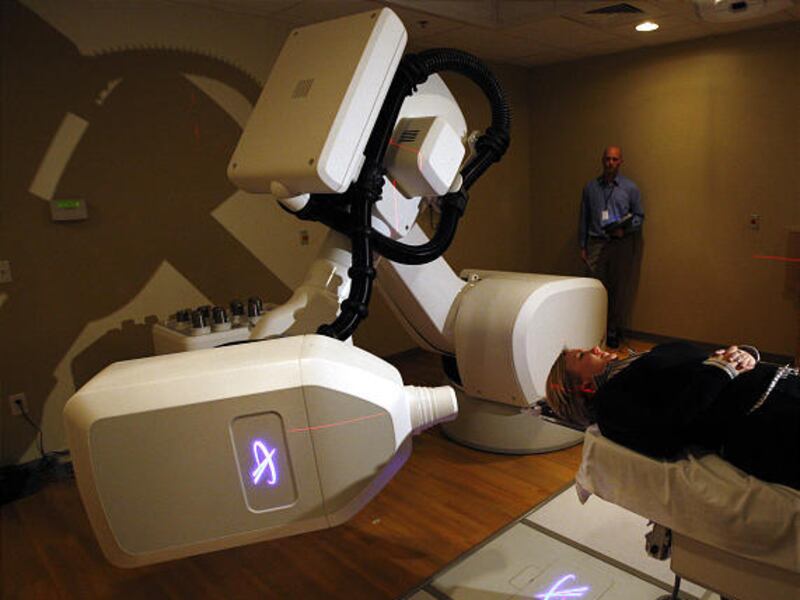



Noninvasive cancer treatment using robotic delivery of stereotactic radiation therapy anywhere on the body is now available in Utah.
The Cyberknife, created by Accuray, is unique because it can deliver high-dose radiation to even a moving tumor such as lung cancer, according to Dr. Leland Rogers, a radiation oncologist with Gamma West Radiation Therapy and medical director of Salt Lake CyberKnife, a collaboration among area physicians, Salt Lake Regional Medical Center and US Radiosurgery.
That ability to compensate for movement, combined with the fact that there's no incision, no pain, pinpoint accuracy and little or no recovery time means the Cyberknife can be used to kill some tumors that have traditionally been considered inoperable, Rogers said. Those factors also mean that patients who would not be candidates for traditional surgery might benefit from the technology.
CyberKnife treatment typically consists of one to five outpatient visits.
The device uses a linear accelerator and a computer that combines previously taken Computed Tomography images of the tumor (other types of scans may be used for different types of tumors) with constantly updated low-dose X-ray images of the patient on the table to precisely target a tumor, malignant or benign. A "gun" within the accelerator rapid-fires electrons to a cup-shaped metal device that has a hole that creates a pinpoint-accurate beam as the electrons convert to radiation. The "cups" come with various-size holes, depending on the size and shape of the tumor. Before it "fires" each 10- to 15-second beam of radiation, the CyberKnife System takes another pair of X-rays to compare to the CT scan. That's why small movement is no deterrent. The robotic arm that contains the linear accelerator just compensates.
CyberKnife is unique in that it can be used for tumors anywhere in the body, including the spine and the lungs, said Jim Sweet, physicist, who demonstrated the machine Monday. Nothing is attached to the patient to prevent movement.
The technology, Rogers said, conquers something that was "absolutely impossible, following tumors that move." Because lung tumors shift with breathing, for instance, this type of radiosurgery was previously not possible. In the case of lung tumors, the patient wears a vest with LED lights on it to help the machine read the movements created as the patient breathes. The machine adjusts to hit only the tumor.
The high-dose radiation treatment protects healthy tissue by delivering its beam through 120 nodes, each with 10 different positions. Rogers likens it to the hood on a salon's hair dryer, with its tiny holes. The CyberKnife works in a similar half-sphere design. The nodes are those holes, the beams delivered from various directions through whatever configuration of nodes is needed so that all of them reach the tumor to create a high concentration of the tumor-killing radiation while sparing healthy cells from damage.
Treatment typically takes about an hour, although it can vary depending on location of the tumor, whether the patient has previously had radiation treatment, how close other vital organs are and other factors.
Salt Lake CyberKnife is located at 3820 S. 700 East, Suite 105, in Salt Lake City.
E-mail: lois@desnews.com