


Bison are back in the Book Cliffs.
Though native to the Uintah Basin area, bison haven't roamed those hills for more than 100 years. Researchers have relied on memoirs from hunters and explorers as well as a few skulls and rock art to confirm their existence in the Book Cliffs and eastern Utah.
And for the past 30 years or so, biologists have dreamed about — and worked on — finding a way to return bison to that area.
"As we settled the West, livestock producers didn't want to compete with bison," said Dax Mangus, biologist in charge of the Book Cliffs. "And it was also a strategy of the U.S. Army in their war with the Indians to eliminate their food source. Through a number of things, bison were eliminated from the West."
Thanks to persistence, creativity, a whole lot of planning and negotiating, bison will once again roam the Book Cliff area.
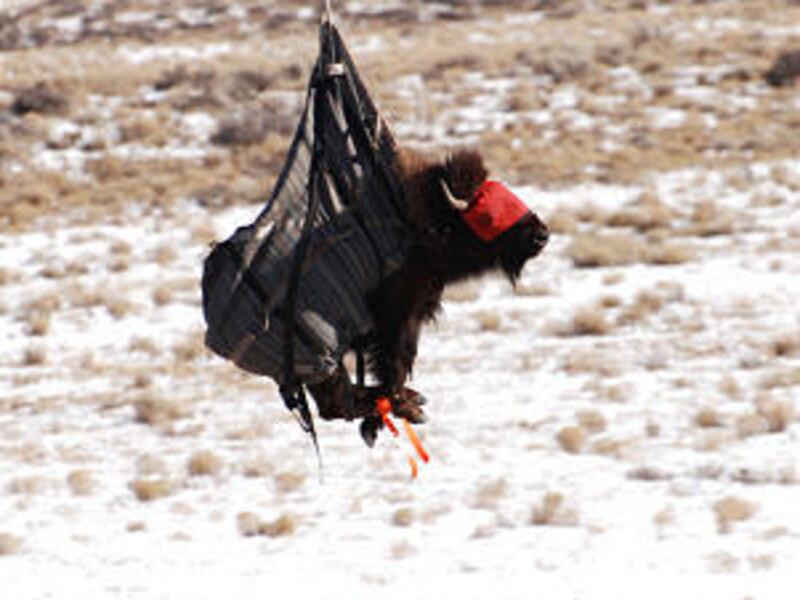
This week, 45 bison, including seven bulls, were moved from the Henry Mountains, which is between Capitol Reef and Lake Powell, to the Book Cliffs. The bison were located by helicopters and captured with nets. Then they were flown, using a sling, to a staging area, where blood samples were taken, and loaded into trailers. They then drove them to Antelope Island, which acted as a staging area for the newly formed herd.
Wednesday the first load of bison was on its way from Antelope Island to the Book Cliffs.
"Everything is going really well," said Mangus Wednesday morning. "We processed all of the animals at Antelope Island (tested them for disease), and they're on the road and soon to be released."
The release will return these iconic animals to one of their native homes, and it was done with the help and cooperation of livestock producers and landowners, as well as many other public agencies.
"There were some concerns (from ranchers) at first," said Mangus. "But it's an ongoing process and it took years to work it all out. One of the major livestock producers, the one most likely to be affected by the herd, wrote a letter of support for the transplant."
Mangus said biologists feel the area can support up to 450 animals, but they will continually monitor the bison and the habitat to ensure there is balance.
"We're very optimistic that everyone can get along out there," he said. "It will be neat, and for some, like Dave Olsen, who was the chief biologist out there before me, it fulfills a career-long dream."
The herd becomes the third bison herd in Utah, with the other two being Antelope Island and the Henry Mountain Herd.
"A lot of people are really excited to see bison return to this area," said Mangus. "People won't have to drive to Yellowstone to see bison."