

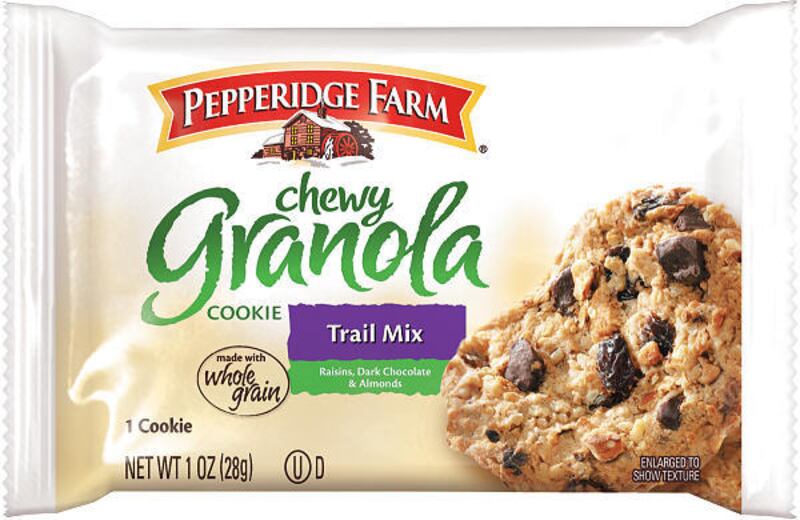
Pepperidge Farm Granola Cookies. Crunchy Dark Chocolate Almond, Crunchy Triple Nut, Chewy Trail Mix, and Chewy Fruit & Nut. $3.69 per 7.2-ounce to 8.6-ounce bag.
Bonnie: These crunchy and chewy granola cookies are the first line of Pepperidge Farm cookies made with whole grains. They contain three kinds of oats — steel cut, rolled and quick-cook oats, and more than half of their flour is whole grain. This still adds up to only 6 to 9 grams of whole grains per cookie, or a mere third to a half of one whole-grain serving. As a refresher, our government's dietary guidelines suggest we eat at least three servings of whole grains each day. One cookie also contains about 130 calories, 6 to 7 grams of fat and 2 grams of fiber.
That wouldn't be so bad if they tasted great. But, truth be told, I wasn't wild about any of these. They're so dry and crumbly that they pretty much won't go down without a glass of cold milk — which is the best thing about them, if you ask me.
Carolyn: Pepperidge Farm cookies are almost always delicious. Can they also be good for you?
These new granola cookies are Pepperidge Farm's most concerted effort toward wholesomeness yet, at least on the cookie side. (The company already makes a number of healthful-sounding breads.) And as for fat and calories, one of these cookies is quite similar to a granola bar. But they taste more like oatmeal cookies studded with serious amounts of nuts, raisins and dark chocolate — in other words, the premium cookies we have always known Pepperidge Farm to be.
The Crunchy Triple Nut and Chewy Trail Mix were my favorites. Oatmeal cookie traditionalist that I am, I would have preferred raisins to the dark chocolate in the Crunchy Dark Chocolate Almond. But only the Chewy Fruit & Nut is dry enough to mistake for health food.
Jif Natural Peanut Butter Spread. $2.70 per 18-ounce or $4.15 per 28-ounce jar.
Bonnie: Jif is now offering a Natural Peanut Butter Spread containing only five ingredients, half the sodium of regular peanut butter and 3 grams of saturated fat.
This new natural product cannot be called "peanut butter" because it does not fit the government's standard of identity. That standard requires 90 percent peanuts and, if a stabilizer is used, partially or fully hydrogenated oil.
Jif Natural does contain 90 percent peanuts but uses palm oil as the stabilizer. Since palm oil isn't hydrogenated, Jif Natural can't be called peanut butter, even though palm oil contains no trans fats, which is good in terms of health. So is the fact that this contains only 75 milligrams of sodium per 2 tablespoon serving, or about half of most regular brands.
It tastes good, too.
Carolyn: Isn't peanut butter grand? Not only does it taste great, but it's also good for you (in the sense of providing a lot of cheap protein), and easy to use both by itself (just spread it on anything!) or in recipes. Given all this, I was shocked to learn that in many other countries peanut butter is considered as odd as the Australian and New Zealand Marmite yeast spread is here.
The cause for this PB appreciation and rumination? The debut of a natural version of what has always been my favorite peanut butter brand. Unlike the natural peanut butter sold at health food stores, Jif Natural is mostly pre-blended, although you will probably want to stir in the eighth-inch of oil sitting on the top before spreading. The main difference between this and regular Jif is the texture: This is a lot softer and looser, like peanut butter when it's spread on hot toast (my favorite way to eat it). It's also a little duller, from not having as much salt.
How is this new product different from the existing Simply Jif? Jif Natural has the same amount of sugar as regular Jif; Simply Jif has one-third less. But the names are so similar I think Jif should change Simply's name to Lower Sugar or replace it with an all-in-one, reduced-sugar-and-salt Natural. Fat is what's responsible for peanut butter's great taste anyway, and all these Jifs have that in spades.
Explorer's Bounty Tribal Stone Crackers. Original, Cinnamon, Onion, and Garlic. $3.99 per 3.52-ounce box.
Bonnie: This new line of organic Tribal Stone crackers is made from Rainforest Alliance Certified yuca. Yuca is that starchy, fibrous, tuberous root also know as cassava or manioc. You may be more familiar with the flour made from its roots — tapioca.
These yuca-based crackers contain no artificial ingredients or preservatives, no added sweeteners and are gluten-free, with only 20 calories and no fat, the latter being unusual for a cracker. These are perfect to serve with anything, and they're pretty tasty!
Carolyn: Bonnie says these are pretty tasty. I say this is one of the least-appealing new products I've tried in at least five years. These new Tribal Stone Crackers from Explorer's Bounty are thick, heavy, dry and almost as tasteless as the stone that was used to grind the yuca flour. The only real flavor here is in the added onion and cinnamon in those varieties, but it's not enough to make up for the many other deficiencies in these crackers.
In fact, these are so bad, that I assumed yuca had some magical nutritional properties to explain why anyone would make or buy them. But no. Driven instead by an environmental agenda, Explorer's Bounty was able to find some farmers willing to grow this popular South American starch in a way that doesn't hurt the planet.
But these crackers will greatly lessen the appeal of any cheese or pate you put on it. The core ingredient may be called yuca, but I say yucky.
Bonnie Tandy Leblang is a registered dietitian and professional speaker. She has an interactive site (www.biteofthebest.com) about products she recommends. Follow her on Twitter: BonnieBOTB. Carolyn Wyman is a junk-food fanatic and author of "The Great Philly Cheesesteak Book" (Running Press). Each week they critique three new food items. © UNIVERSAL UCLICK