

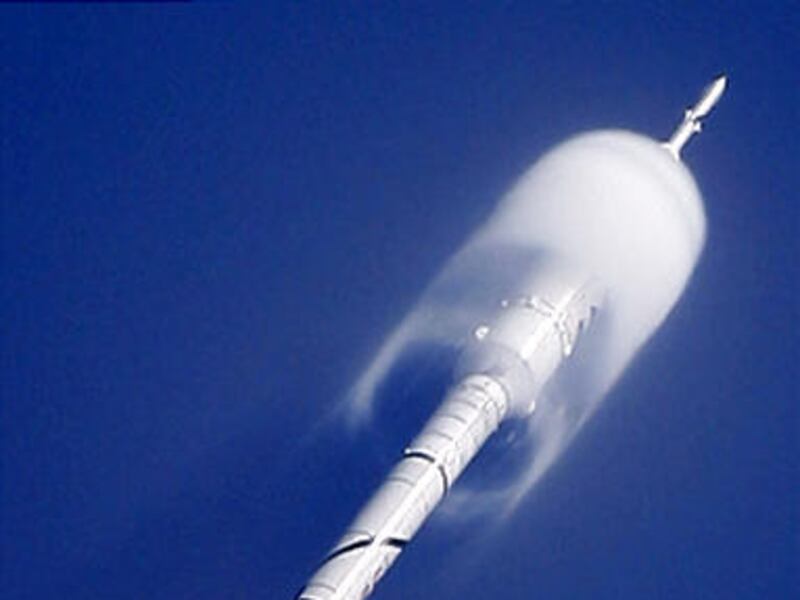
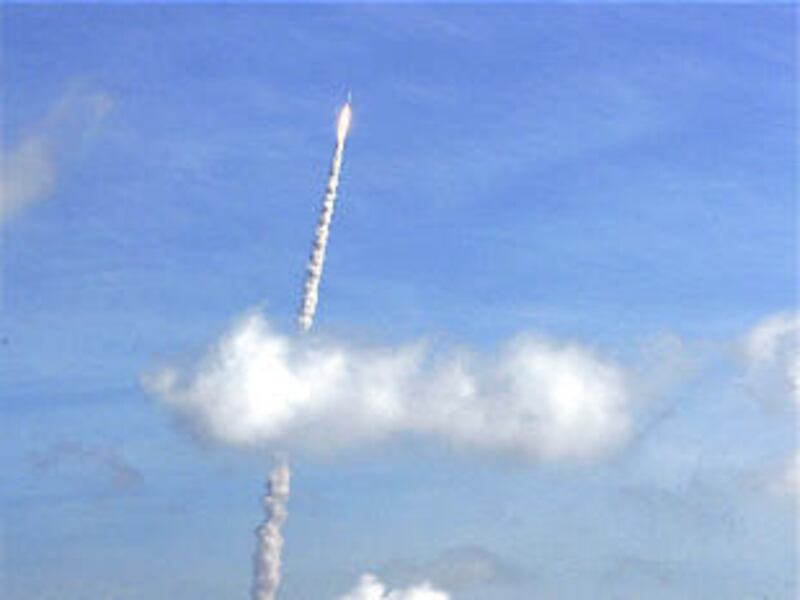
If the United States decides not to go back to the moon and on to Mars a decade from now, no one will be able to blame Alliant Techsystems, executives with the company said shortly after Wednesday's unmanned test launch of the Ares I rocket motor they and 5,000 Utah employees helped design and build.
"This flight test is the culmination of four years of progress and is the critical first step to launching America beyond low-Earth orbit," said Mike Kahn, ATK Space Systems' executive vice president based in Plymouth, Box Elder County.
The 117-foot-long motor that makes up about half of the Ares I-X rocket that was flight-tested Wednesday morning in Florida couldn't have performed better, Kahn and other ATK executives said.
"Ares I architecture provides unmatched crew safety and performance for payload capacity, all while utilizing existing infrastructure," said Kahn, noting that more than 700 sensors collected data during the rocket's roughly six-minute flight.
NASA said the $445 million flight was a tremendous success, based on early indications.
"Oh, man. Well, how impressive is that," said Jeff Hanley, manager of NASA's space frontier program, known as Constellation. "You've accomplished a great step forward for exploration," he told launch controllers.
It was the first time in nearly 30 years that a new rocket took off from Kennedy Space Center.
The flight test of the Ares I-X brings America one step closer to the goals of sending humans beyond low-Earth orbit for sustained exploration of multiple destinations throughout the solar system, he said. The launch is a critical milestone in the development of NASA's Constellation Program, which will also support missions to the International Space Station.
About 3.3 million pounds of thrust propelled the craft up to four times the speed of sound. Some ATK employees who watched the launch said the vehicle performed like a Ferrari as it appeared to almost jump off the launch pad, compared with the lumbering ascent of the space shuttle.
At 130,000 feet, the first stage parachutes, each weighing a ton, deployed, enabling the spent booster to slow its descent prior to splashing down into the ocean, where it will be recovered for reuse.
The rocket's appearance, which is like a giant, metal replica of the cattail plant that populates the wetlands areas near the Plymouth design and test facility, is just one reason the most powerful motor ever made is also the safest, said ATK Vice President Charlie Precourt.
"The information gathered from the flight today will be used to verify the effectiveness of the rocket's design and ensure that it is safe and stable in flight before astronauts begin traveling into orbit and beyond," he said.
The Ares I rocket signals a new era in the U.S. space program and is further evidence of the hard work and dedication of all of the workers and engineers at NASA, ATK and Northrop Grumman, many of whom are Utahns, U.S. Rep. Rob Bishop, R-Utah, said in a news release. "It took the concerted efforts of thousands of people over many years, under very tough budget conditions, to get the Ares I to this point."
NASA contends the Ares I will be ready to carry astronauts to the International Space Station in 2015, four to five years after the shuttles are retired. But a panel of experts said in a report to President Barack Obama last week that it will be more like 2017, and they stressed that the entire effort is underfunded.
The first Ares moon trip would be years beyond that under the current plan.
e-mail: jthalman@desnews.com. Contributing: Marcia Dunn, Associated Press