

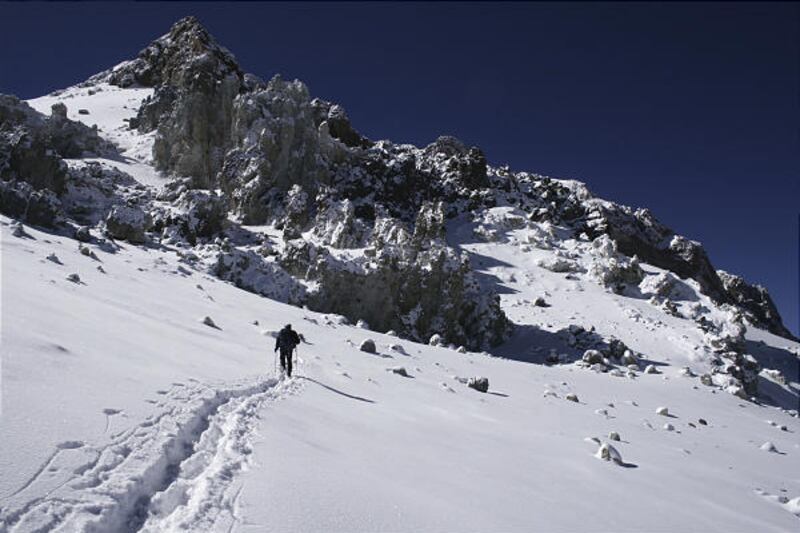
BUENOS AIRES, Argentina — The short, frigid climbing season on the Western Hemisphere's highest mountain is proving more deadly than usual this summer, with five deaths and another climber missing on the increasingly crowded peak called Aconcagua.
Most recently, Arthur DeLisle, a paramedic from Everett, Wash., was hiking alone at 16,400 feet when he was hit by falling rocks and later died of a head wound and a collapsed lung as rescuers ushered him down the mountain.
Officials say fatalities on the 22,841-foot Andean peak in western Argentina appear to be loosely tracking a surge in foot traffic — a six-fold increase in summit attempts over the past two decades as mountaineering has gone mainstream and increased in popularity.
That trend has been accompanied by improved equipment and an expansion of safety features such as high-altitude shelters and rescue helicopters, which have ferried 193 people off the mountain, mostly with altitude sickness, since the climbing season started in mid-November.
"It wouldn't have occurred to many people to climb Aconcagua before, but now, thanks to these new services, the mountain is more accessible," said Sebastian Tetilla, who runs a Mendoza-based expedition company and has summited Aconcagua (Ah-con-CAH-gwah) 25 times since the late 1980s.
Aconcagua also draws climbers because of its status as one of the Seven Summits, the group of peaks made up of the highest on each continent.
And while that makes it a prized accomplishment for anyone, less-experienced climbers are particularly attracted because the easiest route up the mountain doesn't present technical challenges.
It's essentially a very long, steep hike. It usually takes 15 days as climbers acclimate to the altitude, but has been done in 15 hours from the park entrance at 9,200 feet.
"You literally just put one foot in front of another and you can get to the top," said Brian Block, who reached the summit in 1999 and is an outdoor equipment sales representative based in Adel, Iowa.
DeLisle wasn't a veteran climber, said Thomas Tomberg, chief of the Edmonds Fire Department in Washington where DeLisle worked. Tomberg described the 51-year-old former Marine as an avid outdoorsman who performed extraordinarily well under pressure, helping to deliver at least 23 babies during his career as a paramedic and firefighter.
"If you had a traumatic injury, you wanted Art to be your medic," Tomberg said.
DeLisle left behind a wife and a stepson. Family members were not returning calls from the media.
Training and equipment are other keys to succeeding on Aconcagua. Block said he assisted an Argentine climber with "crampons that looked like they were from 1975" after the man became disoriented and fatigued in the 30-below-zero temperatures.
During the current climbing season, a four-month window of summer that peaks in the first week of January, an Italian and her Argentine guide died after being caught in a snowstorm near the summit; an Englishman died steps from the top of an apparent heart attack; and a 42-year-old German fell into a crevasse and died. A 31-year-old Frenchman has been missing on the mountain since Jan. 4.
Typically, there are one or two deaths a year on the mountain. The record for fatalities was set in 1998 when 10 climbers died.
In the 2007-08 climbing season, a record 4,548 people attempted to reach the summit, according to park records. In most years, about 40 percent succeed.
Seasoned climbers say Aconcagua's dangers revolve around rapidly changing weather and each individual's susceptibility to altitude sickness on the highest mountain outside of Asia.
"It has kind of an evil side to it," said Bill Crouse, a Utah-based mountain guide and sales manager for Black Diamond Equipment who has summited Aconcagua three times. "The winds are extreme there. They come from all different directions."
On North America's tallest peak, 20,320-foot Mount McKinley in Alaska, climbers must register months in advance and prove they have the experience necessary to tackle the ascent. These factors help keep inexperienced parties off the mountain, Crouse said.
At Aconcagua, where anyone can climb after a brief medical checkup, provincial authorities are considering requiring guides for less-experienced hikers in hopes of curtailing injuries and deaths, said Guido Loza, director of the Department of Natural Resources in Mendoza province, which oversees Aconcagua Park.
He said 80 percent of evacuations this season have been for illnesses associated with altitude. Many have involved inexperienced climbers unfamiliar with how their bodies react to the oxygen-depleted air.
Fifteen years ago, those people would have descended for nearly three days on a mule, vastly increasing the risk of death, Loza said.
But 15 years ago, he said, many of those climbers would not have been there.
Associated Press writer Morgan Lee contributed to this report from Mexico City.