

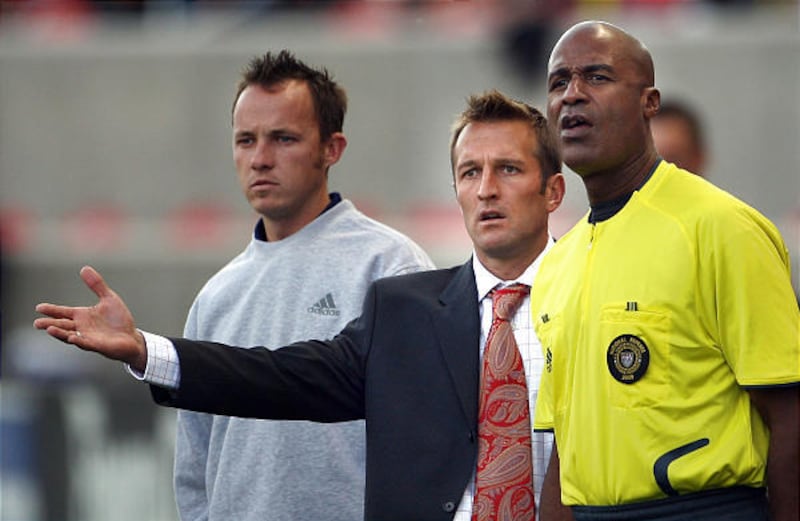
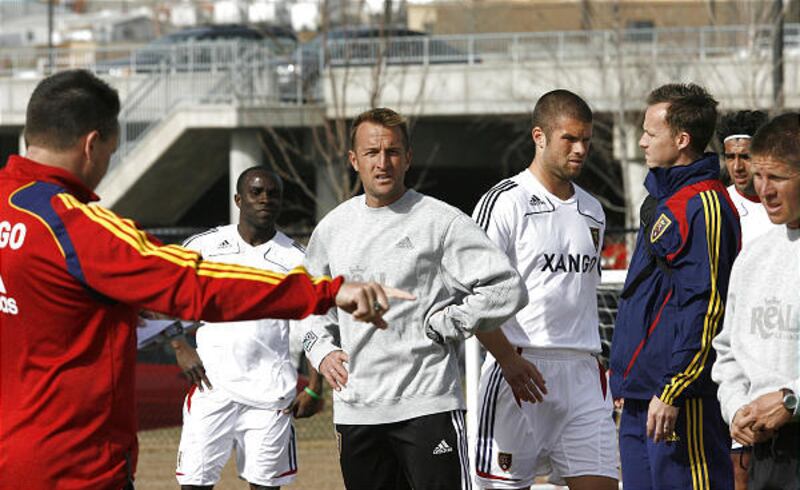

Jason Kreis doesn't believe there's a perfect coach out there, though he admits Lakers coach Phil Jackson might be.
Kreis also admits that he craves the same type of success and job security that Jackson has attained.
"I look at it the way I did when I was a very young professional soccer player — I want to do well in the worst way, and am willing to work 110 percent, work all the time to try and get to that level of success," Kreis said. "That's just kind of how I'm geared, how I'm driven."
As a player, he achieved remarkable success with mostly hard work, finishing with more than 100 career goals and winning an MLS MVP award in 1999. Not that long ago, Kreis believed he could reach the same level of success in coaching with similar hard work.
He knows he was a bit naive to think he could "make chicken salad out of chicken (poop)."
When Kreis took over as Real Salt Lake head coach on May 3, 2007, the psychology major from Duke University believed he had all the answers. He believed that by making training sessions more competitive, holding players accountable and treating them with open and honest communication, success would simply follow.
"I think I'm a little more realistic than I was before I started the job," Kreis said. "I thought it would be a pretty easy job, and I thought a coach could have drastic changes on levels of play."
In the first four or five months on the job, Kreis discovered you also need some talented players to be successful, something RSL lacked in 2007.
Although Kreis has tweaked some aspects of his coaching style, he hasn't changed his core philosophies.
"When the rubber hits the road and you've got to get results on the weekend, I think you wind up making some practical decisions," said RSL general manager Garth Lagerwey.
Kreis credits his previous coaches with helping him establish a core philosophy of open and honest communication. Kreis had a hunch he wanted to be a coach dating back to his first experiencing working with kids when he was 14 in Omaha, Neb. He took great pleasure from the experience, and believed the ideal scenario for the rest of his foreseeable life would be to play professional soccer followed by coaching professional soccer.
So throughout his career — whether it was at Duke, in MLS or his stints with the U.S. National Team — Kreis tried to be observant.
No one coach was unbelievable, according to Kreis. From a player's point of view, Kreis believes every coach had some positives and negatives about their style. It's those variations that helped him formulate the type of coach he wanted to be.
His most influential coach, and the coach he still speaks to frequently, is Gary Williamson, who was Kreis' under-19 youth coach in Louisiana. He's since moved on to become the director of coaching for North Texas State Soccer, but Kreis still considers him the best coach he ever played for. Williamson has a master's degree in philosophy, and Kreis believes the two see the game and life quite similarly.
It's about honesty with players.
"Fundamental to how I wanted to coach was about open and honest communication," Kreis said. "I really had a lot of appreciation for coaches that could just be honest with players, whether that was a good message or a bad message.
"I craved it as a player, and I know as you go along in your career you become tired of hearing what the coaches wants you to hear and you'd rather just hear the truth — whether it's good, bad or indifferent."
That aspect of his coaching hasn't changed, and probably never will. It's the tactical weekend-to-weekend aspects that continue to evolve as Kreis gains experience. With a career coaching record of 20-29-20, but a 14-16-13 mark in the past two years with those coveted better players, there's definitely room for growth.
RSL's general manager believes increased success will follow Kreis.
"One of the foundational reasons I think he's going to be a great coach: He was always the hardest worker on the team, and I say that as a former teammate of his," Lagerwey said. "He was not a prima donna and he was not a guy with a vast array of talent. He had to earn it."
He's still trying to earn it as a coach, and he's doing it with more and more detractors in the stands. It's stressful and straining and definitely not as easy as he thought it would be.
Kreis said he hopes he continues to figure things out and follow along the ideal career path he set for himself back when he was 14.
"There's plenty of cases out there of coaches that have coached in the professional level for a long, long time, but they're definitely a rarity, not the norm," Kreis said. "Would I like to be that guy? Yeah, I would because that would prove I'm successful at my next great challenge."