

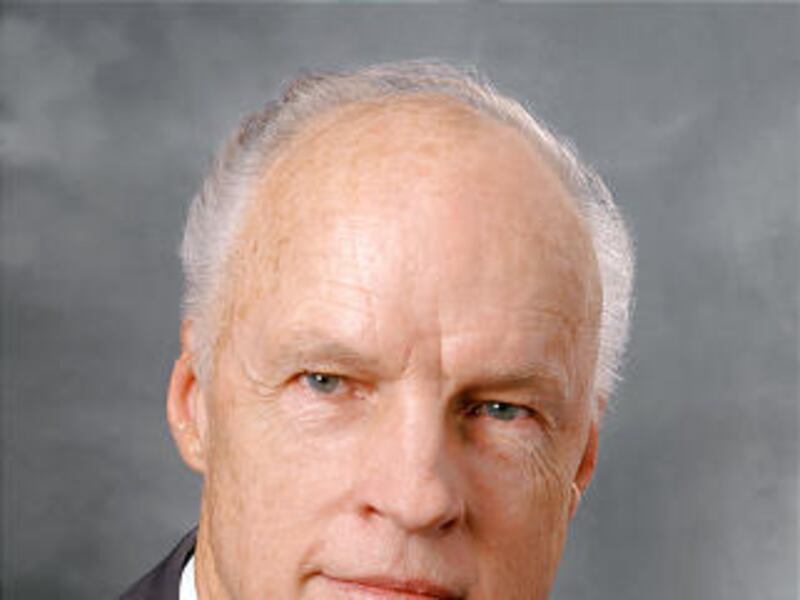
When LDS historian and philosopher Truman G. Madsen died on Thursday, May 28, there was an outpouring of gratitude for his life. People spoke of his unassuming personality, his speaking style, his work with interreligious dialogue or his leadership at Brigham Young University's Jerusalem Center.
But it was his words that captured people's imagination; that inspired spirits and challenged minds.
"He transcended complexity and achieved simplicity without being simplistic or simple-minded," said Philip Barlow, the Leonard J. Arrington Chair of Mormon History and Culture at Utah State University.
"Truman was a true poet of the most fundamental axioms of Mormon doctrine, philosophy and theology," said John W. Welch, a professor at BYU's J. Reuben Clark Law School. "By 'poet' I mean … an inspired creator. One of the things that I think is most highly admired in artistic geniuses is the ability to take very complicated and almost bewildering things and crystallize them into simple, unforgettable statements or expressions. Truman had that gift."
Today, Mormon Times takes a broad survey of Madsen's thoughts — presenting quotations from several of his works that demonstrate his insight and poetic use of language.
" 'To be or not to be?' That is not the question. No one can choose to be or not to be. … What is the question? The question is not one of being, but of becoming. 'To become more or not to become more.' This is the question faced by each intelligence in our universe. At this point, and not before, the absolute and inescapable need for God and His Christ arises." ("Eternal Man," p. 31-32)
"The redeeming truth is that Jesus Christ lived and died not only to heal, lift, and fulfill all men but all of man — intelligence, spirit, and body." ("Eternal Man," p. 51)
"The Atonement was and is perfect because it empowers mankind for a perfect work: perfection. Christ's mission was to overcome the vast difference between his nature and blessedness and our own." ("The Highest in Us," p. 6)
"Many of us in the modern world are prodigal sons. We have not only left home, we have forgotten it and the Father who still waits to unfold to us not only 'all that I have' but also, 'all that I am.'" ("Eternal Man," p. 41)
"Come to him. He turns no penitent one away. Would you, if you had paid so much in suffering? Would you ever give up? All the doors that are locked against the Lord are locked by us." ("The Highest in Us," p. 30)
"The greatest tragedy of life is that, having paid that awful price of suffering 'according to the flesh that his bowels might be filled with compassion,' and being now prepared to reach down and help us, he is forbidden because we won't let him. We look down instead of up." ("The Highest in Us," p. 85)
"There is a story of a grandfather, a holy man, who, caring for his grandson, sent him out to play. Shortly the boy returned sobbing as if his heart would break. He explained, 'I was playing hide-and-seek with my friends. I went and hid and waited but no one came for me. They all ran away.' The grandfather embraced him and said, 'Now you know how God feels. He hides and no one comes for him.' " ("Souls Aflame," BYU devotional, November 1983)
"Occasionally we struggle in amateur research in church history to understand what kind of a portrait, in terms of sheer physical appearance, we could draw of Christ if we simply utilized what modern witnesses have said about their glimpses of Him. It's an impressive portrait. But one thing perhaps we sometimes neglect in that curiosity is an awareness, or a seeking for an awareness, of His personality, of those subtler realities that we already recognize in other persons in all variations but which have been perfected in Him. … The temple is a place of learning to know Him." ("The Temple: Where Heaven Meets Earth," p. 7)
"The privilege of attending the house of God is in effect to have our physical beings brought into harmony with our spirit personalities." ("The Temple: Where Heaven Meets Earth," p. 9)
"In the temple setting it is clear that by proper use of the name or names, one does not speak of or about God. He speaks to or for or with God." ("The Temple: Where Heaven Meets Earth," p. 143)
"In religious tradition much is said and even canonized about how God is 'absolutely other.' They say that not one sentence you can utter about human beings applies in any way whatever to God; God must be absolutely different, say they, or we could not love and worship Him. Joseph Smith died to get back in the world the truth that we are in fact in the image of God. In fact, that means that as a statue exactly resembles the person it represents, so man exactly resembles the nature of the Father and the Son. That's the great and glorious secret. Man and woman are theomorphic, they are in the form of God. That is the foundation of divine-human love." ("The Temple: Where Heaven Meets Earth," p. 35)
"My testimony to you is that you have come literally 'trailing clouds of glory.' No amount of mortal abuse can quench the divine spark. If you only knew who you are and what you did … if you knew the latent infinite power that is locked up and hidden for your own good now — if you knew these things you would never again yield to any of the putdowns that are a dime a dozen in our culture today." ("The Highest in Us," p. 12)
"The body is not a prison house. It can become distorted, it can become perverted, and it can become in many ways a burden, but that is not the divine intent." ("The Temple: Where Heaven Meets Earth," p. 21)
"(W)ere it not for the veil of forgetfulness, we could not stand this world. Our mortal amnesia is the Lord's anesthesia." ("The Highest in Us," p. 18)
"We stand and testify and speak well about the Lord's menu. But do we deliver the Lord's food — and feed his sheep with heavenly manna?" ("The Highest in Us," p. 27)
"There may be things in our lives that make us more or less unworthy of certain privileges. But of one thing we are never unworthy: prayer." ("The Highest in Us," p. 85)
"If 'pray always' means vocally, none of us can. But if 'pray always' includes the kind of prayer that is wordless and from the heart, we are getting closer. And if it means even more that we are to be in the spirit of prayer regardless of what we may be doing — living prayerfully — then all of us can." ("The Highest in Us," p. 82)
"In the Lord's prayer we are asked to pray in a way that says … 'Do not forgive me, oh Lord, one whit more than I am willing to forgive all others.' That's the meaning of the sentence: 'Forgive us our trespasses as' — meaning 'in likeness to' or 'just as much as' — 'we forgive the trespasses of one another.' " ("Jesus of Nazareth" tapes, Bookcraft Recordings)
"In refusing to forgive another, we, in effect, attempt to deny the blessings of the Atonement to that person." (Quoted in "The Forgiving Heart" by Roderick J. Linton, Ensign, April 1991)
E-mail: mormontimes@desnews.com